
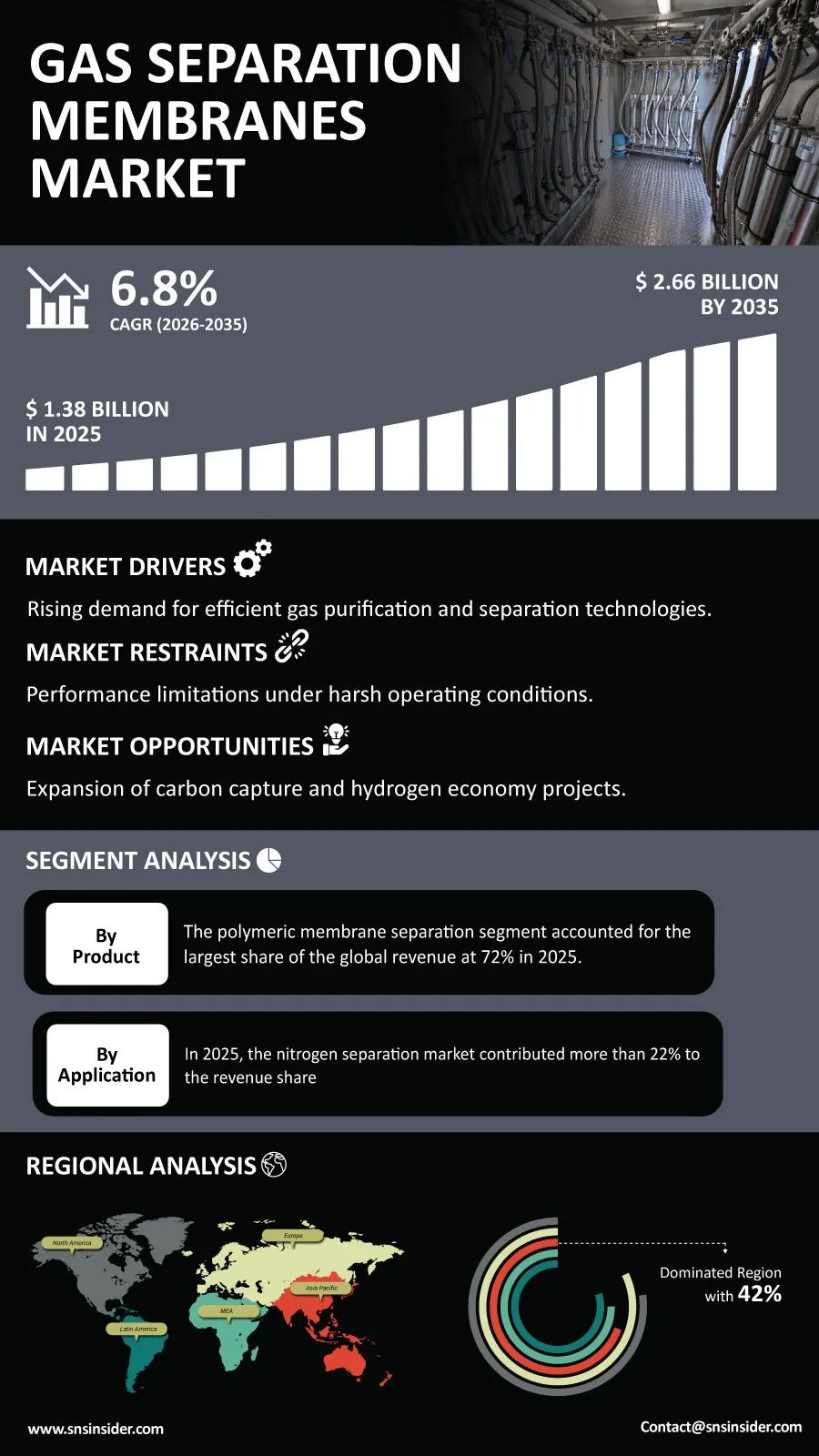
The global Gas Separation Membrane Market is witnessing steady expansion as industries prioritize low-carbon technologies, energy efficiency, and cleaner industrial operations. “According to a recent study by SNS Insider, the global Gas Separation Membrane Market size valued at USD 1.38 Billion in 2025, is anticipated to grow to USD 2.66 Billion by 2035, registering a CAGR of 6.8% over the 2026–2035 forecast period.”
The rising pressure from regulatory agencies to cut down on greenhouse gas emissions and the rise in investments for the development of carbon capture facilities and hydrogen generation have raised the demand for high-efficiency separation membrane technology. Companies are opting for membrane systems over traditional systems for gas separation because of their low energy requirements and small footprint and cost-saving potential. The ongoing government initiatives for clean energy innovation will drive the market.
To Get Detailed Insights on the Gas Separation Membrane Market – Request a Sample Report
Carbon Capture and Clean Energy Investments Create Long-Term Growth Opportunities
Growing international commitments to reaching zero net emissions have led to increased investment in CCUS technologies, and there are now great prospects for membrane technology companies involved in gas separation. Membranes become more and more relevant as technologies to separate CO2 from exhaust gases of energy-intensive industrial facilities such as those that produce cement, steel, petrochemicals, and generate electricity.
The emerging hydrogen economy also provides an opportunity for growth in areas that hold promise. With the increasing demands for clean hydrogen generation, the membrane technology is being used in purification techniques that increase hydrogen purity levels without any energy loss. The advances in the field of polymer chemistry, composite materials, and mixed matrix membranes help increase the efficiency of separation.
Key Market Insights Highlight Expanding Industrial Applications
In terms of the product, membrane separation using polymers held a share of around 72% in the global market revenue in 2025 due to low costs, efficiency in terms of selectivity, and the use of such membranes for the processes like carbon dioxide separation, hydrogen recovery, and air separation. The developments in membrane materials including polyimide and polysulfone help this segment improve its competitiveness.
In terms of application, nitrogen separation was responsible for the generation of more than 22% of revenue share in 2025 due to increasing demand for this segment from sectors like chemical processing, electronics, inerting, and industrial safety operations. Growth in the adoption of nitrogen generation systems will help this segment grow in the forecast period.
In terms of end use, the segment of petrochemicals and oil & gas was the leading one with a revenue share of about 27% in 2025. The membranes are gaining acceptance for processes like hydrogen recovery, natural gas treatment, carbon dioxide separation, and gas dehydration.
Advanced Membrane Technologies Transform Industrial Gas Processing
Innovation continues to be a key competitive aspect in the gas separation membrane industry. Companies continue to invest in new technologies involving the production of polymers and inorganic membranes that are capable of providing enhanced performance characteristics and longevity.
Process monitoring of digital nature, automation of membranes as well as intelligent optimization of the plants are also helping in improving operational efficiencies in industrial gas separation plants. All these technologies have helped in reducing maintenance costs, lowering energy costs and improving productivity while meeting tougher environmental regulations.
Asia Pacific Captured 42% Revenue Share in the Gas Separation Membrane Market in 2025, While North America Emerges as the Fastest-Growing Region
The Asia Pacific region held the largest share of the Global Gas Separation Membrane Market in 2025 with 42%, due to the rise in industrialization and development of natural gas infrastructure and investments in carbon capture technology in countries like China, India, and Japan. The rise in industrial activities and government policies for emission reduction from industries is likely to drive market dominance.
The North American region is projected to witness high growth during the forecast period owing to the incentives from governments for adopting carbon capture and storage technology, hydrogen production, and solutions for industrial emissions. The European region is also growing at a steady pace, due to its target of reducing carbon emissions and strict environmental regulations. The Latin American region and the Middle East & Africa region are proving to be potential markets for the industry.
Industry Participants Focus on Innovation and Sustainable Gas Separation Solutions
The Competition in the Gas Separation Membrane Market is still largely driven by innovation, superior membrane material, and investment in carbon capture technology and hydrogen separation technology. The major players in the market continue to invest heavily in research and development efforts along with launching superior membrane technology that can support decarbonization efforts.
Key companies operating in the global Gas Separation Membrane Market include Air Products and Chemicals, Inc., Air Liquide Advanced Separations, Honeywell UOP, Membrane Technology and Research, Inc. (MTR), Parker Hannifin Corporation, Evonik Industries AG, Schlumberger Limited, Generon IGS, DIC Corporation, Global CCS Institute, and Ube Industries Ltd.
An SNS Insider analyst Himanshu Sharma commented, "The accelerating adoption of carbon capture technologies, hydrogen infrastructure, and energy-efficient industrial processes is creating sustained opportunities for gas separation membrane manufacturers. Companies investing in advanced membrane materials, high-performance separation technologies, and scalable clean energy solutions will be well positioned to benefit from the global transition toward low-carbon industrial operations."
About the Author

Get in touch




