
Natural Gas Market Report Scope & Overview:
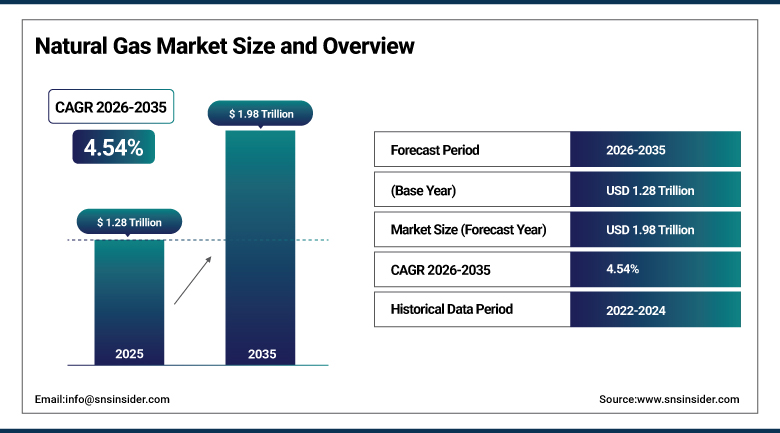
The Natural Gas Market was valued at USD 1.28 trillion in 2025 and is expected to reach USD 1.98 trillion by 2035, growing at a CAGR of 4.54% from 2026–2035.
The Natural Gas Market is witnessing steady growth in the global market owing to rising energy demand across industries. Increasing transition toward cleaner-burning fossil fuels and expanding LNG trade are boosting market development. Growing investments in gas exploration, pipeline infrastructure, and storage facilities are supporting market expansion. Producers are focusing on production efficiency, methane emission reduction, and digital monitoring technologies. Rising demand from power generation, industrial manufacturing, and transportation sectors is driving infrastructure modernization. Increasing integration of renewable natural gas, hydrogen blending, and carbon capture technologies is further accelerating market adoption.
The International Energy Agency reports that the demand for natural gas resumed its structural growth in 2024 with an increase of 2.8%, reaching a historical peak. The region of Asia-Pacific was responsible for almost 45% of global demand growth, with industry and electricity generation being responsible for 75% of consumption growth. For 2025, demand growth slowed down to 1%-1.3%.
To Get more information Natural Gas Market - Request Free Sample Report
Natural Gas Market Trends
-
Increased deployment of carbon capture technologies is helping to cut down greenhouse gas emissions and increase sustainability in the natural gas chain of operations.
-
Digital monitoring and predictive maintenance through artificial intelligence are increasing the efficiency of pipelines, their reliability, and performance throughout the world.
-
Leak detection technology along with automation technologies is increasing leak detection capability and cutting down the cost of maintenance of infrastructure.
-
Replacement of coal-based power generation plants by gas-based power generation plants is increasing clean power generation around the world.
-
Investments in combined-cycle gas turbines power plants are increasing efficiency of power generation operations.
-
Urbanization and industrialization are increasing natural gas demands in power generation and manufacturing industries.
U.S. Natural Gas Market Size Outlook
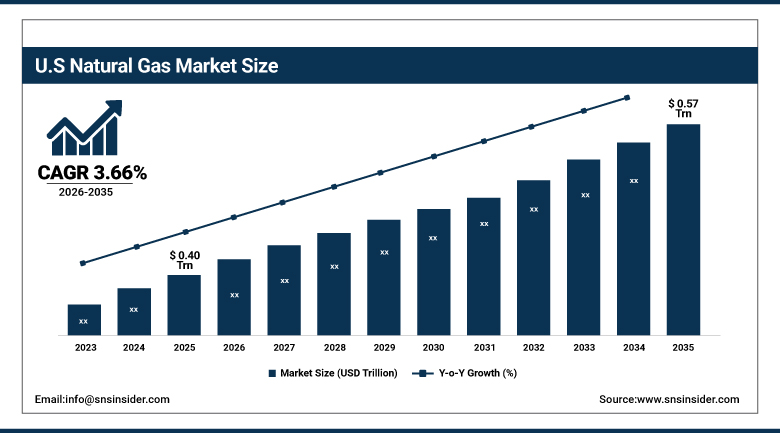
The U.S. Natural Gas Market was valued at USD 0.40 trillion in 2025 and is expected to reach around USD 0.57 trillion by 2035, growing at a CAGR of 3.66% from 2026–2035.
The U.S. natural gas market is expanding steadily owing to strong domestic production and growing energy consumption across industries. Increasing LNG export capacity and pipeline infrastructure investments are supporting market growth across domestic and international markets. Rising adoption of advanced drilling technologies is driving operational efficiency and production optimization across upstream operations. Growth in power generation demand and industrial fuel applications is further accelerating natural gas consumption nationwide. Producers are focusing on emission reduction, digital monitoring systems, and carbon capture integration across operations. Increasing use in electricity generation, manufacturing, and transportation applications is strengthening long-term market penetration.
Based on the reports of the U.S. Energy Information Administration, in 2025, the US was able to produce a record high of 39 trillion cubic feet of dry natural gas, which amounts to 106.8 billion cubic feet per day on average. The LNG exports were estimated at 14.2 billion cubic feet per day with increasing export facilities. In addition, natural gas accounted for 41% of electricity production from utility-scale power plants.
Natural Gas Market Segment Analysis
-
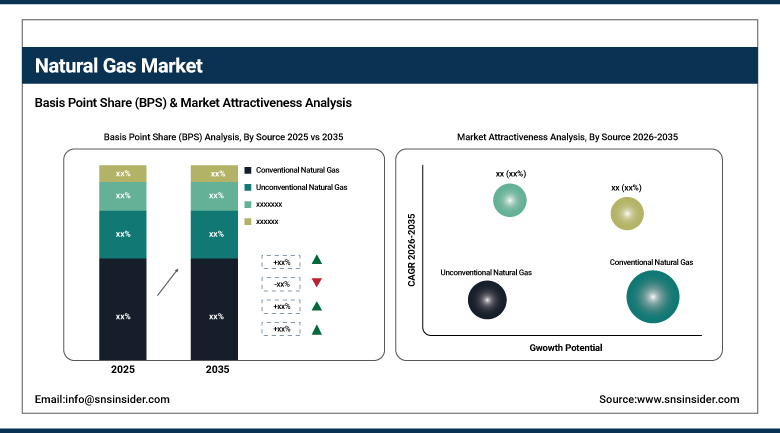
By Source, conventional natural gas dominated the market with 82.40% share in 2025; while biomethane/renewable natural gas is the fastest growing segment with CAGR of 16.94% during 2026 to 2035.
-
By Application, power generation dominated the market with 34.60% share in 2025; while transportation fuel is the fastest growing segment with CAGR of 12.04% during 2026 to 2035.
-
By Trade Form, pipeline gas dominated the market with 71.80% share in 2025; while liquefied natural gas is the fastest growing segment with CAGR of 7.24% during 2026 to 2035.
-
By End User, utilities and power generators dominated the market with 46.50% share in 2025; while transportation sector is the fastest growing segment with CAGR of 14.41% during 2026 to 2035.
By Source, conventional natural gas dominated the Natural Gas Market, while biomethane/renewable natural gas is the fastest growing segment.
The conventional natural gas category ruled the Natural Gas Market with the dominated share of revenue in 2025. This is due to the ample availability of resources, proven production processes, and widespread pipeline networks globally. High demand for natural gas in power generation, industrial manufacturing, and household applications has ensured steady consumption. Supply contracts, proven infrastructure for distribution and competitive costs of production further helped the category dominate. Regular investment in exploration activities and processing plants also aided its dominance.
The biomethane/renewable natural gas category is anticipated to witness the fastest CAGR during 2026-2035. The growth of the category is attributed to the growing decarbonization efforts, use of renewable energy sources, and incentive schemes of the governments worldwide. The adoption of the concept of circular economy has led to production using agricultural residue, landfill, and organic waste. Investments in upgrades in technology and infrastructure for production of renewable gas are speeding up commercialization of the technology.
By Application, power generation dominated the Natural Gas Market, while transportation fuel is the fastest growing segment.
Power Generation emerged as the largest contributor to the Natural Gas Market owing to high revenues in 2025. This was due to wide applications of natural gas across utility-scale electricity power generating plants. Natural gas was favored as a transition fuel due to its low emissions compared to coal and oil. Further, an increase in the installation of combined-cycle gas turbines, baseload generation capabilities, and investment in grid modernization contributed to demand growth. Increasing energy demands across industrialized and developing nations also contributed to the market dominance of this segment.
Transportation Fuel segment is projected to experience fast-growing CAGR over 2026-2035. Adoption of compressed natural gas and liquefied natural gas-powered vehicles is driving the growth of this segment. Fueled by regulations promoting the use of clean transport fuels by governments, the market will continue to witness steady growth. Investments in fueling stations and fleet of heavy-duty vehicles is fueling growth.
By Trade Form, pipeline gas dominated the Natural Gas Market, while liquefied natural gas is the fastest growing segment.
Pipeline Gas emerged as the leading segment of the Natural Gas Market due to its dominated share in revenues in 2025. This is due to its well-developed transmission network in the main producer and consumer nations. The existing network makes the process of transportation cost-effective, consistent, and reliable for industrial, residential, and power-generation purposes. Long-term agreements, low costs of transportation via land routes, and good integration with the national energy system added to the dominance of Pipeline Gas.
Liquefied Natural Gas is estimated to exhibit the fastest CAGR during the forecast period from 2026-2035. The increasing globalization of the LNG trade is driving the demand for flexible natural gas transportation options between countries. Investments in liquefaction and regasification terminals will boost the international supply potential and market availability of LNG. Increasing energy security programs, growing demand from APAC countries, and the possibility of supplying gas into regions without pipelines make the use of LNG more attractive.
By End User, utilities and power generators dominated the Natural Gas Market, while transportation sector is the fastest growing segment.
Utilities & Power Generators held dominance in the Natural Gas Market by recording the highest revenue share in 2025. This domination was fueled by heavy use of natural gas in power generation in developed and emerging economies. Additionally, retirement of coal-based power plants contributed to heavy reliance on natural gas. Reliable sources of power generation, low carbon footprints, expanding gas-powered capacity, and investment in the power sector have bolstered the dominance of the segment.
The Transportation Sector Segment is anticipated to witness the fastest growth during the forecast period of 2026 to 2035. This is attributed to the growing use of compressed natural gas and liquefied natural gas in transportation. Moreover, rising government incentives towards using clean energy in transportation is also propelling the growth of the market. The growing refueling infrastructure, stringent emission standards, increasing use of heavy vehicles, and adoption of renewable natural gas are also contributing to segmental growth.
Regional Analysis
|
Region |
Major Country |
Share within Region, 2025(%) |
|---|---|---|
|
North America |
United States |
87.60% |
|
Europe |
Germany |
22.80% |
|
Asia Pacific |
China |
42.10% |
|
Middle East & Africa |
UAE |
18.40% |
|
Latin America |
Brazil |
46.30% |
North America Natural Gas Market Insights.
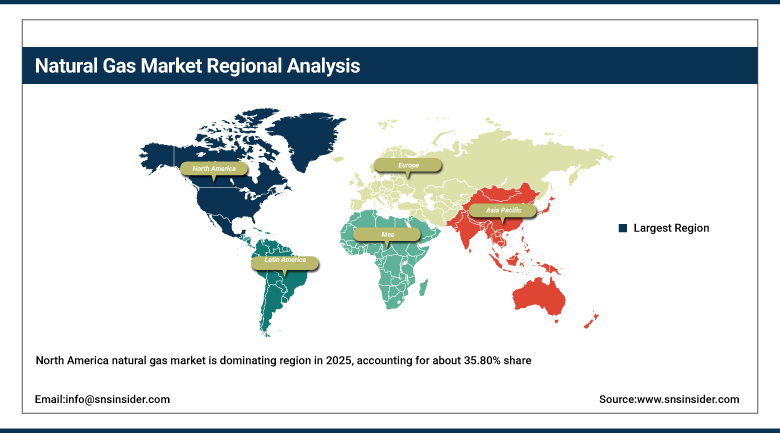
North America natural gas market is dominating region in 2025, accounting for about 35.80% share, driven by abundant shale gas resources, extensive pipeline infrastructure, and strong domestic consumption. The region benefits from advanced drilling technologies and significant liquefied natural gas export capacity. Increasing investments in upstream exploration and transmission networks are strengthening market growth. Expansion of gas-fired power generation and industrial applications further reinforce the region’s dominant position in the market.
As per Canada Energy Regulator, the average production rate of natural gas on a marketable basis was 18.3 billion cubic feet per day in Canada in 2024 and increased to 19.0 billion cubic feet per day in 2025. As per the International Energy Agency, North America is dominating the LNG export growth in the world due to increased efficiency in the region.
Get Customized Report as per Your Business Requirement - Enquiry Now
Europe Natural Gas Market Insights.
Europe natural gas market is characterized by stable growth in 2025 owing to increasing energy diversification and expanding liquefied natural gas imports. Key countries include Germany, France, United Kingdom, Italy, and the Netherlands. Rising investments in gas storage facilities and cross-border pipeline connectivity are supporting market resilience. Increasing adoption of renewable gas and hydrogen blending initiatives is strengthening long-term demand. Regulatory reforms continue encouraging efficient natural gas infrastructure modernization across the region.
Natural gas made up about 21% of the European Union’s gross inland energy consumption, according to the European Commission and the Agency for the Cooperation of Energy Regulators. The EU gas storage was above 95% capacity before winter, exceeding the target of 90%. LNG imports represented 41% of the total gas imports into the region.
Asia Pacific Natural Gas Market Insights.
Asia Pacific is the fastest growing region in the Natural Gas Market, registering a CAGR of about 5.99% during 2026–2035. Rapid industrialization and expanding energy demand are driving strong consumption across China, India, Japan, South Korea, and Southeast Asia. Increasing LNG import infrastructure and gas-fired power generation are accelerating regional market growth. Government policies promoting cleaner energy sources continue supporting widespread natural gas adoption.
The International Energy Agency and the Energy Institute estimated that the world's demand for natural gas increased by 1% to 1.6% in 2025. The Asian-Pacific region experienced almost no change in demand as the higher natural gas production in China decreased the import of spot LNG by 14%. Natural gas production in the region accounted for 16% of the total natural gas production worldwide.
Middle East & Africa and Latin America Natural Gas Market Insights.
The Middle East & Africa along with Latin America regions are witnessing steady growth due to expanding gas production and increasing infrastructure investments. Key contributing countries include Saudi Arabia, Qatar, UAE, Brazil, Argentina, and Mexico. Growing industrialization, rising electricity demand, and LNG development projects are supporting market expansion. Continued investments in exploration and export infrastructure are strengthening long-term regional opportunities.
The Middle East produced around 18% of the total production of natural gas in the world, while Latin America provided around 5% of the total production of natural gas. The Middle East contains almost 40% of the world's proved natural gas resources. The development of liquefied natural gas capacity, especially in the North Field projects in Qatar, is enhancing regional security and international natural gas trade.
Market Dynamics
Growth Drivers: Cleaner energy transition increases long-term natural gas demand across power generation and industrial sectors.
Focus on lowering carbon emissions is driving up natural gas utilization in the production of electricity and industry operations globally. Governments are opting to phase out old coal-based power plants and replace them with highly efficient gas-based plants in a bid to increase energy security. Increase in industrial activities is creating a need for clean fuel sources. Investment in combined-cycle gas turbine plants is contributing to the efficiency and flexibility in electricity production. The ongoing process of urbanization and population growth alongside industrial development will keep driving up natural gas usage going forward.
The increase in the demand for natural gas slowed down to about 1% in 2025 as compared to 2.8% in 2024 according to the report of International Energy Agency. About 70% of the increased demand came from the building sector due to the cold weather in North America and Europe. Demand for gas from the power sector remained under 1%, and natural gas made up 17% of total primary energy demand increase.
Restraints: Renewable energy expansion and stricter regulations reduce long-term conventional natural gas consumption growth.
The rapid growth of renewable energy technology in solar and wind power, and energy storage solutions is lowering the dependency on traditional fossil fuel electricity production. Methane emissions regulations and environmental compliance policies are becoming more stringent in natural gas production. Higher carbon costs make the costs of explorations, production, and transportation increase. Capital investments are being moved to renewable energy sources and technologies. Increased environmental issues with regard to methane emissions are affecting policies and infrastructure development needs. All of these create difficulties for traditional natural gas market expansion.
Opportunities: Carbon capture and digital infrastructure create long-term efficiency and commercial growth opportunities globally.
The energy companies have introduced carbon capture technology in order to decrease emissions from natural gas extraction and power plants. The use of digital energy monitoring platforms, artificial intelligence, and predictive maintenance has improved the efficiency and performance of the pipelines. The use of smart sensors and automation technologies is increasing the accuracy of leak detections as well as lowering the cost of maintenance of the pipelines. The increase in the investment in intelligent gas networks has ensured efficient operation and transmission of natural gas.
Worldwide CCUS operation was more than 50 million tonnes of CO₂ per year, driven by 700+ projects. AI-based monitoring systems and advanced predictive maintenance tools can decrease upstream methane emissions by up to 50%.
Recent Developments
-
2026: Shell plc published its 2026 LNG Outlook, forecasting global liquefied natural gas demand to increase 65% by 2050.
-
2025: Chevron Corporation reached a final investment decision on the Gorgon backfill development to connect Geryon and Eurytion fields.
-
2025: Saudi Aramco significantly expanded its domestic gas infrastructure by initiating commercial natural gas production at the Jafurah megaproject.
-
2024: Exxon Mobil Corporation expanded its carbon capture capabilities by agreeing to transport and store up to 1.2 million metric tons of $CO_2$ annually from CF Industries.
Natural Gas Companies are:
-
Shell plc
-
Saudi Aramco
-
Exxon Mobil Corporation
-
BP plc
-
TotalEnergies SE
-
Chevron Corporation
-
Equinor ASA
-
ConocoPhillips
-
Eni S.p.A.
-
QatarEnergy
-
ADNOC
-
Gazprom
-
PetroChina Company Limited
-
China National Offshore Oil Corporation (CNOOC)
-
Woodside Energy Group Ltd.
-
Cheniere Energy, Inc.
-
Sempra
-
TC Energy Corporation
-
Kinder Morgan, Inc.
-
Devon Energy Corporation
Natural Gas Market Report Scope:
| Report Attributes | Details |
|---|---|
| Market Size in 2025 | USD 1.28 Trillion |
| Market Size by 2035 | USD 1.98 Trillion |
| CAGR | CAGR of 4.54% From 2026 to 2035 |
| Base Year | 2025 |
| Forecast Period | 2026-2035 |
| Historical Data | 2022-2024 |
| Report Scope & Coverage | Market Size, Segments Analysis, Competitive Landscape, Regional Analysis, DROC & SWOT Analysis, Forecast Outlook |
| Key Segments | • By Source (Conventional Natural Gas, Unconventional Natural Gas, Biomethane/Renewable Natural Gas) • By Application (Power Generation, Residential And Commercial Heating, Industrial Process Fuel, Chemical And Petrochemical Feedstock, Transportation Fuel, Others) • By Trade Form (Pipeline Gas, Liquefied Natural Gas) • By End User (Utilities And Power Generators, Industrial Manufacturers, Residential And Commercial Consumers, Transportation Sector, Others) |
| Regional Analysis/Coverage | North America (US, Canada), Europe (Germany, UK, France, Italy, Spain, Russia, Poland, Rest of Europe), Asia Pacific (China, India, Japan, South Korea, Australia, ASEAN Countries, Rest of Asia Pacific), Middle East & Africa (UAE, Saudi Arabia, Qatar, South Africa, Rest of Middle East & Africa), Latin America (Brazil, Argentina, Mexico, Colombia, Rest of Latin America). |
| Company Profiles | Shell plc, Saudi Aramco, Exxon Mobil Corporation, BP plc, TotalEnergies SE, Chevron Corporation, Equinor ASA, ConocoPhillips, Eni S.p.A., QatarEnergy, ADNOC, Gazprom, PetroChina Company Limited, China National Offshore Oil Corporation (CNOOC), Woodside Energy Group Ltd., Cheniere Energy, Inc., Sempra, TC Energy Corporation, Kinder Morgan, Inc., Devon Energy Corporation |

Frequently Asked Questions
The power generation dominated through extensive gas-fired electricity production, coal replacement, and efficient combined-cycle power generation expansion.
North America dominated the global natural gas market in 2025.
The global natural gas market is expected to grow at a CAGR of 4.54% from 2026 to 2035.
The global natural gas market was valued at USD 1.28 trillion in 2025.
The major growth factors include rising global energy demand, cleaner fuel transition, expanding LNG trade, gas infrastructure investments, carbon capture adoption, and digital methane monitoring technologies.
