
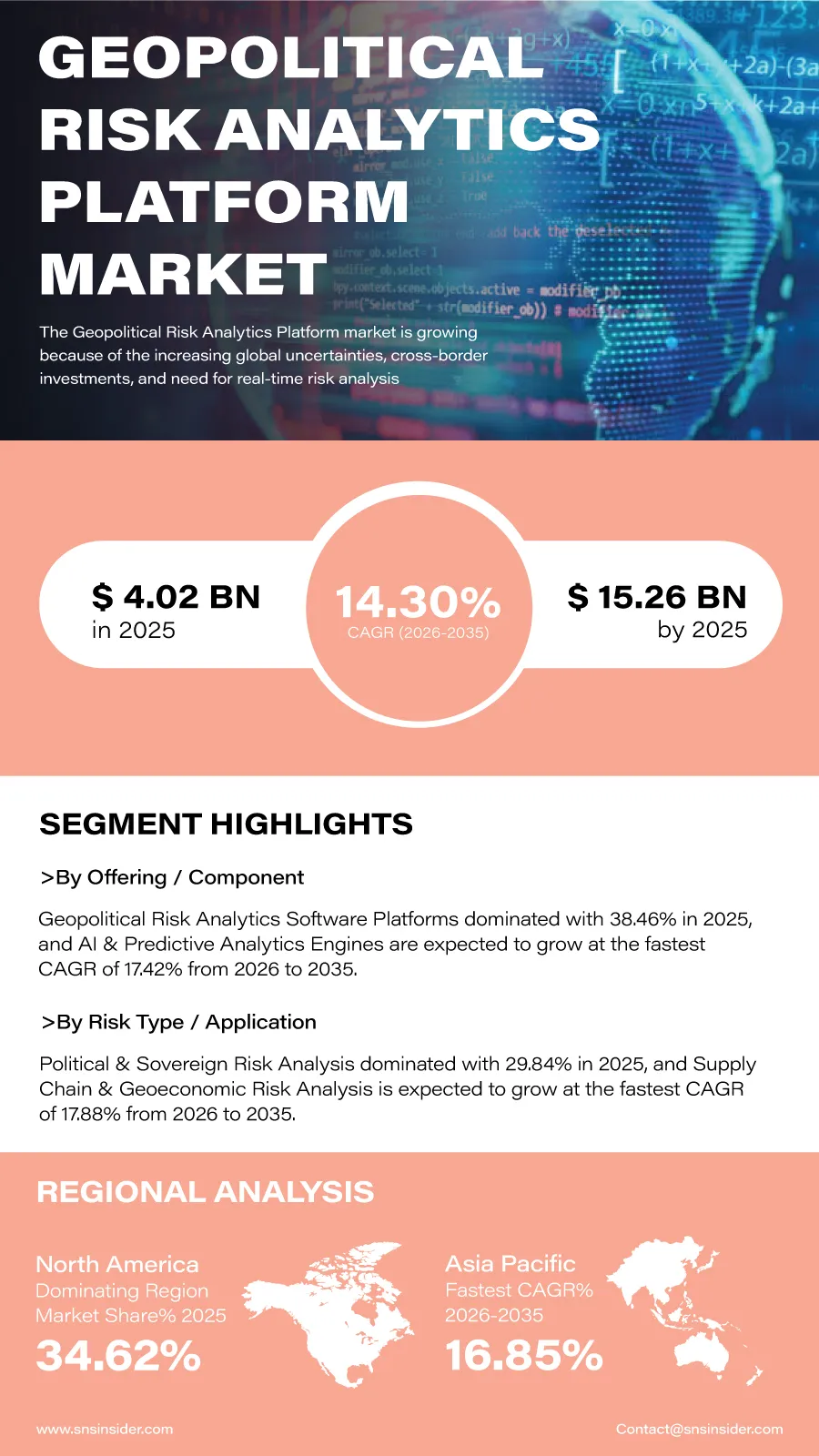
The global Geopolitical Risk Analytics Platform Market is expected to witness substantial growth as enterprises strengthen their ability to anticipate political, economic, and regulatory disruptions affecting international operations. “According to a recent study by SNS Insider, the global Geopolitical Risk Analytics Platform Market size valued at USD 4.02 billion in 2025, is anticipated to grow to USD 15.26 billion by 2035, registering a CAGR of 14.30% over the 2026–2035 forecast period.”
As the global supply chain networks become more integrated, businesses are increasingly relying on intelligence systems that can help them detect new geopolitical risks before they impact their operations. Enterprises and government agencies are implementing cutting-edge analytics systems to analyze political changes, sanctions, regional wars, trade embargoes, and macroeconomic trends.
To Get Detailed Insights on the Geopolitical Risk Analytics Platform Market – Request a Free Sample Report
The rise of the use of AI, machine learning and big data analytics is revolutionizing the way in which companies measure their geopolitical exposure. The current platforms offer continuous surveillance, predictive modeling and scenario analysis that allow executives to react promptly to new circumstances in the global environment.
AI-Driven Risk Intelligence Creates Long-Term Growth Opportunities
Predictive Intelligence platforms which integrate datasets related to politics, economics, cyber events, climate, and regulations into comprehensive analytical platforms are being developed with increased interest from organizations. The integration of different datasets would enable companies to assess inter-related risks effectively and plan strategically.
There will be more investments by financial institutions, multinationals, logistics companies, and governments in geopolitical intelligence due to the increasing complexity of international business environment. The capacity to foresee any disruption in investments, logistics, and compliance strategies would offer competitive edge.
However, advancements in cloud computing technology, natural language processing, and generative AI would help platform providers to generate insights and scenarios quickly as well as visualize risks in real-time.
Key Market Insights Highlight Shifting Demand Patterns
By offering, geopolitical risk analytics software platforms are forecasted to account for 38.46% of market revenue worldwide in 2025, considering their capability to provide intelligence gathering, risk visualization, and decision-making processes in one platform. The adoption of AI and predictive analytics engines will see the highest growth from 2025-2035 due to the requirement of forward-looking intelligence to forecast geopolitics and their impact on businesses.
Based on risk type, political and sovereign risk analysis will contribute 29.84% of the overall market revenue in 2025 due to constant demand for analyzing the stability of governments, policy changes, sanctions, and international politics. Geoeconomic and supply chain risk analysis will grow at the highest CAGR through the forecast period as companies are trying to develop more resilient operations against global risks and changing trade policies.
By deployment mode, cloud-based platforms captured around 62.84% of market share in 2025 as they offer scalable IT infrastructure, updates, and access in real-time across globally dispersed organizations. In addition, the cloud deployment mode will also continue its dominance and remain the fastest growing segment through 2035 as companies speed up their digitization initiatives.
In terms of the end user, BFSI and investment firms contributed 31.72% to the market revenue in 2025, whereas multinationals and supply chain management are forecasted to have the highest growth rate due to the increasing demand for geopolitical intelligence worldwide.
An Infographic Representation of the Global Geopolitical Risk Analytics Platform Market
Advanced Analytics Technologies Accelerate Industry Transformation
Geopolitical risk analytics platforms are fast developing from simple country risk assessments to full-fledged intelligence ecosystems that can analyze interlinked developments politically, economically, cyberspace-wise, and environmentally. Technologies like AI dashboards, alert systems, graph analytics, and scenario models are allowing companies to detect risks more quickly and accurately than ever before.
These platform vendors are also improving collaboration through embedding risk intelligence into corporate workflows, investment management tools, and supply chain planning applications. These initiatives are aiding companies in making their operations more robust and faster decision-making in today’s highly volatile world.
Regional Markets Demonstrate Strong Growth Potential
North America will hold 34.62% of market share worldwide in 2025 due to presence of multinational corporations, financial organizations, governmental bodies, and technology firms which require advanced geopolitical intelligence solutions. Ongoing investments in AI-powered solutions and regulatory compliance are aiding regional dominance in the market.
Asia Pacific is expected to be the fastest-growing region over the forecast period due to growth in geopolitical intelligence investments by governments, financial organizations, and multinational organizations owing to increasing international trade and changing regional security dynamics. Ongoing digitization and cross-border investments are helping fuel demand within the region.
Europe will also be contributing significantly to market growth with rising regulations and supply chain resilience strategies along with geopolitical complexities prompting enterprises to enhance their risk management capacities. On the other hand, Latin America and MEA are seeing rising penetration due to need for increased visibility on regional political, regulatory, and economic events.
Industry Participants Focus on AI Innovation and Predictive Intelligence Solutions
The competitive landscape remains highly dynamic as technology providers continue investing in artificial intelligence, predictive analytics, cloud-native architectures, and advanced data integration capabilities. Strategic product innovation, expanded geopolitical datasets, and intelligent scenario modeling are enabling vendors to deliver more comprehensive risk intelligence solutions for financial institutions, multinational corporations, governments, and global enterprises.
Key companies operating in the global Geopolitical Risk Analytics Platform Market include Bloomberg, S&P Global, Moody's Analytics, Palantir Technologies, IBM, SAS Institute, Oracle, SAP, Accenture, Verisk Analytics, LexisNexis Risk Solutions, Dun & Bradstreet, FICO, FIS, Adenza, Riskonnect, PRS Group, Maplecroft, Seerist, and Control Risks.
An SNS Insider analyst Sakshi Kale commented, “The increasing complexity of global political and economic environments is transforming geopolitical intelligence into a strategic business necessity rather than a specialized analytical function. Organizations investing in AI-powered predictive analytics, integrated risk monitoring, and real-time scenario modeling will be better positioned to navigate uncertainty, strengthen operational resilience, and support informed decision-making across global markets.”
About the Author

Get in touch




