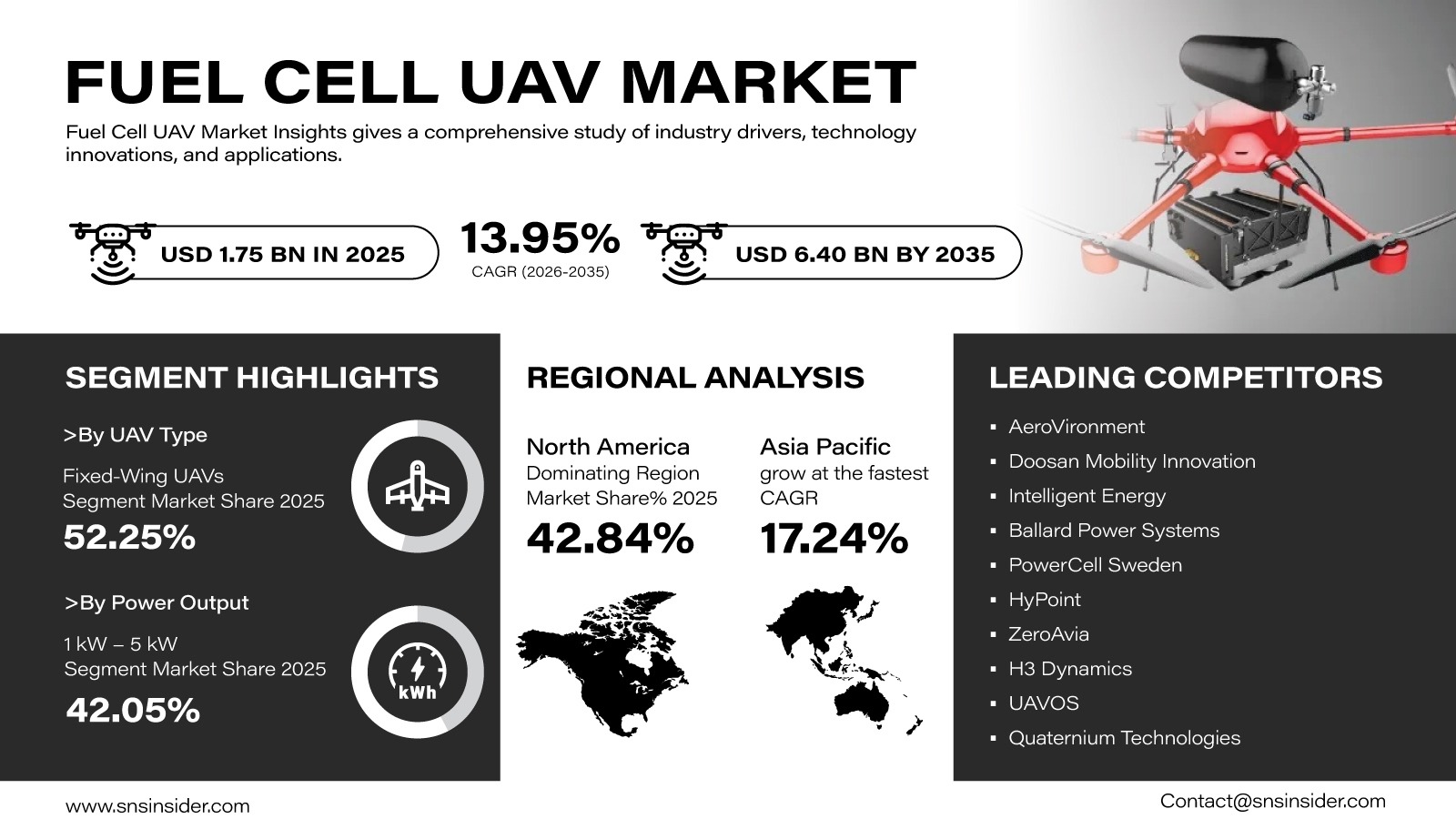
The global Fuel Cell UAV Market is entering a new phase of expansion as industries increasingly prioritize long-endurance unmanned aerial systems capable of supporting demanding missions with lower emissions and greater operational efficiency. “According to a recent study by SNS Insider, the global Fuel Cell UAV Market size valued at USD 1.75 billion in 2025, is anticipated to grow to USD 6.40 billion by 2035, registering a CAGR of 13.95% over the 2026–2035 forecast period.”
The increasing use of UAVs for defense purposes, industrial inspections, logistics, precision agriculture, and emergency services has changed the requirement for sophisticated propulsion systems. As there is a need for aircraft that can stay aloft for longer periods of time without being charged often, the use of hydrogen fuel cells is seen as a more viable option than batteries.
To Get Detailed Insights on the Fuel Cell UAV Market – Request a Free Sample Report
The increasing investment in the field of clean aviation along with the development in the technology of hydrogen storage and the fuel cells’ design is bringing the fuel-cell powered UAVs closer to commercial production, making them an important constituent of the future UAV fleet.
Defense Modernization and Sustainable Aviation Drive New Investment
The trend seen around the world today involves governments investing more resources in UAV technology to enhance surveillance, information gathering, security at borders, and disaster management. Long flights require energy sources that offer reliability, as well as reduced interruptions, which make fuel cells suitable.
Companies are also realizing the benefits of using UAVs in various applications where there is need to stay in the air for a long period. The ability to remain airborne will help companies become productive and efficient by ensuring mission time is not lost through maintenance activities.
At the same time, the aviation industry's transition toward lower-emission technologies is encouraging greater research into hydrogen-powered aircraft. Continued improvements in fuel cell efficiency, lightweight composite materials, and compact hydrogen storage solutions are expanding the practical deployment of fuel cell UAV platforms across increasingly diverse applications.
Key Market Insights Reflect Rapid Technology Adoption
From the category of UAVs, fixed-wing platforms comprised the largest 52.25% share in terms of revenues earned from the worldwide market in 2025 owing to their excellent endurance and long range of operation.
Hybrid UAVs will record the highest growth rate over 2025–2035 owing to growing demand for UAVs capable of performing vertical takeoff and long-distance flying.
Fuel cell wise, Proton Exchange Membrane Fuel Cells (PEMFC) comprised 67.25% share in the revenues earned from the global UAV fuel cells market in 2025 owing to their high efficiency and lightweight nature that suits them for use in unmanned aviation platforms. The solid oxide fuel cells (SOFC) are anticipated to grow at a faster rate as the performance of such fuel cells will be improved for use in large UAV systems through future research.
On the basis of power output, the 1 kW-5 kW segment held the maximum share of 40.25%, and less than 1 kW systems are projected to show significant growth as more applications of smaller UAVs are emerging.
In the defense/military segment, 52.12% revenues were earned in the year 2025. In contrast, commercial applications including logistics, inspection, agriculture, and mapping applications will record the fastest growth during the next decade.
Defense organizations continued to be the largest end user segment with 55.54% share, whereas commercial organizations are expected to show higher CAGR during the next decade.
An Infographic Representation of the Global Fuel Cell UAV Market
Hydrogen Innovation Expands Commercial Opportunities
The constant breakthroughs in hydrogen technology are continuously improving the prospects for unmanned flights driven by fuel cells. The innovations in energy density and efficiency are allowing companies to develop aircraft that can perform longer missions with larger payload capacity.
The increased cooperation between aerospace manufacturers, fuel cell manufacturers, research organizations, and government agencies is accelerating the process of developing products. Cooperation is helping in the development of high-efficiency UAVs that could be used in civil and military applications.
With the increased support from governments for hydrogen power generation all around the world, manufacturers will be benefiting from increased funding for infrastructure, research programs, and aviation technologies.
Regional Markets Continue Accelerating Worldwide
North America generated 42.84% of total revenues of the Global Fuel Cell UAV Market in 2025 due to high military expenditure, state-of-the-art aviation sector, and investment in hydrogen-based aviation technology. Ongoing efforts to modernize and use UAVs in military activities will ensure continued growth in the region.
The Asia-Pacific region is anticipated to become the fastest-growing regional market with a CAGR of 17.24% from 2026 to 2035. High defense expenditure, increasing commercial uses of drones, increased investment in hydrogen, and booming UAV manufacturing industry in China, India, Japan, and South Korea will drive the regional market.
Europe also continues advancing steadily as governments encourage cleaner aviation technologies and support hydrogen innovation through research funding and industrial partnerships.
Industry Leaders Accelerate Next-Generation UAV Development
Competition across the Fuel Cell UAV Market remains highly dynamic as manufacturers focus on improving endurance, payload capacity, autonomous flight capabilities, and propulsion efficiency. Companies continue investing heavily in hydrogen technologies that enhance mission flexibility while reducing operational emissions.
Key companies operating in the global Fuel Cell UAV Market include AeroVironment, Doosan Mobility Innovation, Intelligent Energy, Ballard Power Systems, PowerCell Sweden, HyPoint, ZeroAvia, H3 Dynamics, UAVOS, Quaternium Technologies, MMC UAV, UMS Skeldar, Schiebel, Elbit Systems, Israel Aerospace Industries, Northrop Grumman, Lockheed Martin, Boeing, Airbus, General Atomics, Indian Space Research Organisation (ISRO), and Korea Aerospace Industries Ltd.
An SNS Insider analyst Santosh Bhul commented, "Growing investments in hydrogen technologies, defense modernization, and commercial drone applications are reshaping the future of unmanned aviation. Companies delivering high-efficiency fuel cell propulsion, longer endurance, and scalable UAV platforms are expected to capture significant growth opportunities as industries increasingly demand sustainable, mission-ready aerial systems."
About the Author

Get in touch