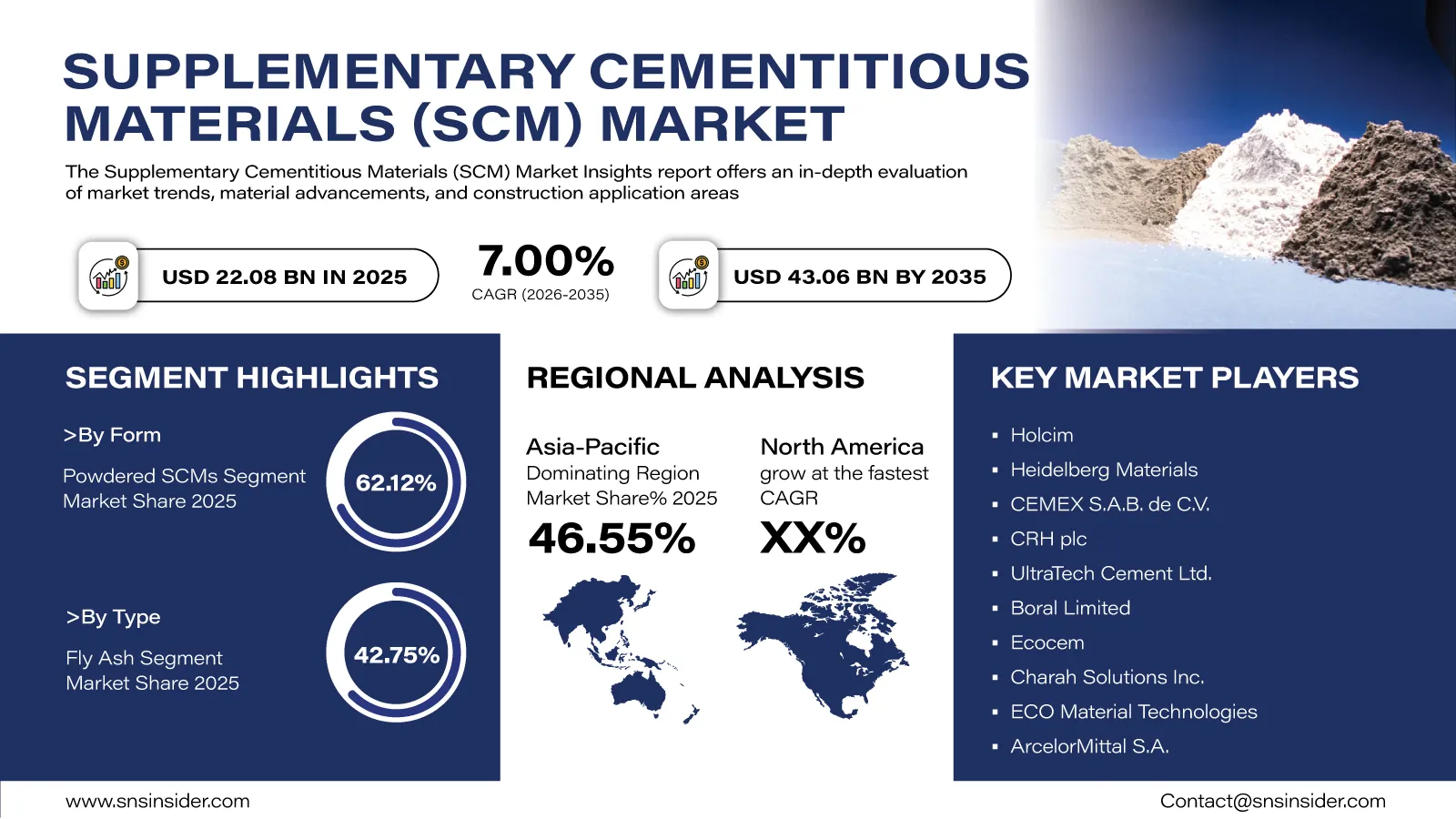
The global market for Supplementary Cementitious Materials (SCM) is experiencing huge momentum as governments, cement producers, and construction firms are moving toward sustainable infrastructures and carbon-reducing building material. “According to a recent study by SNS Insider, the global Supplementary Cementitious Materials (SCM) Market size valued at USD 22.08 billion in 2025, is anticipated to grow to USD 43.06 billion by 2035, registering a CAGR of 7.00% over the 2026–2035 forecast period.”
The rising demand for reducing carbon emissions in the cement production process is leading to the adoption of supplementary cementing materials in housing, business, industrial, and infrastructural works. Such materials help increase concrete strength, cut down on the amount of clinker used, and meet environmental objectives.
To Get Detailed Insights on the Supplementary Cementitious Materials (SCM) Market – Request a Free Sample Report
Faster urbanization, heavy investment in infrastructure, and more stringent sustainability demands have also contributed to the fast-paced growth in the market. In 2025, the global consumption of supplementary cementitious materials used in the production of cement and concrete was more than 410 billion tons.
Decarbonization Strategies and Infrastructure Investments Drive Long-Term Growth
Blended cements have been becoming more common in construction firms due to the tightening of climate policies and emission standards by governments. The partial substitution of traditional clinkers with SCM can help cement manufacturers reduce the carbon footprint and increase the quality of concrete.
Large-scale infrastructure construction related to roads, bridges, railway lines, airport constructions, port developments, dams, and urban constructions is creating constant demand for high-performance concrete. At the same time, the implementation of various green building materials certification systems is driving the adoption of SCMs in construction projects.
Innovation is also affecting the market as producers utilize alternative materials like calcined clay and engineered pozzolans to overcome changes in raw material availability and increase their supply chain resilience.
Key Market Insights Highlight Changing Material Preferences
By the nature of the product form, powdered SCMs generated 62.12% of the market revenue share in 2025, owing to their wide suitability for manufacturing cements and concrete mixes. Processed and engineered SCMs are anticipated to record the fastest growth over the coming years up to 2035 owing to increasing preference for high-quality and sustainable building materials.
By type, fly ash generated a market revenue share of 42.75% in 2025, thanks to its broad application for blended cement and concrete construction. Silica fume is expected to be the fastest growing type in the forecast period because of its increased utilization in ultra-high-performance concrete, tunneling, bridges, and other challenging civil construction projects.
By application, ready-mix concrete accounted for 38.05% of market demand share in 2025, thanks to its continuous growth in residential, commercial, and infrastructure construction projects. Mass concrete applications are expected to grow at the fastest rate because of heavy government investments in the construction of transport routes, dams, foundations, and other major civil engineering projects.
Advanced Processing Technologies Support Sustainable Construction
Innovation through technology is still evolving to make supplementary cementitious materials even better in performance and flexibility. Mechanical activation, improved grinding methods, and engineered SCM systems will be developed to increase reactivity, longevity, and consistency of supplementary cementitious materials used in construction applications.
In addition, digital monitoring of quality, blending of materials, and improved logistics are contributing to the development of sustainable cement production as well. With sustainability becoming a key strategy for the entire construction industry, the role of advanced SCM technologies in reducing carbon footprint and creating resilient infrastructure should only grow.
Further developments in the area of research on alternative cementitious materials are contributing towards the diversification of the market and less dependency on traditional industrial waste products.
Regional Markets Continue to Expand with Strong Infrastructure Activity
The market share held by the Asia-Pacific region was 46.55% in 2025, and it will continue to be the biggest and the fastest-growing market region up until 2035. The main factors contributing to increased demand in China, India, and Southeast Asia include ongoing urbanization, transportation development, construction of more buildings, and supportive government policies towards green building construction.
The North American market experiences stable growth thanks to the implementation of big rehabilitation infrastructure projects, highway renovations, and more environmentally responsible construction. Regulatory encouragement for lower-carbon cement production is increasing regional demand.
Europe also constitutes an important market due to government support of circular economic policies, tighter emission regulations, and the use of blended cements. On the other hand, Latin America and the Middle East & Africa have growing demand due to infrastructure development, industrial development, and urbanization projects that increase sustainable construction material use.
Industry Participants Focus on Low-Carbon Innovation and Circular Construction
The competition within the international SCM industry is becoming fiercer with the increase in the number of low carbon products produced by major companies and their efforts in adopting circular construction processes and new technology for material processing. The companies are also collaborating more with the infrastructure builders.
Key companies operating in the global Supplementary Cementitious Materials Market include Holcim, Heidelberg Materials, CEMEX S.A.B. de C.V., CRH plc, UltraTech Cement Ltd., Boral Limited, Ecocem, Charah Solutions Inc., ECO Material Technologies, ArcelorMittal S.A., Tata Steel Ltd., JSW Cement Ltd., Dangote Cement Plc., Votorantim Cimentos, Siam Cement Group (SCG), Taiheiyo Cement Corporation, Nippon Steel Blast Furnace Slag Cement Co. Ltd., Ferroglobe PLC, Sika AG, and BASF SE.
An SNS Insider analyst Himanshu Sharma commented, “The global construction industry's transition toward lower-carbon infrastructure is significantly expanding opportunities for supplementary cementitious materials. Companies investing in alternative SCM technologies, advanced processing capabilities, and circular construction solutions will be well positioned to benefit as sustainability becomes a central priority across the global built environment.”
About the Author

Get in touch