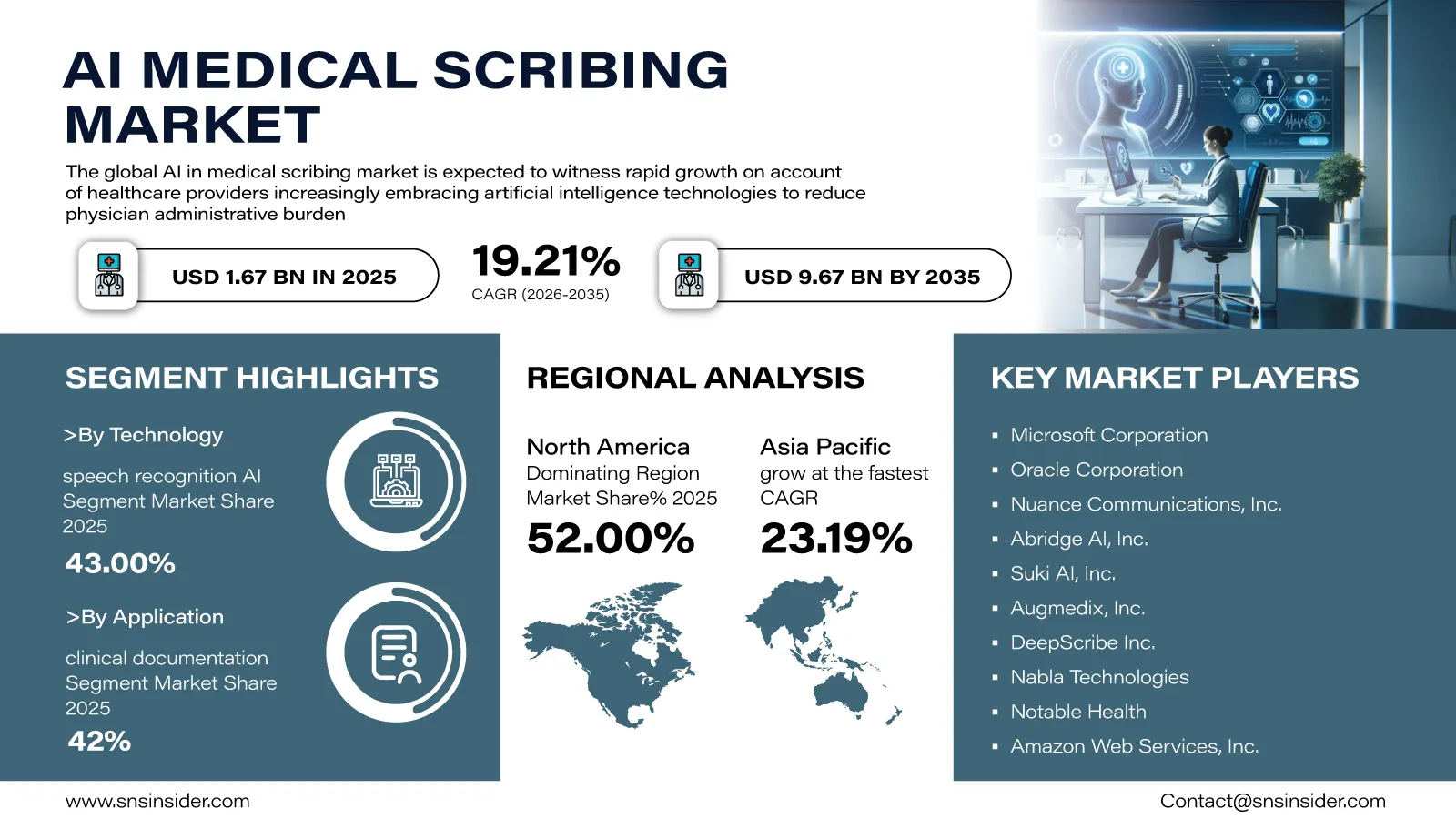
The global AI Medical Scribing Market is expected to experience exceptional growth over the next decade as healthcare providers adopt AI-based solutions to make their documentation process more efficient, decrease burden, and increase efficiency. “According to a recent study by SNS Insider, the global AI Medical Scribing Market size valued at USD 1.67 billion in 2025, is anticipated to grow to USD 9.67 billion by 2035, registering a CAGR of 19.21% over the 2026–2035 forecast period.”
The global healthcare providers are utilizing advanced documentation systems that streamline workflows and help doctors spend more time interacting with their patients. In light of the ongoing digital revolution in hospitals, doctor’s offices, and telemedicine, the need for AI-driven applications which can produce high-quality clinical documentation with little human involvement is growing fast.
With healthcare institutions increasingly becoming modernized in terms of their IT framework, AI medical scribing has been identified to be among the most successful uses of AI in healthcare.
To Get Detailed Insights on the AI Medical Scribing Market – Request a Free Sample Report
Generative AI and Ambient Intelligence Transform Clinical Documentation
Healthcare organizations have adopted advanced technologies that involve AI in recording clinician-patient interactions, organizing patient data, and documenting during the entire patient interaction. There have been constant improvements in conversational AI and speech processing, resulting in better automation of processes and helping clinicians document with greater efficiency and accuracy.
The field is also seeing the fast pace of incorporation of intelligent assistants into electronic health record systems that help clinicians simplify their administrative tasks while maintaining documentation standardization.
Higher investments in the development of digital healthcare technology and automation platforms will definitely contribute to more rapid adoption of these solutions.
Key Market Findings Highlight Emerging Growth Opportunities
By technology, the share of AI for speech recognition was 43.00% of the total global market revenue in 2025, which is an indication of high popularity of this solution in hospitals and physician practices in order to automate clinical documentation.
Moreover, ambient AI scribing and generative AI are expected to be the fastest growing sectors until 2035, experiencing a growth rate of 25.20%. These areas are going to benefit from the rising popularity of intelligent documentation systems that generate structured clinical documentation without any manual effort.
From a deployment perspective, cloud-based solutions represented 68.00% of total market revenue in 2025, demonstrating strong demand for scalable and connected healthcare technologies. The cloud deployment segment is also expected to maintain the fastest growth trajectory with a CAGR of 20.54% during the forecast period.
In terms of applications, the area of clinical documentation accounted for 52.00% of the total market revenue in 2025, due to the rising importance of AI for the improvement of medical record creation and documentation. On the other hand, the fastest growing application sectors are medical coding and revenue cycle support that will experience a CAGR of 21.68%.
Concerning the end user segment, hospitals and health systems were the largest one, occupying 49.00% of the overall market revenue in 2025. Furthermore, physician practices and clinics are expected to have the fastest growth at a CAGR of 20.22%, driven by increasing demand for scalable documentation solutions across outpatient healthcare environments.
An Infographic Representation of the Global AI Medical Scribing Market
Healthcare Digital Transformation Continues to Drive Market Expansion
Fast adoption of the latest electronic technologies in healthcare, virtual care services, and workflow intelligence platforms creates the necessary prerequisites for implementation of the AI medical scribing systems. Healthcare organizations give preference to technologies that will increase their efficiency, improve satisfaction of the doctors, and minimize the burden of documentation.
Increasing popularity of the automation and value-based care is leading to the implementation of AI-powered documentation tools in routine work of the healthcare organizations. This technology improves workflow efficiency and helps clinicians to concentrate on patients and their decisions.
Regional Markets Present Significant Growth Potential
North America was responsible for 52.00% of the world market revenues in 2025 owing to its highly developed healthcare IT infrastructure, extensive use of EHRs, and significant investments in healthcare AI. Innovative advancements and timely commercialization of AI clinical documentation solutions help solidify the region's market supremacy.
On the other hand, the Asia Pacific region will witness the highest market growth rate over the forecast period with 23.19% CAGR till 2035. Growing digitization in healthcare, increased adoption of cloud computing solutions, development of telehealth services, and investments in artificial intelligence create a lot of opportunities for healthcare providers in the region.
Industry Leaders Continue Expanding AI Healthcare Capabilities
Competition within the AI medical scribing market remains highly dynamic as technology companies continue investing in generative AI, ambient intelligence, cloud infrastructure, and healthcare workflow automation. Strategic collaborations, platform innovation, and deeper integration with digital health ecosystems remain key priorities for market participants.
Leading companies operating in the global AI Medical Scribing Market include Microsoft, Oracle, Nuance Communications, Abridge AI, Suki AI, Augmedix, DeepScribe, Google, Amazon Web Services, and Epic Systems.
An SNS Insider analyst Parry Kardani commented, "Artificial intelligence is rapidly transforming clinical documentation from a manual process into an intelligent, automated workflow. Continued advancements in generative AI, ambient listening technologies, and healthcare interoperability are expected to significantly improve physician productivity while supporting more efficient healthcare delivery worldwide."
About the Author

Get in touch