
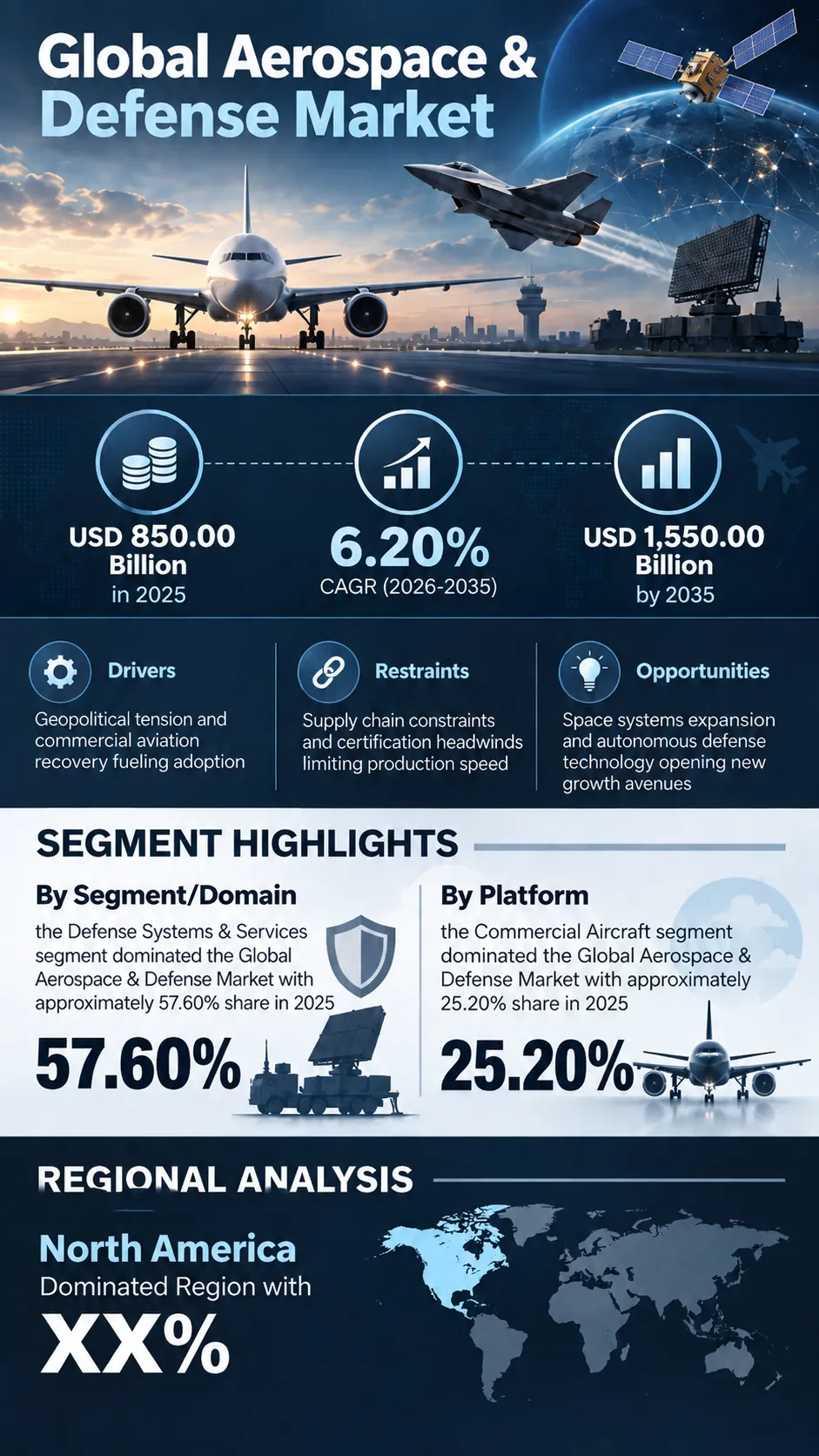
The Global Aerospace & Defense Market continues its steady climb as governments and airlines both lean further into modernization, autonomous technology, and fleet renewal. “According to a recent study by SNS Insider, the Global Aerospace & Defense Market size valued at USD 850.00 billion in 2025, is anticipated to grow to USD 1,550.00 billion by 2035, registering a CAGR of 6.20% over the 2026-2035 forecast period.”
There have been steady changes within propulsion, avionics, and autonomous systems technology over time, due to which many manufacturers aiming at improved capability and modernization readiness can take advantage of this trend. This includes the need for more resilient, AI-enabled platforms that give governments and airlines confidence in operational readiness and fuel efficiency, across a wide range of applications from fighter aircraft to commercial jetliners. This applies in situations where aerospace and defense platforms are used across commercial aviation, military operations, and space exploration applications.
Manufacturers are constantly working to improve platform capability and delivery reliability in order to meet various needs of governments and commercial airlines worldwide.
To Get Detailed Insights on the Global Aerospace & Defense Market – Request a Sample Report
Geopolitical Tension and Commercial Aviation Recovery Ecosystems Create New Demand
The global aerospace and defense market has evolved from steady, cyclical procurement into a broader mix of modernization-driven, autonomous, and space-focused programs. The growing investment in AI-enabled avionics, autonomous systems capability, and multi-domain platform development has required the development of more efficient and reliable production systems.
New propulsion and systems approaches can improve platform capability, reduce production bottlenecks, and expand the range of applications aerospace and defense platforms can serve. This gives manufacturers the possibility to be more effective when reaching government and airline buyers and strengthening claims around readiness and operational reliability.
Prime contractors, government defense agencies, and commercial airlines are increasingly cooperating due to the growing interest in developing future solutions for resilient, technologically advanced aerospace and defense capability.
Key Market Findings Highlight High-Growth Segments
The defense systems & services segment dominated all categories in the global aerospace and defense market share with a market revenue share of approximately 57.60% in 2025 due to sustained government defense budgets and multi-decade sustainment demand.
The fastest growing category is expected to be the space systems segment, which will grow at a CAGR of approximately 9.30% through 2035. This will be possible owing to expanding satellite constellation deployment and commercial launch service scaling.
By platform, commercial aircraft held the largest share of total market revenue at approximately 25.20% in 2025 due to rising global passenger traffic and fleet renewal programs. The unmanned systems segment will see the fastest growth in revenue generation at a CAGR of approximately 12.40%.
Regional trends show North America leading with an 81.64% share within the region in 2025, while Asia Pacific is expected to register a fast growth trajectory driven by rising defense budgets and expanding domestic aerospace manufacturing across the region.
Platform Modernization, Autonomous Capability, and Application Diversification Gain Importance
In this regard, manufacturers have been looking at aerospace and defense platforms that would modernize more readily, operate more autonomously, and serve more diverse mission applications.
Innovation in AI-enabled avionics, autonomous systems technology, and multi-domain platform development has been making it possible for companies to come up with products that can meet increasingly demanding government and airline expectations. In addition to that, increasing emphasis on space systems capability is also making it possible for companies to find solutions that support expanding satellite and launch infrastructure demand.
Such trends are likely to become even more prominent in the future.
North America Leads Amid Deep Contractor Concentration and Defense Procurement
North America represented an 81.64% share within the region of global market revenue in 2025 and was the largest regional market, owing to the United States' position as home to the world's largest concentration of prime defense contractors and the deepest sustained government defense procurement budget of any single national market. In addition, Asia Pacific is expected to register a fast growth trajectory during the forecast period, propelled by rising defense budgets and rapidly expanding domestic aerospace manufacturing capability across the region's fast-growing economies.
On the other hand, Europe represented a meaningful share of global market revenue in 2025, aided by France's position as home to Airbus, Dassault Aviation, Thales, and Safran, giving the country one of the deepest aerospace industrial bases anywhere in the world.
Leading Companies Drive Innovation and Competition
The environment continues to stay very dynamic since players continue innovating on propulsion, avionics, and autonomous systems technology as well as forming partnerships in order to enhance their position in the industry.
Some of the major companies that operate in the global aerospace and defense market are Lockheed Martin Corporation, The Boeing Company, Airbus SE, Northrop Grumman Corporation, RTX Corporation, General Dynamics Corporation, BAE Systems plc, Thales Group, Safran SA, and GE Aerospace.
An SNS Insider Analyst Sushant Kadam commented, “The steady combination of sustained defense modernization and recovering commercial aviation demand is creating consistent growth across nearly every major aerospace and defense segment. Manufacturers that successfully combine AI-enabled avionics innovation, autonomous systems capability, space infrastructure investment, and reliable government and airline partnerships will be best positioned to capitalize on emerging opportunities across commercial aviation, military and defense operations, and space exploration applications.”
About the Author

Get in touch




