
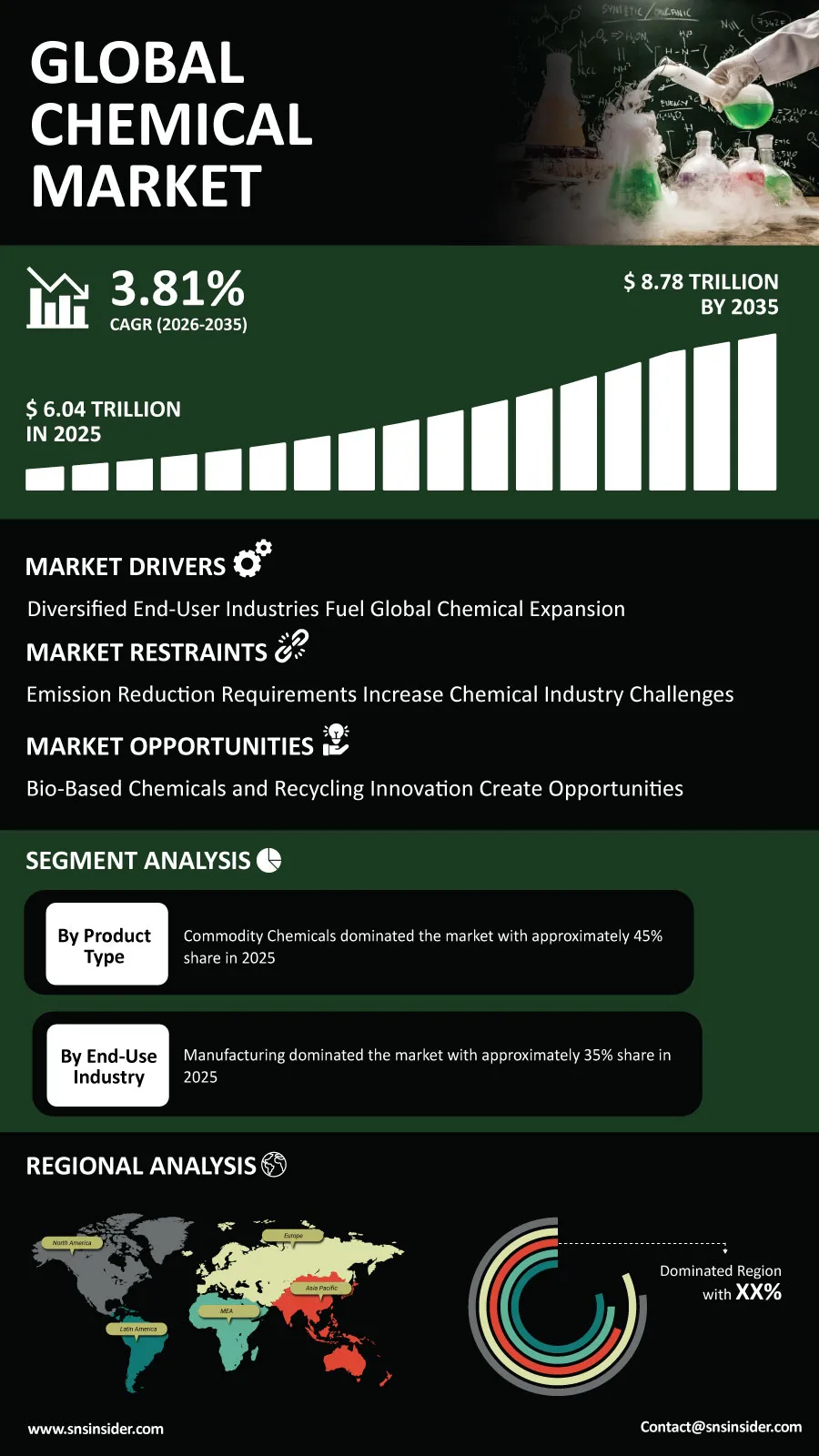
The worldwide Chemical Market is poised to enter a fresh phase of consistent growth owing to the impact of industrial production, infrastructure, and cleantech investments on demand from several industry verticals. “According to a recent study by SNS Insider, the global Global Chemical Market size valued at USD 6.04 Trillion in 2025, is anticipated to grow to USD 8.78 Trillion by 2035, registering a CAGR of 3.81% over the 2026–2035 forecast period.”
Chemical producers are taking advantage of higher consumption in the agricultural, pharmaceutical, construction, automotive, electronic, and consumer goods industries. With economies building modern infrastructures and growing domestically, the need for commodity and specialty chemicals is on the rise. The move towards low carbon production and manufacturing worldwide is also motivating businesses to produce greener chemicals and be more efficient and diversify their sources of raw materials.
To Get Detailed Insights on the Global Chemical Market – Request a Sample Report
Sustainable Manufacturing and Advanced Materials Create Long-Term Opportunities
Investment in environmentally friendly manufacturing processes is rising within the industry owing to the growing pressures from regulators and changes in consumer demands. Bio-based raw materials, recycled materials, and low-emission manufacturing techniques are becoming critical in growth plans as the companies use such techniques to become sustainable and competitive.
The rapid growth of electric cars, semiconductor manufacturing, renewable energy plants, and battery manufacturing has created new avenues for high performance specialty chemicals. Moreover, digital manufacturing processes and AI-driven process improvements are enabling chemical firms to improve efficiency and become resilient in their supply chains.
Key Market Insights Highlight Shifting Industry Demand
Market revenue by product type is led by Commodity Chemicals which make up about 45% of the global market revenue in 2025, as they are used widely in manufacturing, construction, petrochemicals, and industrial processing activities. Specialty Chemicals will record the highest growth until 2035, with a CAGR of 5.2%, backed by the growing demand for application-specific, sustainable, and high-performance chemicals.
The Agriculture sector makes up almost 28% of the total market demand in 2025, as fertilizers and crop protection chemicals continue to be vital in boosting agricultural productivity. The Pharmaceuticals & Healthcare sector will record the highest growth rate until 2035, with a CAGR of 5.8%, fueled by increased manufacturing of pharmaceuticals and active pharmaceutical ingredients and expanding healthcare facilities.
Among the end-user industry segments, Manufacturing was the leading market segment, accounting for around 35% in 2025 due to wide use of chemicals in industrial operations. On the other hand, the Electronics & Semiconductors industry is estimated to grow at the fastest rate at a CAGR of 6.1% because of increasing production of semiconductors and AI hardware, and growing need for ultra-high purity chemicals. Distribution-wise, Direct Sales commanded more than 50% of the overall market revenues, whereas Online Chemical Marketplaces would record the highest growth.
Technology Innovation Accelerates Chemical Industry Transformation
Innovativeness continues to be one of the key characteristics of the worldwide chemicals industry, with firms investing significantly in innovative materials, nanotechnologies, green hydrogen uses, and sustainable product development. Advancements in the realm of catalyst technologies, high-tech production, and intelligent production systems have allowed companies to increase the quality of products and reduce costs and negative impacts on the environment.
The use of artificial intelligence, predictive maintenance systems, industrial automation, and digital supply chain management is revolutionizing manufacturing processes. The mentioned technologies help producers enhance production planning, increase energy efficiency, improve quality control, and adapt to changing market conditions.
Regional Markets Continue to Drive Global Industry Expansion
In 2025, Asia Pacific was the dominant regional market, backed by the presence of a large manufacturing base, industrialization, increased capacity for petrochemicals, and demand from automotive, electronics, construction, and agriculture industries. China remains the leader in regional production, whereas other countries such as India, Japan, and South Korea support the market through their increasing investment in specialty chemicals and advanced manufacturing.
North America will remain the fastest-growing region during the forecast period, backed by abundant shale gas deposits, increasing investment in specialty chemicals and semiconductors, renewable energy projects, and sustainable production processes. Europe leads in the development of green chemistry and production of high-end specialty chemicals, whereas Latin America and the Middle East & Africa increase their production capacity through downstream chemical manufacturing.
Industry Leaders Expand Capacity and Focus on Sustainable Innovation
The competitive environment is continually changing as top chemical producers focus on expanding production, R&D, digitization, and sustainable practices. These companies enhance their product lines via advanced materials, circular business models, low carbon manufacturing, and other types of investments that foster growth in various industrial sectors.
Key companies operating in the global Chemical Market include BASF SE, Dow Inc., LyondellBasell Industries N.V., SABIC, INEOS Group, DuPont de Nemours, Inc., Evonik Industries AG, Covestro AG, Mitsubishi Chemical Group Corporation, LG Chem Ltd., Sumitomo Chemical Co., Ltd., Toray Industries, Inc., Arkema S.A., Air Liquide S.A., Akzo Nobel N.V., Eastman Chemical Company, Celanese Corporation, Huntsman Corporation, Wacker Chemie AG, and Solvay S.A.
An SNS Insider analyst Himanshu Sharma commented, "The global chemical industry is undergoing a structural transformation driven by sustainable manufacturing, digitalization, and the emergence of advanced industrial applications. Companies investing in specialty chemicals, cleaner production technologies, and innovation across high-growth sectors such as semiconductors, renewable energy, healthcare, and electric mobility are expected to strengthen their competitive position and unlock significant long-term growth opportunities."
About the Author

Get in touch




