
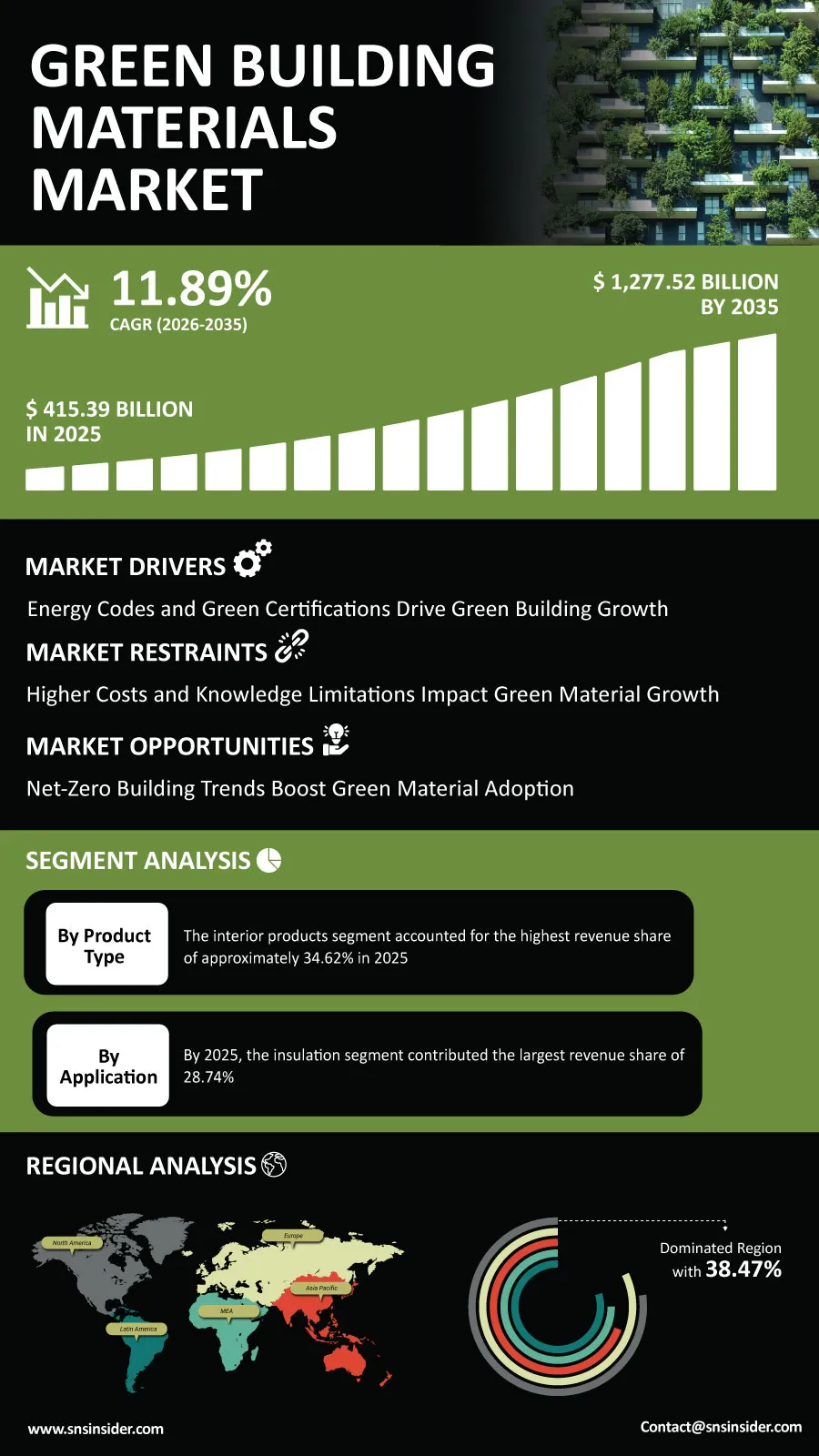
The Green Building Materials Market all over the globe is experiencing significant growth due to increased investment made by governments, developers, and construction firms in infrastructure and buildings that are environmentally friendly and energy efficient. “According to a recent study by SNS Insider, the global Green Building Materials Market size valued at USD 415.39 Billion in 2025, is anticipated to grow to USD 1,277.52 Billion by 2035, registering a CAGR of 11.89% over the 2026–2035 forecast period.”
The increasing focus on zero-emission building practices, sustainable construction programs, and sustainable life cycles has impacted procurement practices in residential, commercial, and institutional construction processes. The builders are now considering advanced insulation technologies, recycled building materials, energy-efficient roofs, and green interior materials in their efforts to enhance performance and lower costs.
To Get Detailed Insights on the Green Building Materials Market – Request a Sample Report
Net-Zero Construction Initiatives Create Significant Growth Opportunities
Sustainable infrastructure investments made by public organizations as well as private entities have created more avenues for producers of green building products. Governments all around the world keep on enhancing energy rules for buildings in addition to implementing incentive schemes aimed at promoting construction materials that are environmentally friendly.
The rising trend of zero-energy buildings, building renovations, and climate resilience programs will also lead to growing demand for high-quality construction materials that increase energy efficiency and lower embodied carbon emissions. The companies that invest in biobased materials, raw materials recycled, and environmental product declarations will be profiting from the growing demand all around the world.
Key Market Insights Highlight Evolving Product Demand
In terms of the product type, Interior Products had around 34.62% share of overall market revenue in 2025 owing to robust use of low-VOC paints, eco-friendly flooring, ceiling tiles with recycled material content, and green finish products. The Solar Products category is expected to exhibit the fastest growth in 2035 at a CAGR of 13.47% because of rising utilization of building-integrated photovoltaics systems and solar roofs.
According to application, the Insulation segment held a dominant position in the global market with around 28.74% revenue share in 2025 due to the increasing demand for thermal insulation products for improving the energy efficiency of buildings. The Roofing segment is expected to lead the growth in the market during the forecast period because of the increasing significance of cool roofs, green roofs, and solar roofs.
In terms of end users, Non-Residential Buildings made up around 57.36% of the market revenue in 2025, owing to the adoption of green certifications for commercial offices, healthcare establishments, education centers, and governmental infrastructure projects. On the other hand, Residential Buildings are anticipated to experience the highest growth rate during the forecast period until 2035 at a CAGR of 12.61%, attributed to increasing consumer awareness regarding energy-saving homes and indoor living conditions.
Material Innovation Accelerates Sustainable Construction
Product innovation is revolutionizing the market for sustainable building materials due to innovations that offer improved sustainability along with improved durability and energy savings. Innovations in advanced insulation, bio-based building materials, intelligent building envelope systems, and structural materials made using recycled content are allowing constructors to meet high standards of sustainability without impacting performance.
Digital building design software, life cycle assessment software, and integrated supply chain management systems are also increasing the transparency of material sourcing and construction processes. This is contributing towards improved resource optimization within the construction firms while meeting their sustainability goals.
North America Held 38.47% of Green Building Materials Market Revenue in 2025; Asia Pacific to Expand at a 13.72% CAGR Through 2035
The North American region dominated the global Green Building Materials Market with a share of over 38.47% of revenue share in 2025 owing to the presence of developed green building rating systems, energy efficient laws, and extensive use of sustainable construction practices. The continued efforts towards regional demand from federal incentives, corporate ESG policies, and increasing investments in environment-friendly commercial constructions will further propel the regional demand.
The Asia Pacific region is anticipated to exhibit the fastest regional growth over the forecast period at a CAGR of 13.72%. Fast-paced urbanization, development of infrastructure, green buildings initiatives by governments, and investments in energy-efficient construction practices in China, India, Japan, and Southeast Asia will fuel market growth. The Europe region is also anticipated to retain its dominance owing to strict environment-related laws and construction renovation programs.
Industry Participants Strengthen Sustainable Product Portfolios
In the Green Building Materials Market, Competition is on the rise due to increased capacity production by producers and creation of new low carbon emitting materials together with environmentally friendly production processes. Renewable raw materials, advanced insulation techniques, solar integrated buildings and circular economy strategies have been used by firms to satisfy the emerging sustainability needs.
Key companies operating in the global Green Building Materials Market include Saint-Gobain S.A., Kingspan Group plc, Owens Corning, BASF SE, Armstrong World Industries, Rockwool International A/S, Johns Manville (Berkshire Hathaway), Knauf Insulation GmbH, Interface, Inc., Forbo Holding AG, USG Corporation (Knauf), Holcim Group, GAF Materials LLC, CertainTeed LLC, Ecological Building Systems, Nucor Corporation, Trex Company, Inc., Fiberon LLC, Tesla Energy, and GreenMan Technologies, Inc.
An SNS Insider analyst Himanshu Sharma commented, "The accelerating transition toward sustainable construction, stricter building performance regulations, and growing corporate ESG commitments are creating strong long-term demand for advanced green building materials. Companies investing in low-carbon manufacturing technologies, high-performance energy-efficient products, and circular economy innovations are expected to strengthen their competitive advantage as global construction increasingly prioritizes sustainability and resource efficiency."
About the Author

Get in touch




