
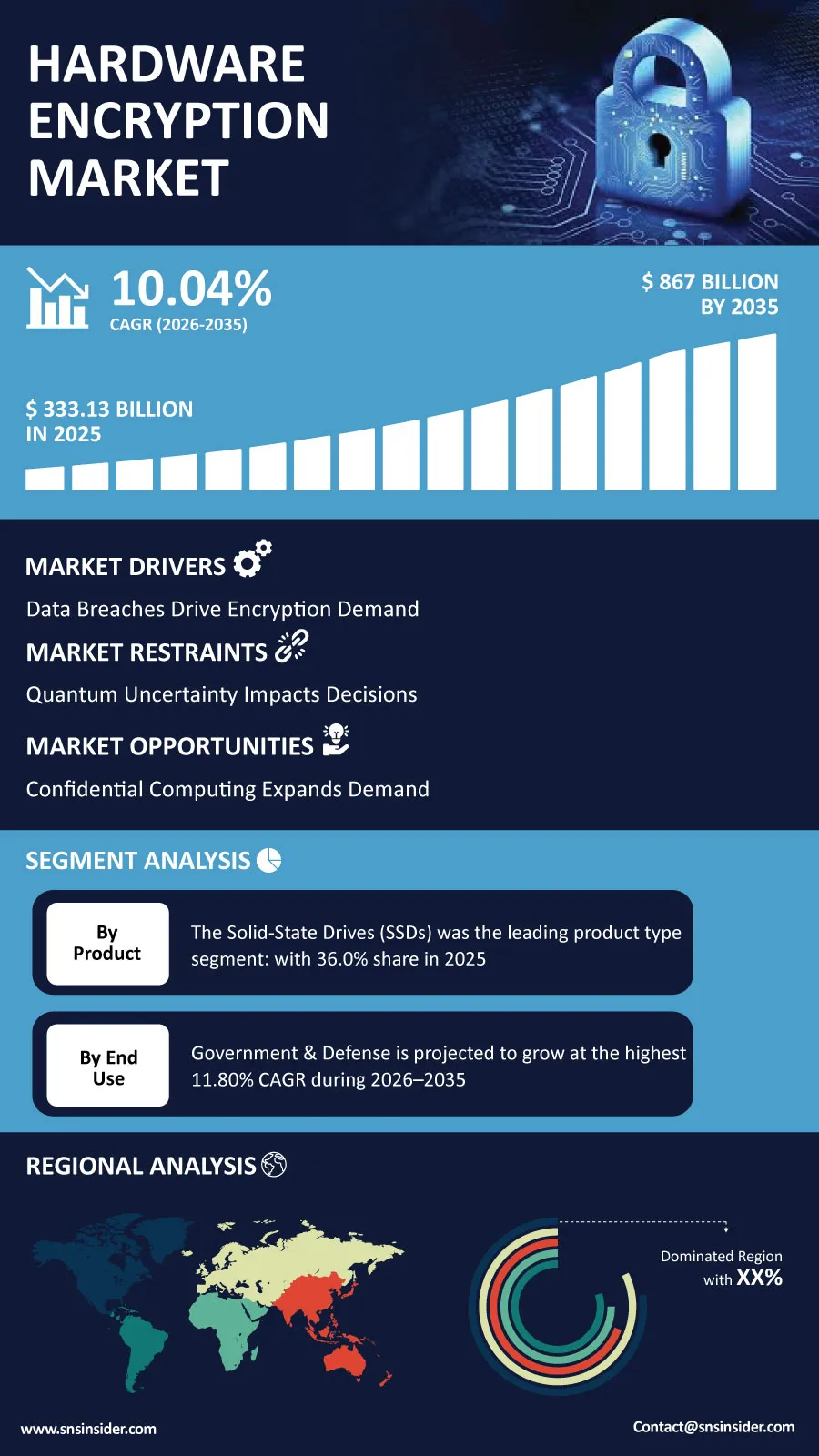
The global Hardware Encryption Market is entering a new phase of growth as organizations strengthen digital security strategies against increasingly sophisticated cyber threats. “According to a recent study by SNS Insider, the Hardware Encryption Market size valued at USD 333.13 billion in 2025, is anticipated to grow to USD 867 billion by 2035, registering a CAGR of 10.04% over the 2026–2035 forecast period.”
The explosion of digital transformations across different sectors has led to a massive rise in the amount of sensitive data created, distributed, and stored on a daily basis. Companies are adopting hardware-oriented security solutions that have specialized encryption features since hardware solutions are more secure than software-only solutions and also help to comply with industry regulations.
The swift expansion of cloud services, interrelated devices, digital banking, healthcare, and government e-services keeps fueling the demand for secure hardware solutions at the same time that companies are protecting themselves against future cyber threats by investing in encryption solutions that can meet the changing requirements of cryptography.
To Get Detailed Insights on the Hardware Encryption Market – Request a Sample Report
Rising Security Investments Create Long-Term Growth Opportunities
Governments around the world are prioritizing security infrastructure that would be able to face the latest developments in cybersecurity in view of the increasing frequency of the occurrence of such cybercrimes as ransomware attacks, data breaches, and cases of identity theft. One of the most important roles in maintaining confidentiality of sensitive data is played by encryption technologies.
The use of hyperscale data centers and hybrid cloud ecosystems stimulates the creation of hardware security modules, encryption storage devices, and secure processing systems. Many financial organizations, healthcare firms, defense organizations, and cloud service providers of software pay much attention to this branch of technology and invest enormous sums of money into cryptographic systems.
Due to the demand of the industries to the next generation of cryptographic standards, hardware developers succeed in making their systems flexible to fluctuations in the security sphere.
Key Market Insights Highlight Shifting Demand Patterns
Based on architecture, FPGA accounted for 41.7% of global market revenue in 2025 due to its flexibility and ability to support evolving encryption workloads across enterprise, telecommunications, and defense applications. The ASIC segment is expected to register the fastest growth through 2035, driven by demand for highly efficient and application-specific security solutions.
By product, Solid-State Drives (SSDs) represented 36.0% of market revenue in 2025 owing to widespread enterprise adoption of encrypted storage technologies. Smart Cards are anticipated to witness the fastest growth over the forecast period as secure authentication, digital identity, and contactless payment applications continue expanding worldwide.
In terms of application, Data Security captured 33.4% of the market in 2025 as organizations prioritized protection of business-critical information. Cloud Encryption is projected to grow at the fastest pace through 2035 due to accelerating migration toward cloud-native infrastructure and zero-trust security frameworks. Among end users, Consumer Electronics held the largest market share at 38.2% in 2025, while Government & Defense is expected to record the highest growth during the forecast period.
Advanced Encryption Technologies Strengthen Digital Infrastructure
Vendors are driving innovation in secure storage, trusted hardware platforms, and cryptography processing units in response to rapidly advancing cybersecurity needs. Improved integration of these technologies with artificial intelligence, edge computing, and interconnected infrastructure makes it possible for businesses to enhance security without compromising efficiency.
Some manufacturers are also creating programmable systems that will enable them to a) adapt to new cryptographic processes, b) enhance their performance, and c) minimize delay during the cryptocurrency operation, while still ensuring secure authentication of users around the world and across devices.
North America Held the Largest Share of the Hardware Encryption Market in 2025; Asia Pacific Projected to Register the Fastest CAGR Through 2035
In 2025, North America’s position as the leading region in cybersecurity remained intact thanks to its significant investment in cybersecurity, high rate of implementation of enterprise technology, strict regulation policies, and the presence of key players in hardware security technology sector. The investments in financial services, healthcare, governmental agencies, and cloud infrastructure resulted in strong regional demand.
It is expected that Asia Pacific will show the most notable growth during the period until 2035 due to digitalization, growing cloud infrastructure, increasing semiconductor production, and improving data privacy laws. The development of consumer electronics sector in the region should create opportunities for the development of hardware encryption technologies.
As digital ecosystems continue expanding worldwide, organizations across both developed and emerging markets are expected to increase deployment of hardware-based security technologies to strengthen resilience against increasingly sophisticated cyber threats.
Industry Participants Focus on Secure Innovation and Next-Generation Cryptography
Competition across the hardware encryption market remains strong as companies invest in secure storage technologies, hardware security modules, trusted computing platforms, and advanced cryptographic processors. Product development efforts increasingly focus on supporting scalable security architectures, regulatory compliance, cloud-native environments, and future-ready encryption capabilities.
Key companies operating in the global Hardware Encryption Market include Seagate Technology Holdings plc, Western Digital Corporation, Samsung Electronics Co. Ltd., Micron Technology Inc., Kingston Technology Company Inc., Intel Corporation, IBM Corporation, Thales Group, NetApp Inc., Broadcom Inc., Marvell Technology Inc., Maxim Integrated (Analog Devices), Kanguru Solutions, iStorage Limited, Apricorn, Cigent Technology Inc., Veracrypt Foundation, Rohde & Schwarz Cybersecurity, Giesecke & Devrient GmbH, and Utimaco GmbH.
An SNS Insider analyst Sakshi Kale commented, "Growing digital transformation, expanding cloud adoption, and increasingly stringent cybersecurity requirements are reinforcing the importance of hardware-based encryption across global industries. Organizations investing in resilient, future-ready encryption platforms will be better positioned to protect sensitive data while meeting evolving regulatory and operational security demands."
About the Author

Get in touch




