
Hydrogen Economy Market Report Scope & Overview:
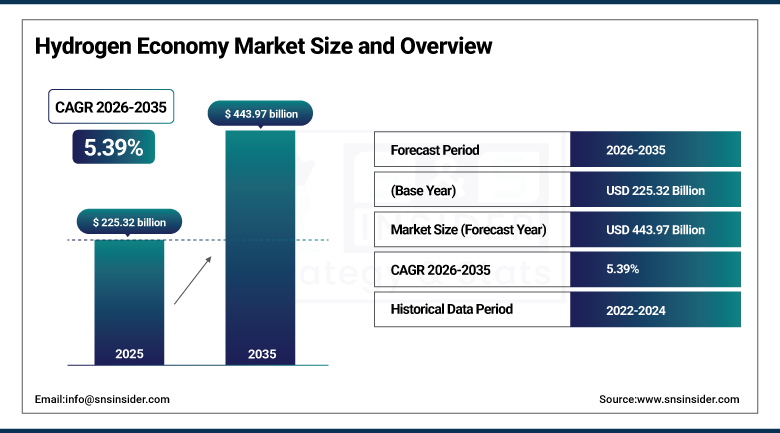
The Hydrogen Economy Market was valued at USD 225.32 Billion in 2025 and is projected to reach USD 443.97 Billion by 2035, expanding at a CAGR of 7.02% during the forecast period 2026–2035.
Hydrogen economy has quickly become a vital component of the energy transition process around the world, as authorities, industry players, and energy companies search for alternative energy sources that will allow achieving decarburization goals set in the long term. Hydrogen continues to play a crucial role in oil refining, ammonia production, methanol production, steel manufacturing, heavy-duty transportation, and energy generation, while being more and more widely used as an energy vector for integrating renewable energy sources. Investments in hydrogen facilities, infrastructure for storage, transportation, fuel cells, and carbon capture solutions are fostering the development of a favorable environment for wide industrial use of the resources.
There are many things going on with regards to the technological evolution, such as electrolysis solutions, carbon capture solutions, digital solutions for plant optimization, artificial intelligence solutions for production monitoring and predictive asset maintenance, and hydrogen plants powered by renewable energy sources. Industries are adopting automation solutions, real-time analysis, cloud-based operations, digital twins, and electrolyze management solutions.
Market Size and Forecast
-
Market Size 2026E: USD 241.07 Billion
-
Market Size 2035: USD 443.97 Billion
-
CAGR: 7.02% from 2026 to 2035
-
Fastest Growing Region: Asia Pacific
-
Largest Region: North America
To Get more information Hydrogen Economy Market - Request Free Sample Report
Hydrogen Economy Market Trends
-
Rapid commercialization of large-scale green hydrogen production facilities globally.
-
Expanding electrolyzer manufacturing capacity supporting renewable hydrogen deployment.
-
Increasing hydrogen adoption across heavy transportation and industrial decarburization initiatives.
-
Growing investments in hydrogen storage, distribution, and export infrastructure.
-
AI-enabled optimization improving hydrogen production efficiency and operational reliability.
The U.S. Hydrogen Economy Market Size Outlook
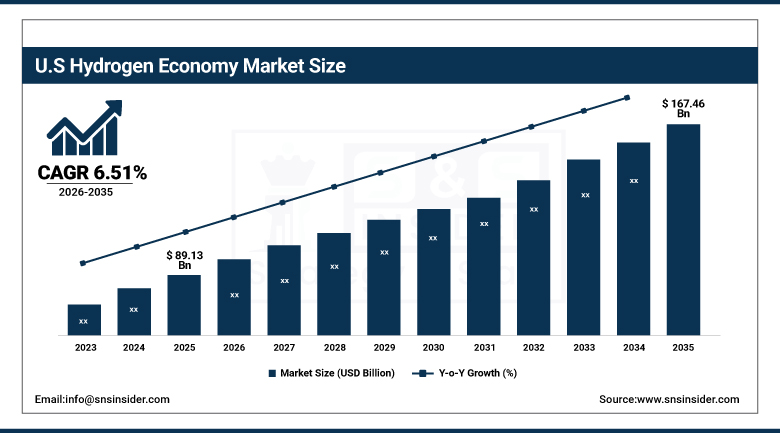
The U.S. Hydrogen Economy Market was valued at USD 89.13 billion in 2025 and is expected to reach approximately USD 167.46 billion by 2035, expanding at a CAGR of 6.51% during 2026–2035.
The United States continues to lead the hydrogen economy in North America due to its industrial hydrogen production capacity, large-scale refining activities, state-of-the-art natural gas network, growing renewable energy utilization, and federal backing of hydrogen commercialization efforts. Sectors such as refining, chemical processing, fertilizer production, steel making, heavy-duty transport, and electricity generation have continued investing in hydrogen technology development to meet their decarburization goals while ensuring reliable operations.
Investments in electrolyzer production facilities, hydrogen production using carbon capture technology, fueling stations, and regional hydrogen clusters have been creating an attractive environment for investments. The involvement of energy giants, industrial gases firms, utility companies, and technology developers further aids the commercialization process through several end use markets while building domestic hydrogen value chains. Moreover, ongoing innovations in proton exchange membrane electrolysis technology, solid oxide electrolysis, digital process optimization, intelligent management of hydrogen production, and hydrogen storage solutions have increased production efficiency while lowering lifecycle costs.
Hydrogen Economy Market Segment Analysis
-
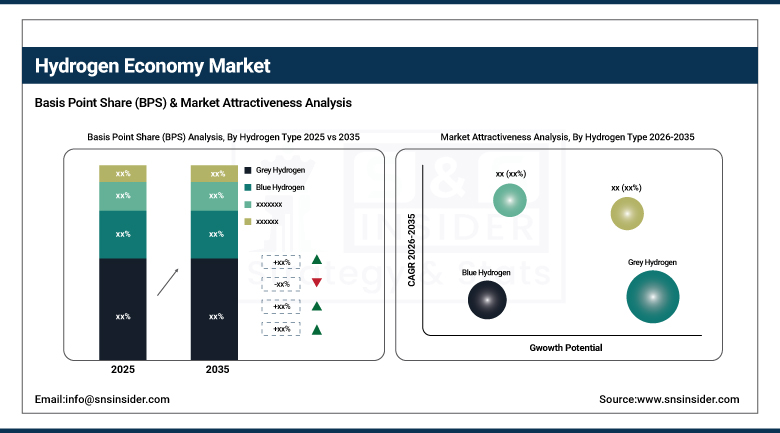
By Hydrogen Type, grey hydrogen dominated the market with 61.00% share in 2025, while green hydrogen is projected to witness the fastest growth with 21.49% CAGR during the forecast period.
-
By Production Technology, steam methane reforming without CCS dominated the market with 49.00% share in 2025, while electrolysis is projected to witness the fastest growth with 20.13% CAGR during the forecast period.
-
By End User, refining & petrochemicals dominated the market with 33.00% share in 2025, while transportation & mobility is projected to witness the fastest growth with 13.18% CAGR during the forecast period.
By Hydrogen Type, grey hydrogen dominated, while green hydrogen grows fastest.
The Grey hydrogen segment held 61.00% market share in 2025 due to its wide applicability in various processes including petroleum refining, ammonia, methanol manufacture and other industrial chemicals. Current infrastructure for steam methane reforming, availability of natural gas, advanced production techniques, and relatively low production costs are driving commercial applications across the globe. Most industries prefer to use grey hydrogen as the main source of feedstock in order to maintain its consistent availability and plan transition towards low carbon sources step-by-step. By June 2025, Air Liquide expanded industrial hydrogen supply solutions to refineries and industrial companies along with investment in low-carbon production methods for gradual decarburization of hydrogen supply chains.
Green hydrogen will grow at the fastest CAGR of 21.49% between 2026 and 2035 due to growing investments in renewable electricity, electrolyzers, and national decarburization programs around the world. Government bodies and other private parties increase the pace of deployment of utility-scale electrolyzers running on renewable energy such as solar power, wind and hydroelectric to minimize dependency on fossil fuel hydrogen. Reduced renewable electricity prices, incentives programs, improved efficiency of electrolyzers, and growing demand from steel manufacturing, transport, fertilizer, and energy storage industries will drive green hydrogen growth.
By Production Technology, steam methane reforming without CCS dominated, while electrolysis grows fastest.
SMR without carbon capture and storage contributed 49.00% share of the hydrogen economy market in 2025 because of its advanced commercial maturity, low cost of production, and wide adoption at the current hydrogen production sites. The technology is the go-to solution for industrial hydrogen production for the purposes of supplying refineries, fertilizer factories, petrochemical units, and other chemical plants. Natural gas pipelines, existing engineering knowledge, efficient production, and less capital costs in comparison to other production technologies still facilitate its industrial adoption. In 2025, Air Products continues making investments in hydrogen production and distribution infrastructure, as well as in carbon reduction projects in selected industrial hydrogen producers.
Electrolysis is estimated to show the highest CAGR of 20.13% during the forecast period since renewable-based hydrogen production will be the key strategy for clean energy transition and industrial decarburization in most countries. Quick development of PEM electrolyzers, alkaline and SOE electrolyzers will boost production efficiency, as well as lower production costs. Growing investments in gig watt scale electrolyzers’ production facilities, renewable energy integration projects, digitalization projects, and hydrogen exports will contribute to its fast commercialization.
By End User, refining & petrochemicals dominated, while transportation & mobility grows fastest.
In 2025, the share of the Refining & Petrochemicals segment in the Hydrogen Economy Market was recorded to be 33.00%, owing to the critical need of hydrogen in processes such as hydrocracking, hydro treating, desulfurization, and the generation of environmentally-friendly fuels for transportation. The refineries have continued using huge amounts of hydrogen to adhere to the fuel quality standards and to boost their efficiency. Petrochemical producers also require hydrogen for a variety of synthesis reactions and applications. In 2025, Shell also increased its number of low-carbon hydrogen projects with integrated refinery applications as part of its energy transition strategy towards industrial decarburization and production of clean fuels.
The Transportation & Mobility sector is estimated to have the highest CAGR of 13.18% during 2026-2035 due to the commercialization of hydrogen fuel cell vehicles in various sectors including heavy trucks, trains, buses, sea ships, and certain aviation applications. Globally, governments have been offering various incentives and climate policy initiatives to deploy hydrogen fueling stations, zero-emissions freight corridors, and the commercialization of fuel cell technology. Technological advancements in fuel cells, hydrogen storage, refueling infrastructure, and vehicle efficiency have made hydrogen fuel increasingly competitive in those sectors where battery-electric technologies face difficulties in operation.
Regional Analysis
|
Region |
Major Country |
Share within Region, 2025 (%) |
|---|---|---|
|
North America |
United States |
92.00% |
|
Europe |
Germany |
24.00% |
|
Asia Pacific |
China |
22.00% |
|
Middle East & Africa |
UAE |
6.00% |
|
Latin America |
Brazil |
5.00% |
North America Hydrogen Economy Market Insights
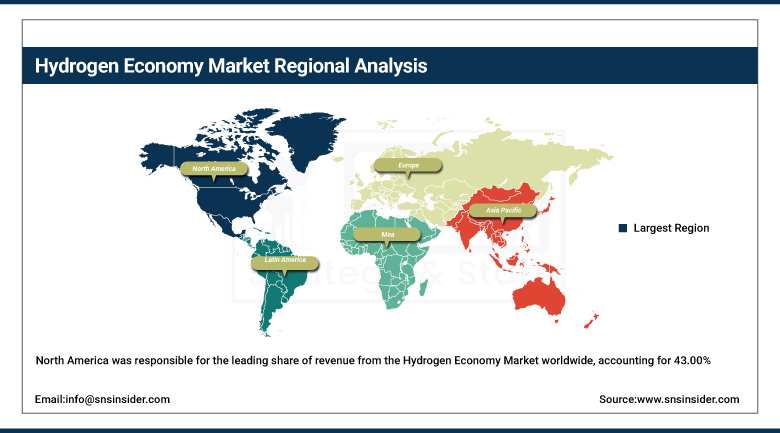
North America was responsible for the leading share of revenue from the Hydrogen Economy Market worldwide, accounting for 43.00%. It will sustain its dominance due to hydrogen production on a significant scale, a developed industry for refining and petrochemicals, government funding, and the emergence of clean hydrogen technologies. The largest part of regional demand belongs to the United States due to significant hydrogen use in petroleum refining, chemicals, fertilizers, and industrial manufacturing.
Funding of infrastructure projects within federal clean energy programs, hydrogen hubs, carbon capture, and renewable hydrogen facilities stimulates the development of the sector in the region. Moreover, installation of electrolyzer manufacturing plants, artificial intelligence-based production optimization systems, digital platforms for asset monitoring, hydrogen pipeline upgrade, and carbon capture technologies enhance competitive advantages of North America. The U.S. department of energy proceeded with the regional clean hydrogen hubs (H2Hubs) program in 2025.
Get Customized Report as per Your Business Requirement - Enquiry Now
Europe Hydrogen Economy Market Insights
Europe continues to be one of the most advanced hydrogen markets globally due to the continent's aggressive decarburization objectives, comprehensive hydrogen policies, and significant investments in renewable hydrogen production and industry transformation. Various countries such as Germany, France, the Netherlands, Spain, and Denmark continue to invest in the development of electrolyzers, renewable energy from offshore, hydrogen import facilities, cross-border pipeline networks, and industrial hydrogen valleys.
The favorable regulations within European climate policies have promoted commercialization in the oil refinery, chemical industry, steel production, heavy transportation, and power generation sectors. Public and private partnership, growth of renewable electricity capacity, and technology innovations are enabling Europe to develop its status as a global center for production and use of green hydrogen. In 2025, the European Commission will move forward with the funding of the Hydrogen Bank project for the accelerated production of renewable hydrogen.
Asia Pacific Hydrogen Economy Market Insights
The Asia Pacific Hydrogen Economy Market is forecasted to exhibit the fastest CAGR of 7.50%, backed by rapid industrialization, growing capacities of renewable energy sources, and substantial governmental investments in China, Japan, South Korea, India, and Australia. The region maintains expansion of the capacity for electrolyzers, hydrogen mobility solutions, green ammonia production, and export-focused hydrogen projects in order to facilitate its energy transition needs as well as develop its international clean energy trade.
The heavy industries such as steel, chemicals, fertilizer, and transport are actively introducing hydrogen-based technologies in order to lower carbon dioxide emissions and ensure sustainable development. Further investments in research, manufacturing, hydrogen storage, and integration of renewable energy sources are expected to offer many commercial prospects in the regional hydrogen economy market. In 2025, METI of Japan continued the development of national hydrogen programs aimed at industrial decarburization, hydrogen import, and fuel cells commercialization.
Middle East & Africa and Latin America Hydrogen Economy Market Insights
This region is slowly but surely developing its place within the global hydrogen economy using its renewable energy resources, energy infrastructure, and export potential. The countries in this region such as the United Arab Emirates, Saudi Arabia, Oman, and South Africa are actively building production plants for green hydrogen, export terminals, ammonia facilities, and renewable energy complexes designed to supply other regions. Government programs, increasing foreign direct investment and cooperation with global energy companies will help in the commercialization process and diversification of national economies from hydrocarbons.
Latin America is also becoming a promising destination for hydrogen investments thanks to its renewable energy sources, low prices on renewable electricity, and increased government interest in clean energy development. Brazil, Chile, and Argentina are increasing their capacities of green hydrogen production for domestic use and further exports. Increasing investments into electrolyzers, logistics, renewable energy, and decarburization of industries will help to increase the market potential of this region in the coming years. In 2025, NEOM Green Hydrogen Project of Saudi Arabia was under construction and development for the purpose of becoming the world's largest commercial green hydrogen production plant.
Market Dynamics
Growth Drivers: Escalated growth in infrastructure development for green hydrogen and global decarburization plans.
The key reason behind growth in the Hydrogen Economy Market is the substantial rise in both public and private investments in terms of investments in green hydrogen production, infrastructure, and decarburization. There are several hydrogen plans and incentives that have been developed by the government bodies of North America, Europe, and Asia Pacific that support the commercialization of hydrogen technologies.
Moreover, there are many energy companies, industrial gases producers, utilities, and renewable energy firms that are developing electrolyzers, hydrogen storage systems, transport network, ammonia export terminals, and hydrogen refueling stations. The growing demand for reduction of carbon emissions from the refining industry, steelmaking industry, chemicals, transportation sector, aviation industry, and maritime sector is driving the adoption of hydrogen as an energy carrier.
Restraints: High production cost and infrastructural issues hindering commercialization on a large scale.
While there are many long-term opportunities that can be exploited in the future, the hydrogen economy is still facing some commercialization issues, which include high production cost, inadequate transportation infrastructures, and huge capital investment. Production of green hydrogen through electrolysis is more expensive than the traditional process of producing hydrogen from fossil fuels due to the costs associated with the electrolyzers, renewable power, and infrastructure costs.
Moreover, production and distribution of hydrogen involve liquefaction, compression, pipelines, export terminals, refueling facilities, and a lot of money is required before the process can be commercialized. There are also some regulatory issues, such as differences in standards, permitting process, safety issues, and international transportation infrastructures, which pose difficulties to the expansion of the infrastructure. Some developing nations are still facing some affordability issues in terms of renewable energy sources.
Opportunities: Increased use of hydrogen in transportation, power plants, and manufacturing industries.
The rapid diversification of hydrogen applications in addition to conventional refining processes and chemical manufacturing has generated significant business opportunities for market players along the global hydrogen value chain. Various segments, including heavy vehicles transportation, steel production, shipping, air transport, power generation, seasonal energy storage, and synthetic fuels manufacturing have started to employ hydrogen technology in order to achieve decarburization targets.
Increasing commercialization of hydrogen fuel cells, electrolysis powered by renewable energy sources, digital platforms of hydrogen management, and large energy storage solutions has been leading investors to invest in various countries around the globe. In parallel with it, cooperation among countries on hydrogen trading routes, ammonia exports, pipeline connections, and industrial hydrogen hubs is reinforcing global supply chains as well as generating additional business opportunities for technology providers, equipment producers, power plants, and industrial gas providers.
Recent Developments
-
2026: Air Liquide announced continued expansion of large-scale renewable and low-carbon hydrogen projects supporting industrial decarbonization and clean energy transition initiatives across Europe and North America.
-
2025: Air Products continued development of major clean hydrogen production projects and associated infrastructure supporting industrial, mobility, and energy applications worldwide.
-
2025: Nel ASA advanced commercial deployment of next-generation electrolyzer technologies designed to improve renewable hydrogen production efficiency and reduce production costs for industrial customers.
-
2026: Siemens Energy expanded collaborations supporting industrial-scale electrolysis systems and integrated hydrogen solutions for renewable energy projects across global markets.
Hydrogen Economy Market Key Players are:
-
Air Liquide
-
Linde plc
-
Air Products and Chemicals, Inc.
-
Plug Power Inc.
-
Nel ASA
-
Cummins Inc.
-
Bloom Energy Corporation
-
Ballard Power Systems Inc.
-
ITM Power plc
-
Siemens Energy AG
-
thyssenkrupp nucera AG & Co. KGaA
-
Shell plc
-
TotalEnergies SE
-
bp plc
-
Mitsubishi Power
-
Kawasaki Heavy Industries, Ltd.
-
Chart Industries, Inc.
-
Fortescue Ltd.
-
Hexagon Purus ASA
-
ENGIE SA
Hydrogen Economy Market Report Scope:
| Report Attributes | Details |
|---|---|
| Market Size in 2025 | USD 225.32 Billion |
| Market Size by 2035 | USD 443.97 Billion |
| CAGR | CAGR of 7.02% From 2026 to 2035 |
| Base Year | 2025 |
| Forecast Period | 2026-2035 |
| Historical Data | 2022-2024 |
| Report Scope & Coverage | Market Size, Segments Analysis, Competitive Landscape, Regional Analysis, DROC & SWOT Analysis, Forecast Outlook |
| Key Segments | • By Hydrogen Type (Grey Hydrogen, Blue Hydrogen, Green Hydrogen, By-product Hydrogen, Others) • By Production Technology (Steam Methane Reforming without CCS, Coal Gasification without CCS, Electrolysis, Fossil-based Production with CCS, Others) • By End User (Refining & Petrochemicals, Chemicals & Fertilizers, Iron, Steel & Other Industries, Transportation & Mobility, Power, Utilities & Energy Storage, Others) |
| Regional Analysis/Coverage | North America (US, Canada), Europe (Germany, UK, France, Italy, Spain, Russia, Poland, Rest of Europe), Asia Pacific (China, India, Japan, South Korea, Australia, ASEAN Countries, Rest of Asia Pacific), Middle East & Africa (UAE, Saudi Arabia, Qatar, South Africa, Rest of Middle East & Africa), Latin America (Brazil, Argentina, Mexico, Colombia, Rest of Latin America). |
| Company Profiles | Air Liquide, Linde plc, Air Products and Chemicals, Inc., Plug Power Inc., Nel ASA, Cummins Inc., Bloom Energy Corporation, Ballard Power Systems Inc., ITM Power plc, Siemens Energy AG, thyssenkrupp nucera AG & Co. KGaA, Shell plc, TotalEnergies SE, bp plc, Mitsubishi Power, Kawasaki Heavy Industries, Ltd., Chart Industries, Inc., Fortescue Ltd., Hexagon Purus ASA, ENGIE SA |
Frequently Asked Questions
The Hydrogen Economy Market was valued at USD 225.32 Billion in 2025.
The market is anticipated to expand at a CAGR of 7.02% during the forecast period.
Grey Hydrogen accounted for the largest revenue share of 61.00% in 2025 due to its extensive utilization across refining, chemicals, and industrial applications.
