
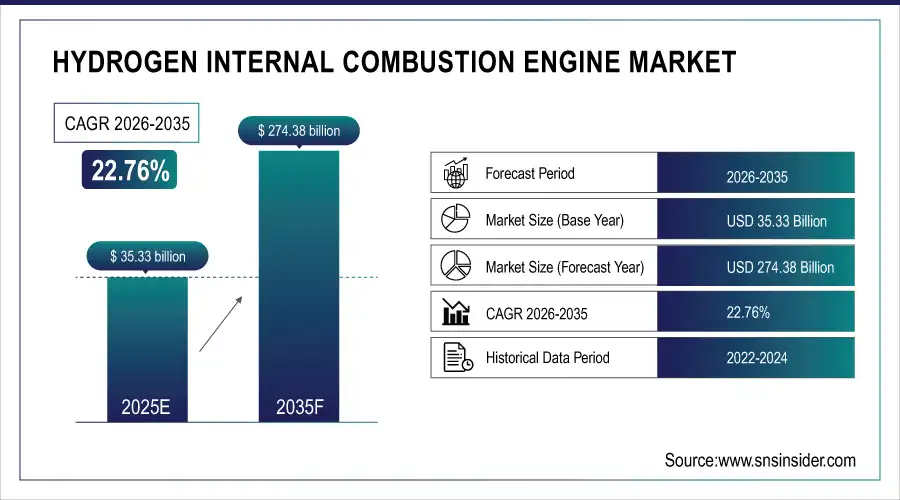
The global Hydrogen Internal Combustion Engine Market is entering a period of rapid expansion as industries seek scalable pathways to lower emissions without abandoning established engine technologies. According to a recent study by SNS Insider, the Hydrogen Internal Combustion Engine Market size valued at USD 35.33 billion in 2025, is anticipated to grow to USD 274.38 billion by 2035, registering a CAGR of 22.76% over the 2026–2035 forecast period.
Rising investment in hydrogen eco-systems and rising pressures to cut down carbon emissions in transport and industry operations have made way for favorable environment for deployment of hydrogen-based engines. This is due to rising efforts of manufacturers to develop such solutions which can cater to difficult applications requiring up-time and higher power.
Moreover, the market is receiving impetus owing to the establishment of hydrogen production plants, distribution channels and refueling infrastructure. Continued investment in hydrogen initiatives by both government and private sectors have led to growing adoption of hydrogen.
Hydrogen Infrastructure Expansion Creates Significant Growth Opportunities
The global move towards energy source diversification and sustainability has sparked the interest in the technologies associated with hydrogen. Specifically, hydrogen internal combustion engines have gained popularity among those organizations that look for ways to reduce emissions using known engine designs and operating techniques.
Various industrial companies, logistic firms, and fleets are considering adopting hydrogen technologies as one of the tools to achieve decarbonization. It helps increase the adoption rate of hydrogen technologies in various countries globally.
At the same time, ongoing advancements in combustion optimization, fuel delivery systems, and engine efficiency are improving performance while supporting regulatory compliance objectives.
Key Market Insights Highlight Shifting Demand Patterns
In terms of engine type, hydrogen-only engines are anticipated to contribute to 61% of market revenue in 2025 owing to growing requirements for a low emission fuel powertrain. On the other hand, dual fuel engines are expected to show highest growth from 2025 to 2035 on account of increasing emphasis on flexibility.
On the basis of vehicle types, commercial vehicles are projected to generate 57% of revenues by 2025. There is increased interest among heavy duty transportation players to evaluate hydrogen fuel cell powered solutions that can enable long haul operations. Off highway vehicles are projected to register the fastest CAGR due to adoption of low emission solutions in construction, mining, and agricultural industries.
Based on applications, transportation is estimated to account for 54% of market revenues in 2025 owing to increasing penetration in the freight, logistics, and public transport applications. Power generation application is projected to become the fastest growing application category due to investments made in distributed energy and backup power solutions.
By end users, commercial fleet owners are projected to account for 59% of market revenues in 2025 due to rising adoption of sustainable fleet solutions. Energy & utilities companies are projected to record the highest growth rate until 2035 on account of increasing relevance of hydrogen in energy resilient solutions.
Heavy-Duty Mobility Applications Continue to Drive Adoption
The market activity stays focused on those segments that have some operational restrictions in using conventional electrification solutions. Industries that require operations in extended working time periods, fast refuelling, and high-load operation are considering hydrogen engines in terms of energy solutions for the future.
Hydrogen engines also show their efficiency in railway, maritime, construction, and stationary equipment markets. With increasing availability and reduction in cost, the implementation will expand into other industries as well.
The development of technological improvements for engines that increase durability, efficiency, and emissions is consistently stressed by industry stakeholders. This is expected to improve the business case for hydrogen combustion engines over the next ten years.
Regional Markets Showcase Strong Investment Momentum
It is estimated that North America will hold a market share of 36.47% by 2025, driven by large-scale hydrogen projects, demand from industries, and investments in transport sector. Continuous involvement of engine makers and infrastructure builders is further consolidating the position of the regional market.
Asia-Pacific is estimated to have the highest growth rate among the other regional markets, growing at a CAGR of 26.29% till 2035. Industrialization and hydrogen projects initiated by governments, along with investments in energy transition projects, are fueling the regional market demand.
Countries across the region are expanding hydrogen production capacity and strengthening supply chains, creating favorable conditions for future market growth.
Industry Participants Focus on Commercialization and Technology Development
Competition within the hydrogen internal combustion engine market is intensifying as manufacturers accelerate product innovation and strategic partnerships. Companies are investing in advanced combustion systems, hydrogen injection technologies, emission control solutions, and application-specific engine platforms designed to meet evolving customer requirements.
Key companies operating in the global Hydrogen Internal Combustion Engine Market include Cummins Inc., Toyota Motor Corporation, Robert Bosch GmbH, Yamaha Motor Co. Ltd., JCB, Deutz AG, Rolls-Royce plc (MTU Engines), MAN Truck & Bus, Caterpillar Inc., Punch Hydrocells, Ashok Leyland, Liebherr Group, Volvo Group, PACCAR Inc., Hyundai Motor Company, Keyou GmbH, Westport Fuel Systems, AVL List GmbH, Garrett Motion Inc., and Landi Renzo S.p.A.
An SNS Insider analyst Santosh Bhul commented, “The market is benefiting from the convergence of decarbonization goals, hydrogen infrastructure investments, and growing demand for practical low-emission solutions in heavy-duty applications. Companies that successfully improve engine efficiency, expand commercialization efforts, and align with evolving hydrogen ecosystems are expected to capture significant growth opportunities over the next decade.”
About the Author

Get in touch




