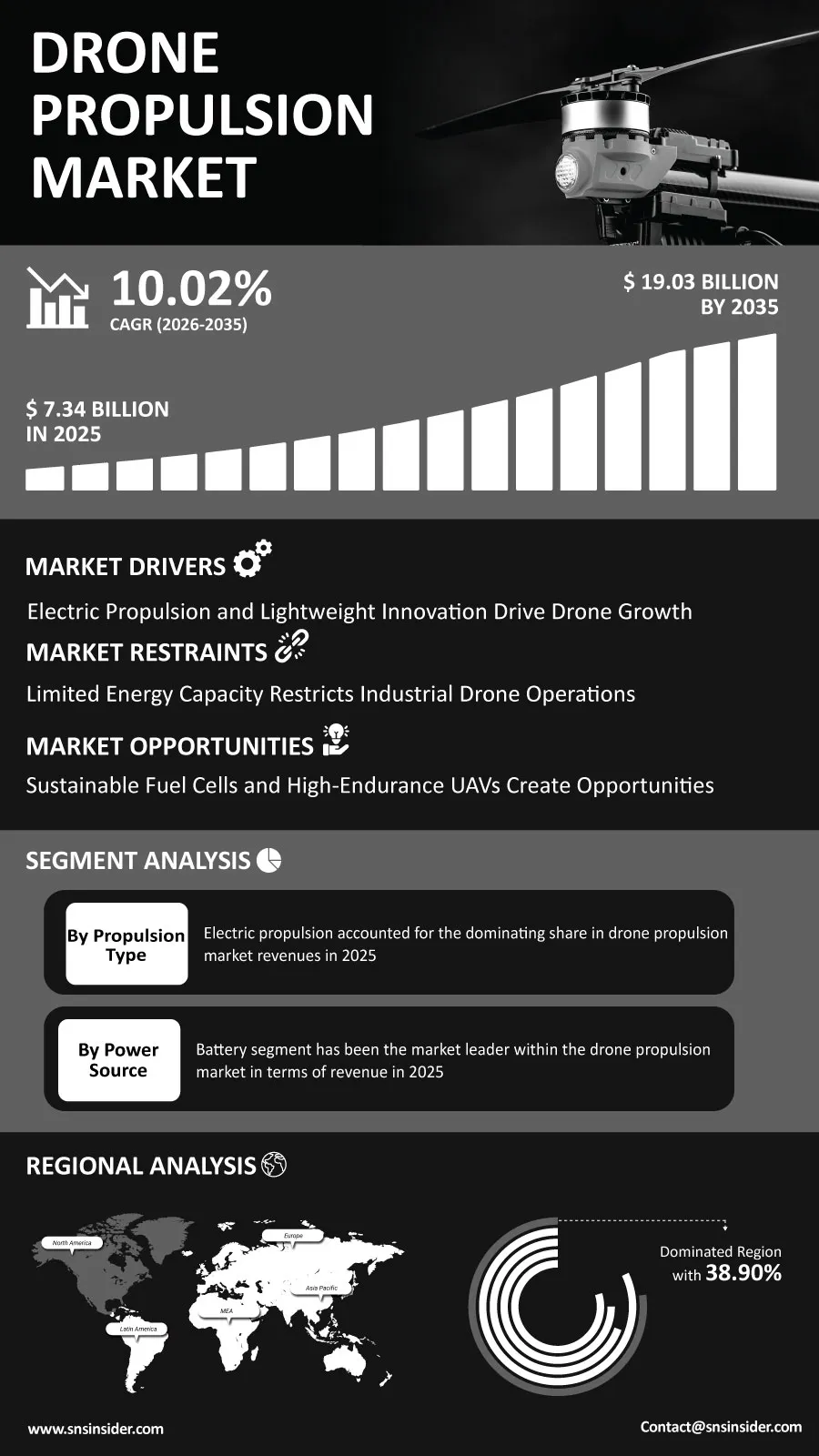
The Drone Propulsion Market is rapidly accelerating globally as unmanned aerial systems are used to perform a range of operations for defense, commercial and industrial applications. “According to a recent study by SNS Insider, the global Drone Propulsion Market size valued at USD 7.34 Billion in 2025, is anticipated to grow to USD 19.03 Billion by 2035, registering a CAGR of 10.02% over the 2026–2035 forecast period.”
The growing use of drones in logistics, infrastructure monitoring, agriculture, emergency service and security applications has led to a strong demand for efficient propulsion technologies. Manufacturers are developing motor systems and energy solutions, fleecing lightweight propulsion architectures as drone operators ask for expanded operational majority without compromising on weight, payload capacity or reliability.
The swift move to sustainable aviation is also impacting product development strategies. Electric propulsion platforms are receiving broad market acceptance as efficient operational and lower maintenance devices and while new hydrogen-based systems are emerging today they have the potential to serve key applications that require long endurance and cleaner burning more sustainable performance.
To Get Detailed Insights on the Drone Propulsion Market – Request a Sample Report
Advanced Unmanned Systems Create New Growth Opportunities
Increasing applications of commercial and defense drones is creating lucrative opportunities for propulsion technology providers globally. With rising adoption of unmanned platforms for activities like asset inspection, precision agriculture surveillance, mapping and delivery services, demand for propulsion systems that can perform efficiently irrespective of working situations is high among organizations.
Growing defense modernization programs are also accelerating the growth of this market, as governments around the world continue to invest in new-age unmanned aircraft systems for intelligence-gathering and tactical applications. These missions demand propulsion systems that provide greater endurance, improved reliability and greater range of operational flexibility.
Alternative energy solutions development is also getting a direction from such factors providing good opportunities for the market in the future. Traditional power systems presented bottlenecks in drone missions requiring longer durations, however this gap is being filled through hydrogen fuel cells, hybrid-electric architectures and even advanced battery technologies.
Key Market Insights Highlight Technology Shifts
By propulsion type, the electric propulsion segment held a market share of 46.80% in terms of revenue for 2025 due to its widespread usage in commercial, consumer & defense drone applications. Advancements in electric motors, controllers and other critical battery technologies are all helping the segment thrive. On the contrary, hydrogen fuel cell propulsion is expected to register rapid growth till 2035 owing to low carbon emissions and growing demand for long-range aircraft operations.
In 2025, the market is segmented based on power source into battery-based systems 48.60%, as they are widely available and cost effective with compatibility to various platforms for different applications. High pressure to the 500 bar is projected to expedite growth of hydrogen segment as manufacturers prioritize high energy density solutions for long distance applications.
By drone type, the multirotor drones segment led the market with a share of 44.50% in 2025 owing to their wide application for inspection, agriculture, surveillance, and commercial purposes. The lift plus cruise segment would be the fastest growing in the forecast period, driven by demand for drones that can takeoff in a vertical fashion and travel long distances without having to change its geometric configuration.
Depending on the type of take-off and landing, it can be divided into a fixed wing aircraft, VTOL and STOL System. The revenue share for VTOL system was about 51.80 % in 2025 This segment is anticipated to grow at a high CAGR during the forecast period from 2030–2035. Their capacity to operate without traditional runways, makes them uniquely positioned for use in urban environments, emergency response and industrial missions.
Propulsion Innovation Accelerates Drone Industry Transformation
Ever more powerful propulsion engineering is making modern unmanned aerial platforms reach new capabilities. Using advanced materials and intelligent control technologies, manufacturers are working to reduce system weight, increase energy efficiency, and improve the reliability of flight.
Artificial intelligence, automated flight systems and digital monitoring tools are showing mixed results toward allowing drones to accomplish more elaborate missions with less human intervention. Such advances are driving the industries towards unmanned solutions for applications that need precision and safety, as well as operational optimization.
Hydrogen powered propulsion is seen as a technology that could potentially be used for drone processes in the future, especially as those are required to have a longer range and less emissions. Funding directed at more efficient lightweight fuel cells, storage systems such as tanks or batteries, and smart management of energy is likely to hasten the pace of commercialization.
North America Accounted for 38.90% Market Share in 2025; Asia Pacific Forecast to Expand at an 11.68% CAGR by 2035
North America held a 38.90% share of global drone propulsion market revenue in 2025, bolstered by its aerospace capacities, defense spending and growing commercial drone proliferation. The United States remains the dominant producer as applications of unmanned aircraft systems continue to expand throughout military, logistics, agriculture and infrastructure usage.
Asia Pacific is expected to grow at the fastest CAGR of 11.68% over the forecast period as a result of growing drone manufacturing activity, industrial automation, and government support for unmanned aviation technologies through 2035. More governments, including China and India, Japan and South Korea are adopting in agriculture, by all means of delivery service and surveillance operation.
Sustainability efforts, aerospace technology innovation initiatives and legislation are stimulating the development of more advanced propulsion systems and Europe is also slowly establishing a market. On the other hand, Latin America and the Middle East & Africa are progressively growing owing to increasing demand for drones in energy, mining, agriculture, and security applications.
Industry Participants Focus on Next-Generation Propulsion Solutions
The drone propulsion market is quite competitive with companies investing in advanced motors, energy-efficient power system and sustainable propulsion technologies. With increasing demands for extended endurance, better payload capability, and autopilots aerial operations, market players are enhancing research and development capabilities.
Key companies operating in the global Drone Propulsion Market include Honeywell International Inc., RTX Corporation, Safran S.A., Rolls-Royce plc, T-Motor Technology Co., Ltd., KDE Direct LLC, H3X Technologies, Inc., Maxon Group, Faulhaber Group, Plettenberg Elektromotoren GmbH, MAD Components Co., Ltd. (MAD Motors), Nidec Corporation, Emrax d.o.o., LaunchPoint Electric Propulsion Solutions, Inc., UAV Propulsion Tech Ltd., Rotron Aerospace, MagLev Aero Inc., Hacker Motor GmbH, Foxtech Technology Co., Ltd., and Northwest UAV Inc.
An SNS Insider analyst Santosh Bhul commented, “The growing adoption of autonomous aerial systems across commercial and defense sectors is accelerating demand for advanced propulsion technologies. Companies investing in electric, hybrid, and hydrogen-powered solutions will play a crucial role in enabling the next generation of efficient, sustainable, and long-endurance drone operations.”
About the Author

Get in touch