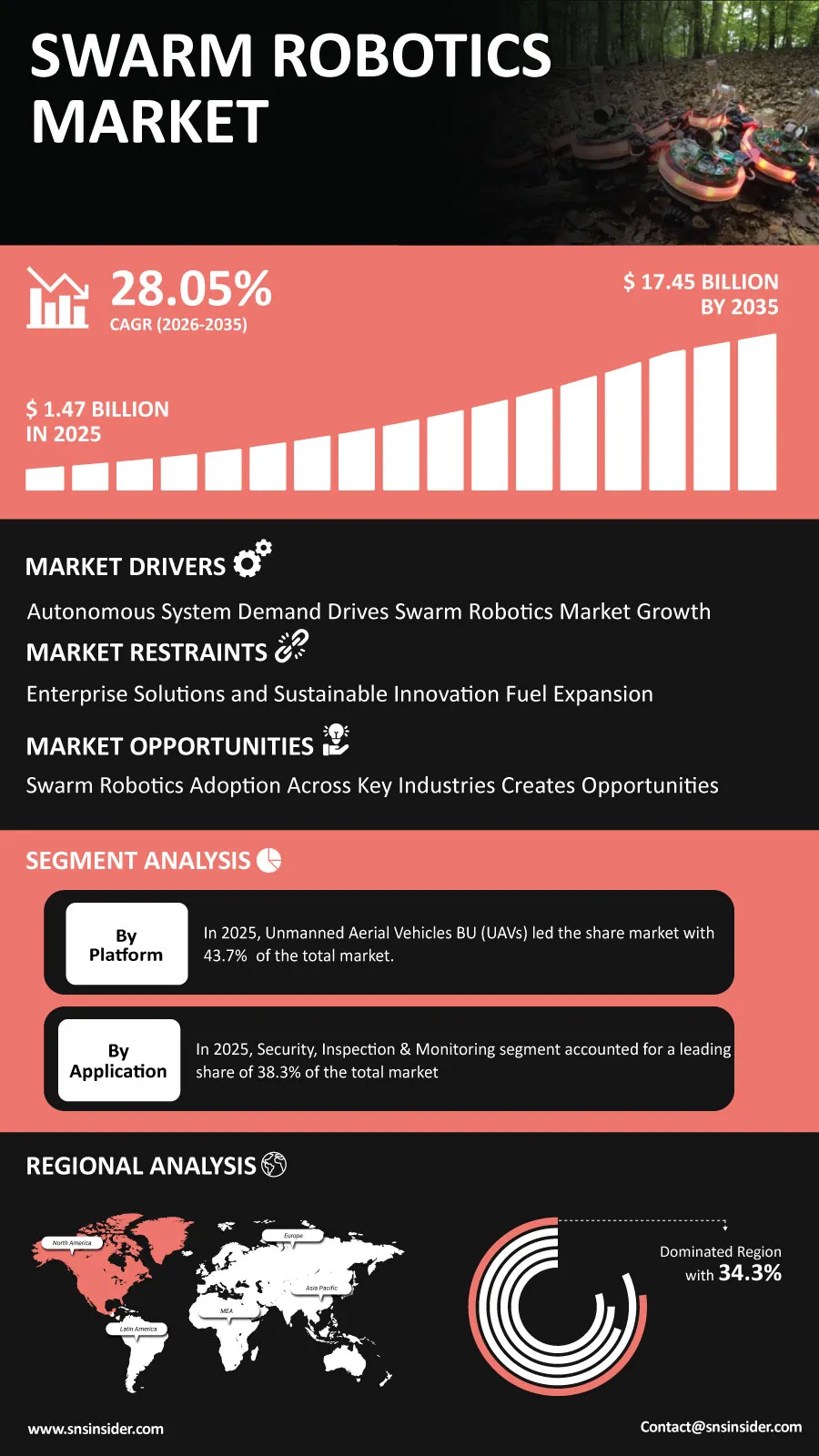
The global Swarm Robotics Market is experiencing significant growth due to the growing demand from various sectors for the use of automated devices to complete challenging tasks. According to a recent study by SNS Insider, the global Swarm Robotics Market size valued at USD 1.47 billion in 2025, is anticipated to grow to USD 17.45 billion by 2035, registering a CAGR of 28.05% over the 2026–2035 forecast period.
Advancements in areas, such as artificial intelligence, machine learning, self-navigation, sensors and machine-to-machine communication have significantly enhanced the ability of robotic swarms to perform cooperatively without much human involvement. This has created new business potential in sectors such as industrial automation, logistics, agriculture, inspection, disaster response among others that would require the use of distributed robotics.
The market is also witnessing benefits due to increased investment in autonomous systems research. Companies are considering swarm systems due to the fact that several small machines working together can complete tasks that might be challenging or uneconomical for one big system.
To Get Detailed Insights on the Swarm Robotics Market – Request a Sample Report
Autonomous Coordination Creates New Growth Opportunities
The move towards decentralized automation is making a positive environment for swarm robotics implementation. In contrast to the centralized approach where the control is exercised by the controller, robotic units operating together can distribute workloads, communicate, adjust to changing circumstances, and keep working despite the failure of individual units.
The use of these possibilities is already being studied by manufacturing and logistics firms for the optimization of warehouse navigation, inspection, inventory, and material handling. The agricultural sector can be another field, where the use of swarm robots can bring positive changes in crop inspection, precision application of chemicals, and field mapping, among others.
Advances in edge computing and wireless communication are further strengthening the technology ecosystem by enabling faster processing and coordination closer to the point of operation.
Key Market Insights Highlight Shifting Demand Patterns
By platform, unmanned aerial vehicles (UAVs) segment accounted for 43.7% in 2025 owing to application of such devices in applications such as surveillance, inspection, environmental monitoring, disaster management and wide area sensing. UGVs are expected to experience high growth rate until 2035 on account of growing demand for autonomous devices in applications such as industrial facilities, agriculture, military and search & rescue missions.
Based on application, segment of security, inspection, and monitoring accounted for roughly 38.3% of market revenues in 2025. The growth of this segment is being driven by the growing use of autonomous systems for observation, monitoring, inspection and situation awareness of infrastructure. The mapping and surveying segment is anticipated to witness the fastest growth owing to increasing demand for automation of spatial data in constructions and mines.
By end use, military and defense sectors were predicted to constitute about 42.8% of the market share in 2025 due to heavy investments in autonomous surveillance and reconnaissance systems. It is believed that the sector of agriculture will record the highest growth rate up to 2035 owing to the adoption of robotic systems by agriculturalists.
AI and Distributed Intelligence Reshape Robotic Automation
In swarm robotics, research is rapidly shifting from its experimental use because of innovations in artificial intelligence that allow for the interpretation of the environment, task allocation, and behavioral modification by robots. Advancements in sensor technology, wireless technology, and autonomous navigation have made robots capable of performing more reliably.
This technology has been shown to be especially useful in applications that involve large coverage areas that need to be rapidly covered, or environments where sudden changes in conditions might occur. Examples of applications that could benefit include disaster management, industrial inspections, and infrastructure assessments.
North America Holds 34.3% Autonomous Robotics Market Share in 2025 as Asia Pacific Emerges as the Fastest-Growing Region
North America will maintain its position as the leading regional market with 34.3% of global revenue generation by 2025. High investments in defense systems, industrial automation, logistics, agriculture, and research in autonomous robots are driving the regional market demand. The U.S. remains at the core of the matter due to high R&D operations and existence of robotics and artificial intelligence businesses.
The Asia Pacific region will show the highest growth rate from 2018 until 2035 due to growing manufacturing sector, defense modernization, warehouse automation, and adoption of agricultural technologies. High investments made by China, Japan, South Korea, India, and others are developing the regional market environment.
Industry Participants Focus on Intelligent Swarm Platforms
The competitive landscape is evolving as robotics companies, AI developers, drone manufacturers, and industrial automation providers invest in coordinated autonomous platforms. Strategic collaborations, research programs, and improvements in perception, navigation, communication, and energy efficiency are expected to accelerate commercialization.
Key companies operating in the global Swarm Robotics Market include Boston Dynamics, Universal Robots, Anduril Industries, TOSY Robotics, Swarm Technology, KUKA Robotics, Clearpath Robotics, DJI Innovations, iRobot Corporation, FANUC, ABB Robotics, Blue Ocean Robotics, Parrot Drones, Roboteam, Opteran, Amazon Robotics, NVIDIA, Autonomous Solutions Inc., DroneSwarm, and Fetch Robotics.
An SNS Insider analyst Sushant Kadam commented, “The rapid convergence of artificial intelligence, autonomous navigation, and distributed communication is creating a powerful foundation for swarm robotics. As organizations seek scalable automation capable of adapting to complex operating environments, developers that improve coordination, energy efficiency, reliability, and interoperability will be well positioned to capture emerging opportunities.”
About the Author

Get in touch