
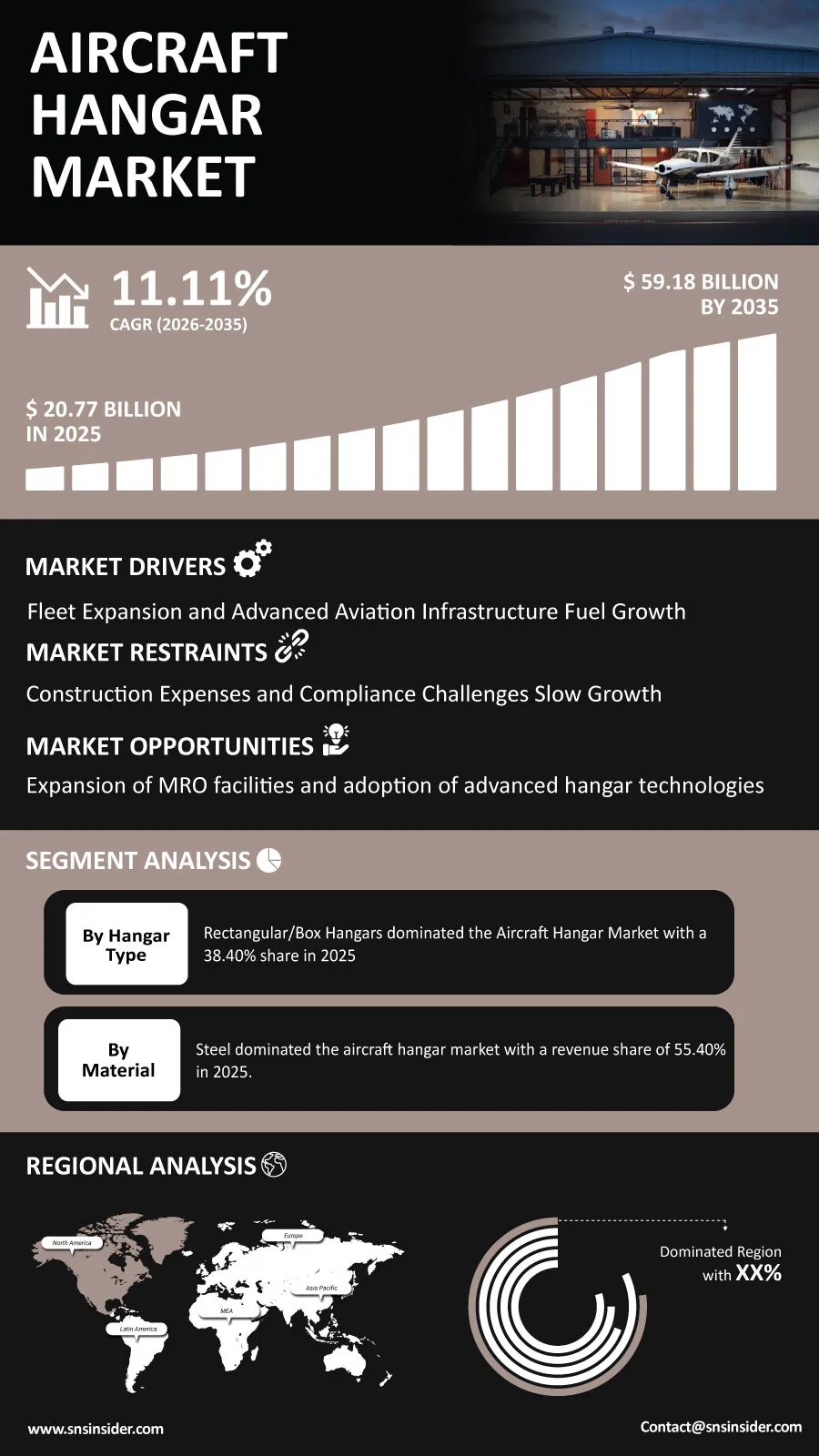
The Aircraft Hangar market on a global level is experiencing strong momentum as aviation companies, airports and defense departments are investing in state-of-the-art infrastructure facilities due to growing aircraft fleet and maintenance requirements. “According to a recent study by SNS Insider, the global Aircraft Hangar Market size valued at USD 20.77 Billion in 2025, is anticipated to grow to USD 59.18 Billion by 2035, registering a CAGR of 11.11% over the 2026–2035 forecast period.”
The fast rebound of commercial aviation, an uptick in aircraft deliveries, and the growing need for maintenance repair & overhaul (MRO) services are overall driving investments into aeronautical infrastructure sectors. Airlines and airport authorities are working on the design, construction and maintenance of efficient storage and servicing facilities that will be able to handle existing next-generation aircraft models while improving operational efficiency.
In addition to the existing demand for bespoke hangar solutions, growing defense aviation programs, ownership of private aircraft and increasing drone operations also generate other potential places. Modular structures, digital monitoring platforms and sustainable construction approaches are collectively changing the way traditional aviation facilities work into smarter more adaptive infrastructure assets.
To Get Detailed Insights on the Aircraft Hangar Market – Request a Sample Report
Aviation Expansion and MRO Investments Create New Growth Opportunities
With the continuous growth of global air transportation, airports and aviation companies are increasingly motivated to invest in new hangar capacity. The increasing airline volumes, growth of the base of airlines and better utilization rates for aircraft are leading to a higher need for storage solutions and support facilities.
Airlines have been outsourcing more of their aircraft maintenance activities to specialist MRO service providers, which are rapidly emerging as a newer and notable growth driver. A constant need to minimize aircraft holding times and enhance fleet readiness rates has led to investments in new-age hangar setups containing state-of-the-art repair & inspection facilities.
Flexible construction models are also being in greater demand by the aviation industry. Faster installation timelines, lower construction complexity and potential facility expansion in light of future needs is prompting the use of modular and pre-engineered hangars. Such solutions may be especially useful for regional airports, military operations and private aviation facilities.
Key Market Insights Highlight Shifting Infrastructure Demand
Box Hangars dominated the hangar type segment of the global aircraft hanger market, accounting for 38.40% in terms of revenue in 2025 due to their ability to hold more than one aircraft category and allow large volume maintenance work. Due to their fast deployment and operational flexibility, aircraft hangars/inflatable hangars are anticipated to register the highest growth through 2035.
Based on construction type, Pre-Engineered Buildings (PEB) accounted for 34.60% in the market share in 2025 with aviation operators preferring long-lasting and cost-effective structural solutions. Modular Hangars are expected to see the highest growth over the forecast period, with a 13.77% CAGR, owing to growing requirement for scalable aviation infrastructure.
Steel leading with a 55.40% market share in 2025 due to its robustness, wear resistance, and large form factor austerity; therefore, no other material can be expected as this one. On the other hand, growth in adoption of Architectural Fabric Membranes is owing to its light weight properties, energy efficient features and fast installing benefits.
Based on end user, Airlines & Airport Authorities accounted for the highest market share with 36.80% shares in 2025, whereas MRO Service Providers will witness strong growth along with rise in outsourcing of aircraft maintenance activities. In 2025, according to applications, Commercial Aviation accounted for around 48.70% of revenues respectively; whereas rapid growth in UAV & Drone Operations market is also anticipated as unmanned aviation technologies became widely adopted.
Smart Technologies and Sustainable Designs Transform Hangar Infrastructure
Aircraft hangar development is facing increasing pressures as automation, digital solutions and green building practices continue to shape how buildings are constructed. Through worldwide IoT-enabled monitoring systems, automated facility management platforms, and predictive maintenance technologies among others, operators can enhance safety in their operations, improve resource utilization with very low operational cost.
Another huge trend in sustainable aviation is the development of a green aviation infrastructure, to which organizations are converting buildings to energy-efficient designs and facilities powered by solar panels as well as advanced insulation technologies. These breakthroughs are enabling aviation stakeholders to mitigate environmental impacts and improve FBOs long-term performance.
Aircraft design will change as technologies advance, and hangars of the future will have to adapt by being more flexible in accommodating electric aircraft, unmanned systems, even sophisticated maintenance equipment and changing operational requirements.
North America Accounted for the Largest Market Share in 2025; Asia Pacific Forecast to Expand at the Fastest CAGR by 2035
North america was recognised as the leading region in generating a large revenue share to the global Aircraft Hangar Market in 2025 due to strong MRO networks, established aviation infrastructure and high defence and commercial aviation activities. The US is the leading contributor within the region as one of the major consumption countries driven by a growing demand for aircraft maintenance, fleet modernization programs and investments in advanced aviation infrastructure.
The report forecasted Asia Pacific will continue to post the fastest growth through 2035, spearheaded by increasing air passenger traffic propelled by expanding fleets and large-scale airport development. It has to compete with the likes of China and India, which are investing heavily in aviation infrastructure for international and domestic connectivity.
European market presence is also sustaining as a result of an advanced aerospace ecosystem, with aircraft manufacturing capabilities and established maintenance networks. At the same time, Latin America and Middle East & Africa are slowly growing on rising airport modernization projects, increase in demand for cargo aviation along with growing investment in defense aviation.
Industry Participants Focus on Advanced Aviation Infrastructure Solutions
The Aircraft Hangar Market has competitive dynamic landscape but companies are trying to innovate buildings construction techniques, digital facility solutions, sustainable aviation infrastructure. Key market players are expanding their foothold by entering into partnerships, expansion projects as well as investing in next-generation hangars.
Key companies operating in the global Aircraft Hangar Market include ABM Industries Incorporated, AAR Corp., AECOM, Airbus S.A.S., AMAC Aerospace AG, Boeing Global Services, Corgan Associates, Inc., Daher Aerospace, Gulfstream Aerospace Corporation, Hensel Phelps Construction Co., Liebherr Aerospace, Lockheed Martin Corporation, MRO Holdings, Rubb Buildings Ltd., StandardAero, Stellar Aviation Group, Turner Construction Company, Vinci Construction, Walbridge, and Willis Lease Finance Corporation (WLFC).
An SNS Insider analyst Santosh Bhul commented, “The expansion of global aviation fleets, increasing MRO requirements, and modernization of airport infrastructure are creating sustained demand for advanced aircraft hangar solutions. Companies investing in modular construction, smart technologies, and sustainable aviation facilities will be positioned to capture emerging opportunities as the aviation ecosystem continues to evolve.”
About the Author

Get in touch




