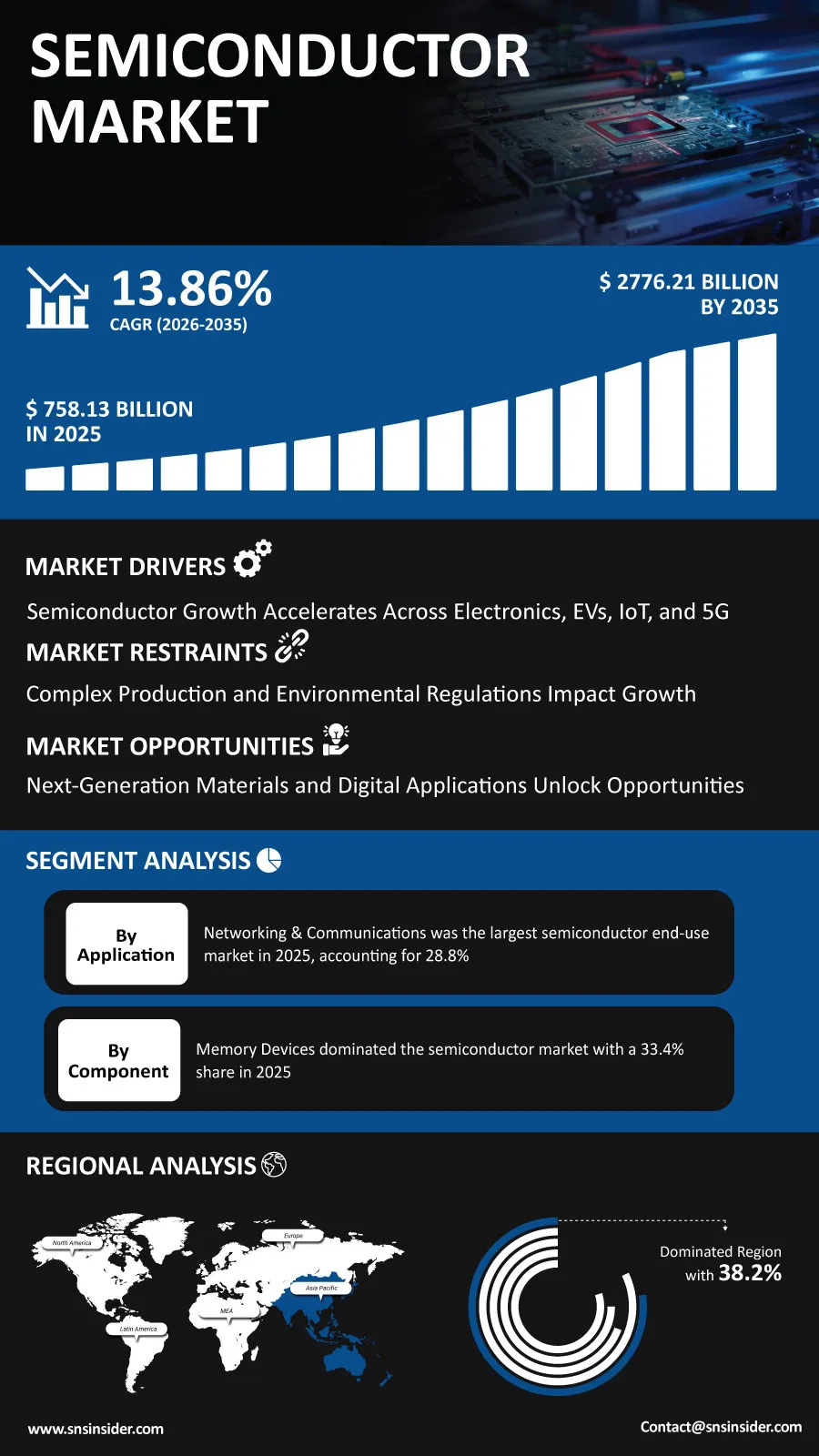
The global Semiconductor Market is entering a period of accelerated expansion as artificial intelligence, connected devices, advanced computing, electric mobility, and next-generation communications increase demand for high-performance chips. According to a recent study by SNS Insider, the global Semiconductor Market size valued at USD 758.13 billion in 2025, is anticipated to grow to USD 2776.21 billion by 2035, registering a CAGR of 13.86% over the 2026–2035 forecast period.
In response to the rising demand for chips, semiconductor companies are enhancing their capacity, technology, and design processes. The demand for semiconductors is no longer just in data centers but has become diversified in other sectors including smartphones, industrial machinery, automobiles, communication systems, and consumer devices.
The semiconductor market is also going through a big geographical and strategic transformation. Countries and tech companies are trying to secure domestic chip production, and producers themselves are enhancing their logistics and advanced packaging and manufacturing facilities.
To Get Detailed Insights on the Semiconductor Market – Request a Sample Report
AI Infrastructure and Digital Transformation Create New Growth Opportunities
One of the other factors that is fast proving to be a significant contributor to semiconductor demand is the proliferation of artificial intelligence technology. The need to process more information and maintain optimal control of energy and heat dissipation in AI systems will drive demand for faster processors, memory, networking chips, and accelerators utilized in data centers.
Another area of growth that holds significant promise is the automotive sector. Electrification, automation, autonomous driving, ADAS systems, digital cockpits, and connected car platforms have led to increased semiconductor content per vehicle. The automotive semiconductor chip companies have been compelled to come up with dedicated chips for power management, sensing, connectivity, and computing in vehicles.
Moreover, advanced materials like silicon carbide and gallium nitride are providing opportunities to efficiently convert power in electric cars, renewable energy systems, and high-tech electronics.
Key Market Insights Highlight Shifting Demand Patterns
By application, networking and communication sector represented 28.8% of revenue share in the worldwide semiconductor market in 2025 owing to the growth in 5G infrastructures, increasing data usage, and investments in data centers. The automotive sector is estimated to experience rapid growth up until 2035 because of advancements in electric and software-defined cars.
Based on component, market share of memory devices stood at 33.4% in 2025, and they are also anticipated to grow at the highest rate during the forecast period. The growing need for high computing performance, artificial intelligence, cloud infrastructure, and digital storage is driving the demand for DRAM and NAND memory technologies, and new memory technologies offer more possibilities.
Advanced Manufacturing Reshapes Semiconductor Industry Priorities
The move towards small process nodes is driving heavy investments in fabrication equipment, process control, advanced packaging, and yield optimization. In addition, chip design companies are increasingly concerned about improving their products' energy efficiency owing to increased processing workloads.
Another trend that is emerging is that of supply chain localization. Chip manufacturers and governments are creating capacity in key areas for manufacturing semiconductors in order to minimize the impact of geopolitics on their operations and gain better access to semiconductors.
India is enhancing its footprint in the semiconductors value chain by way of making strategic investments in advanced packaging and assembly. These moves are helping build up a wider manufacturing and innovation base in the region.
Asia Pacific Leads with 38.2% Revenue Share While North America Drives Future Semiconductor Market Growth
The Asia Pacific region will continue to dominate in semiconductor markets, holding the highest share in 2025 with 38.2% in global revenue. The region will enjoy strong electronics consumption, robust manufacturing capacity and chip production capacity by many manufacturers in Taiwan, South Korea, China and Japan.
North America is set to witness the fastest growth by 2035, due to developments in AI infrastructure, cloud computing, electronics in automobiles, and policies that encourage domestic production of semiconductors. Such policies coupled with investments in plant manufacturing and advanced technology development will help to cement its dominance.
Europe is enjoying the demand for semiconductors in the automotive sector, industrial electronics, and power management sectors while Latin America and the Middle East & Africa are creating opportunities for themselves in digital infrastructure, electronics manufacturing and smart technologies.
Industry Participants Focus on Capacity Expansion and Chip Innovation
Semiconductor competition is still very volatile due to more investment being made by semiconductor companies, foundry houses, equipment makers, and chip designers in new technology. The investments are made for the development of advanced processes, high bandwidth memory, advanced packaging techniques, customized AI chips, and capacity building.
Key companies operating in the global Semiconductor Market include Intel, Samsung Electronics, TSMC, Qualcomm, NVIDIA, Broadcom, SK Hynix, Micron Technology, Texas Instruments, AMD, MediaTek, Applied Materials, ASE Technology Holding, Infineon Technologies, Sony, ON Semiconductor, NXP Semiconductors, STMicroelectronics, Renesas Electronics, and Marvell Technology.
An SNS Insider analyst Sushant Kadam commented, “Artificial intelligence, automotive electrification, advanced connectivity, and data-center expansion are creating a powerful demand cycle for semiconductors. At the same time, localization and capacity investments are reshaping the global supply network, positioning manufacturers with advanced process technologies, resilient production capabilities, and energy-efficient solutions for sustained long-term growth.”
About the Author

Get in touch