
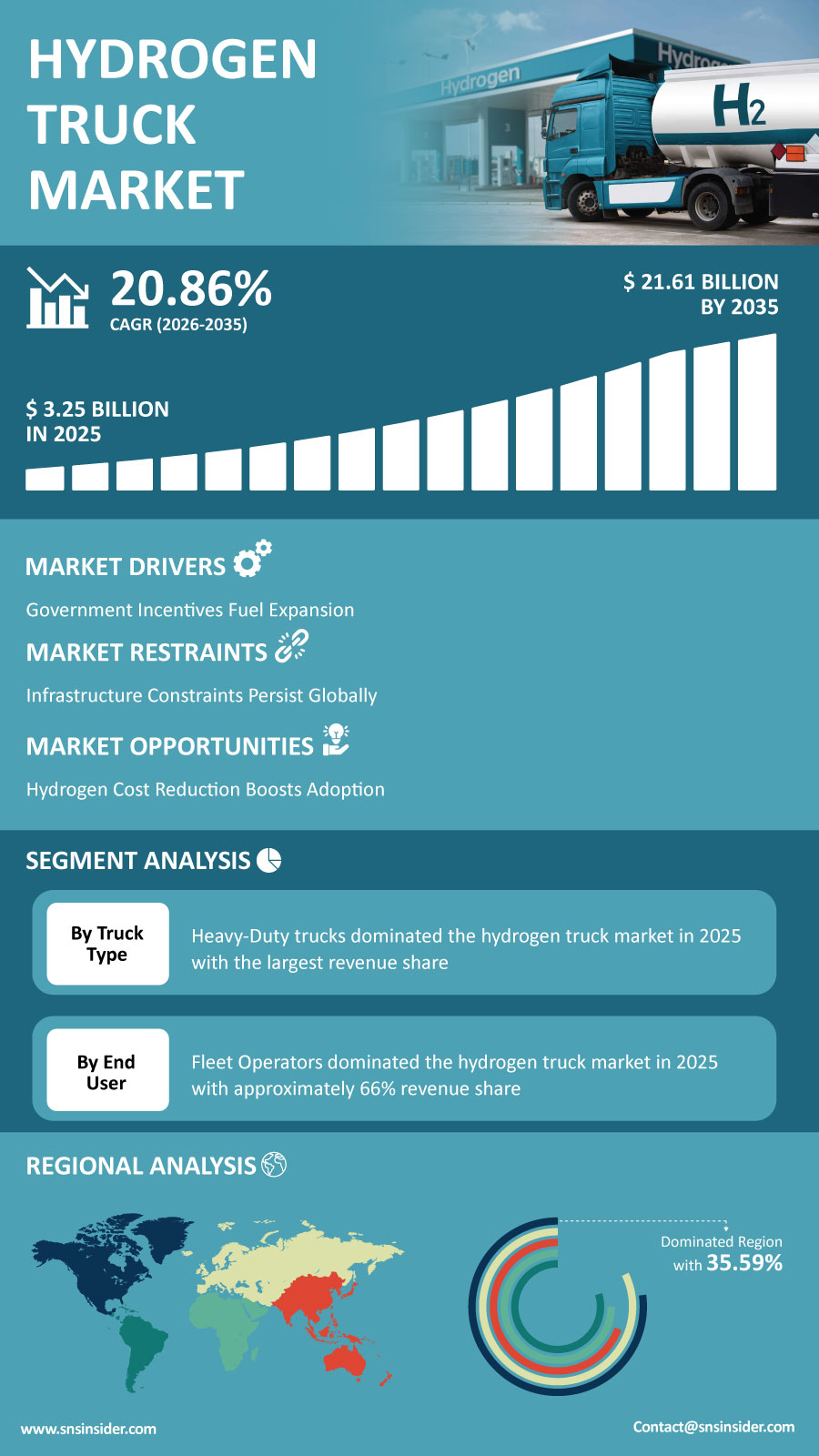
The global Hydrogen Truck Market is entering a transformative phase as transportation companies, governments, and vehicle manufacturers accelerate efforts toward cleaner freight mobility solutions. The rising focus on reducing carbon emissions from heavy-duty transportation is encouraging the adoption of hydrogen-powered commercial vehicles, particularly for long-distance logistics operations where performance, refuelling speed, and operational efficiency remain critical priorities. “According to a recent study by SNS Insider, the global Hydrogen Truck Market size valued at USD 3.25 billion in 2025, is anticipated to grow to USD 21.61 billion by 2035, registering a CAGR of 20.86% over the 2026–2035 forecast period.”
With increasing efforts towards the adoption of zero-emission freight transport, fleets have started looking for solutions other than those that use traditional diesel trucks. The hydrogen fuel cell technology, with its ability to offer increased driving range and fast refueling options, among others, has started gaining popularity as a solution for heavy duty applications.
Hydrogen truck makers are also diversifying their offerings in the commercial sector with advancements in their fuel cell technology, vehicle design, and partnerships with logistics firms. This is aiding in building a better environment for the use of hydrogen trucks in logistics operations.
To Get Detailed Insights on the Hydrogen Truck Market – Request a Sample Report
Hydrogen Infrastructure Expansion Creates New Growth Opportunities
The emergence of refuelling networks for hydrogen has now become one of the most important aspects that will affect the use of hydrogen trucks. The governments and energy corporations are building the production plants and hydrogen fuelling stations in order to solve infrastructure issues.
Furthermore, the availability of green hydrogen generated using the energy from renewable resources has led to additional chances for sustainable transport. The logistics companies and big enterprises consider using hydrogen-fuelled truck fleets in order to achieve their goals concerning reduction of emissions.
Finally, the improvement of the fuel cells' durability and the efficiency of the vehicles themselves, along with economies of scale during production, are contributing to decreasing operational issues related to hydrogen trucks.
Key Market Insights Highlight Shifting Adoption Patterns
Based on propulsion technology, Hydrogen Fuel Cell Electric vehicles dominated the market in 2025 due to their suitability for long-haul transportation, zero tailpipe emissions, and ability to support extended operating distances. Meanwhile, hydrogen internal combustion engine trucks are expected to witness rapid growth as manufacturers explore solutions that utilize existing engine manufacturing capabilities.
By truck type, heavy-duty trucks accounted for the leading market share in 2025, supported by strong demand from freight and logistics operators requiring reliable long-distance transportation solutions. Medium-duty hydrogen trucks are projected to grow significantly as businesses adopt cleaner vehicles for regional distribution and commercial operations.
By application, logistics and freight represented the largest market segment in 2025 as transportation companies increasingly prioritize emission reduction strategies. Construction applications are expected to expand at a faster pace due to growing demand for high-performance zero-emission vehicles capable of operating in challenging environments.
By end user, fleet operators dominated the market with approximately 66% revenue share in 2025, driven by their ability to integrate dedicated hydrogen infrastructure and optimize vehicle utilization. Rental and leasing companies are expected to gain traction as flexible ownership models reduce upfront investment barriers for businesses.
Decarbonization Goals and Fleet Modernization Drive Industry Growth
Heavy-duty transportation remains one of the most challenging sectors to decarbonize due to demanding operational requirements. Hydrogen trucks are gaining attention as a practical solution for applications requiring high payload capacity, frequent operation, and minimal downtime.
Fleet modernization initiatives are encouraging logistics companies to evaluate hydrogen-powered alternatives as regulations on commercial vehicle emissions become stricter. The combination of government incentives, corporate sustainability goals, and technological improvements is creating a favorable environment for market expansion.
Manufacturers are also focusing on integrated solutions that combine vehicles, fuel supply, maintenance services, and digital fleet management tools. These approaches are helping simplify adoption decisions and improve the overall ownership experience for commercial users.
North America Accounted for 35.59% Market Share in 2025; Asia Pacific Forecast to Witness Strong Growth by 2035
The Hydrogen Truck Market in North America ranked as the largest market share holder in 2025, making up roughly 35.59% of total revenues of the market. The rapid development in this area is driven by favorable government incentives, zero emission vehicle rules, and increased hydrogen refueling infrastructure spending. The US maintains its position because of an increasing number of commercial hydrogen trucks and rising demands for sustainable freight transportations.
Another area of interest is Asia Pacific where growth is fueled by hydrogen mobility projects, growing ability of manufacturers to build commercial vehicles, and government-sponsored clean energy programs. Countries such as China, Japan, and South Korea create hydrogen transportation systems for future commercial applications.
Europe is developing steadily as well because of increasingly strict regulations and sustainability goals which make companies move towards heavy-duty transport technologies.
Industry Participants Focus on Hydrogen Mobility Innovation
The competitive landscape of the Hydrogen Truck Market is evolving rapidly as companies invest in vehicle development, fuel cell technology, and hydrogen ecosystem partnerships. Market participants are focusing on improving vehicle efficiency, reducing production costs, and expanding commercial deployment capabilities.
Key companies operating in the global Hydrogen Truck Market include Hyundai Motor Company, Daimler Truck AG, Volvo Group, Nikola Corporation, Hyzon Motors Inc., Toyota Motor Corporation, IVECO Group N.V., PACCAR Inc., Scania AB, MAN Truck & Bus SE, Foton Motor Co., Ltd., Dongfeng Motor Corporation, SAIC Motor Corporation, CNHTC, Weichai Power Co., Ltd., Cummins Inc., Bosch GmbH, Ballard Power Systems Inc., Loop Energy Inc., and Yutong International Holding Co., Ltd.
An SNS Insider analyst Santosh Bhul commented, “Growing regulatory pressure, expanding hydrogen infrastructure, and increasing demand for sustainable freight solutions are accelerating the adoption of hydrogen trucks. Companies that successfully combine vehicle innovation with reliable hydrogen supply networks will be well-positioned to capture future opportunities in the evolving zero-emission transportation market.”
About the Author

Get in touch




