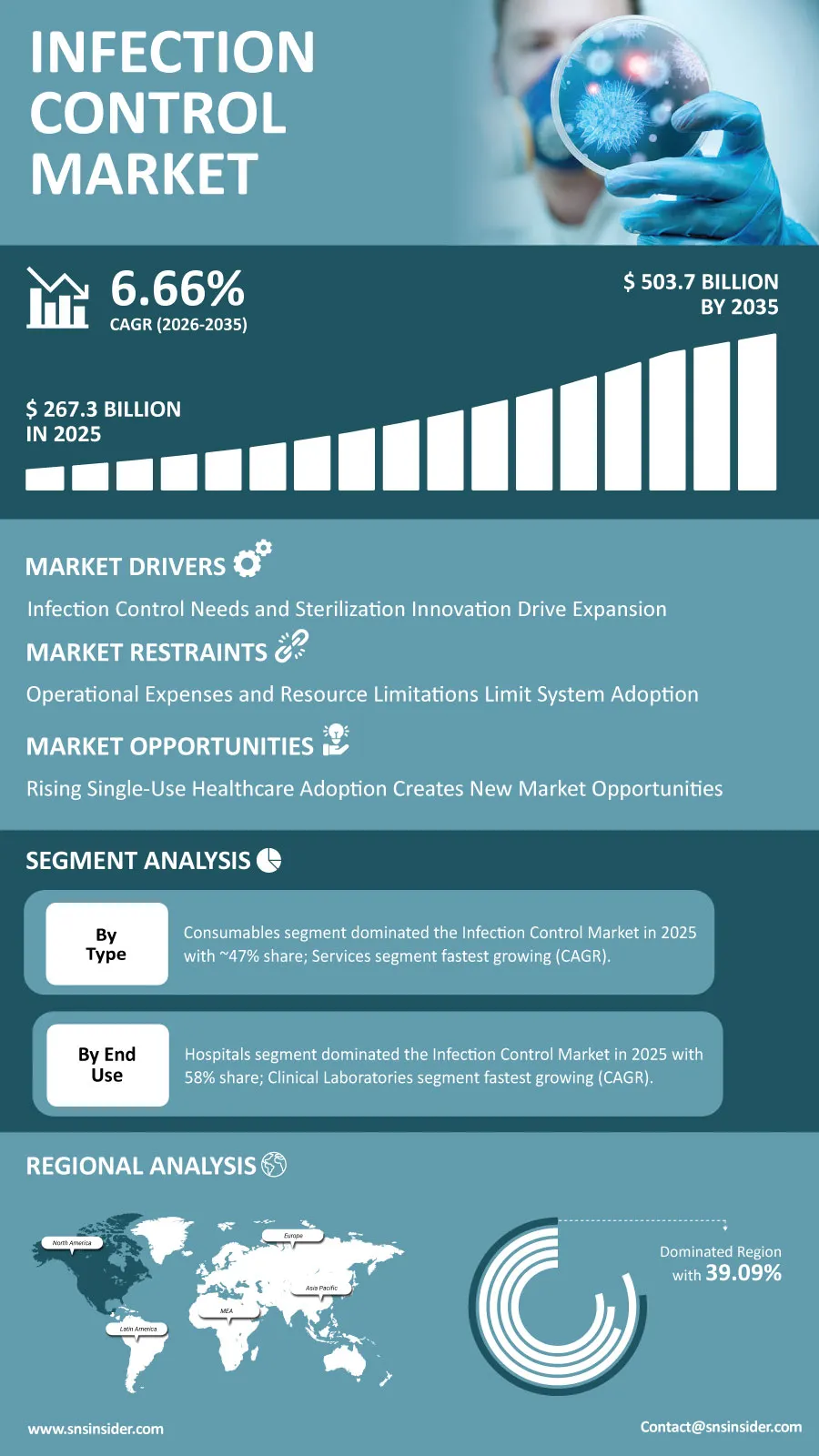
Infection Control Market is experiencing considerable traction as healthcare organizations throughout the world work on minimizing health care associated infections. Greater emphasis on hospital hygiene, better sterilization processes and compliance with regulatory requirements is driving its adoption. According to a recent study by SNS Insider, the global Infection Control Market size valued at USD 267.3 billion in 2025, is anticipated to grow to USD 503.7 billion by 2035, registering a CAGR of 6.66% over the 2026–2035 forecast period.
There is an increasing importance being placed on infection prevention measures in healthcare by providers, due to the fact that there is increased activity in surgeries, increasing infrastructure in healthcare, and increasing resistance to antimicrobials. Infection prevention methods in the current healthcare environment are becoming increasingly technologically advanced, such as automated sterilization and electronic compliance monitoring systems.
To Get Detailed Insights on the Infection Control Market – Request a Sample Report
Healthcare Facilities Accelerate Adoption of Smart Infection Prevention Technologies
The future of infection control measures is becoming more and more focused on automation, digital surveillance, and eco-friendly products. AI-enabled ultraviolet light disinfection robots, hydrogen peroxide sterilization systems, and cloud-based compliance platforms are assisting hospitals to improve their sanitization measures through automation and reduced need for human involvement.
The companies are developing sustainable disinfectants, antimicrobial surfaces, and monitoring wearables that increase the efficiency of hygiene among the hospital staff. Moreover, the growing use of disposable products is helping to prevent cross contamination and make infection prevention easier.
Market Segments Reflect Rising Demand Across Healthcare Services
By type, consumables accounted for approximately 47% of the Infection Control Market in 2025, supported by continuous demand for disinfectants, sterilization supplies, gloves, masks, gowns, and personal protective equipment used throughout healthcare settings. The services segment is projected to record the fastest growth through 2035 as healthcare providers increasingly outsource sterilization management, infection prevention consulting, compliance auditing, and professional training.
Based on end use, hospitals represented approximately 58% of global market revenue during 2025 due to their high patient volumes, complex surgical procedures, and stringent infection prevention requirements. Clinical laboratories are expected to become the fastest-growing end-user segment as diagnostic testing volumes continue expanding and laboratories invest in stronger biosafety and contamination control practices.
Digital Compliance and Sustainability Become Competitive Priorities
Infection control solutions are changing from traditional sterilization products. Organizations in the healthcare sector are focusing on smart solutions that will be able to monitor hand hygiene compliance, validate sterilization processes, and create compliance documentation digitally.
Sustainability of the environment is another critical purchase criteria. Companies are creating solutions such as biodegradable disinfectants, sustainable sterilization techniques, and sustainable disposable solutions.
Regional Markets Continue Expanding with Healthcare Investment
In 2025, North America was the largest regional market due to its advanced healthcare infrastructures, strict regulations on patient safety, and increased usage of sterilization technologies. In North America, the U.S. was responsible for nearly 79% of total revenue. The U.S. Infection Control Market size was valued at USD 67.6 billion in 2025 and is anticipated to grow up to USD 125.5 billion by 2035 at a CAGR of 6.40% during the forecast period.
The Asia Pacific region is expected to record the fastest growth rate until 2035 owing to the efforts made by the government to invest in modernizing their healthcare sector and hospitals. China generated approximately 43% of the total revenue from the region due to increasing healthcare spending and advanced technology demand.
Germany accounted for nearly 28% of total revenue in Europe due to their well-established healthcare system along with investments in the modernization of hospitals. In Latin America, Brazil generated 52% of the total revenue in the region while in the Middle East & Africa, Saudi Arabia recorded nearly 35% of total revenue.
Industry Leaders Focus on Innovation and Regulatory Compliance
Leading manufacturers continue expanding product portfolios through investments in automation, digital documentation, and advanced sterilization technologies. During 2025, STERIS plc introduced an enhanced automated endoscope reprocessor featuring real-time cycle documentation, integrated quality monitoring, and cloud-based compliance reporting. Earlier, in 2024, the company launched an upgraded vaporized hydrogen peroxide sterilization platform designed to improve efficiency against multidrug-resistant pathogens while reducing processing times.
Major companies operating in the global Infection Control Market include 3M Company, STERIS plc, Getinge AB, Belimed AG, Advanced Sterilization Products (ASP), Ecolab Inc., Cantel Medical Corp., Metrex Research, LLC, Tuttnauer Ltd., MMM Group, Steelco S.p.A., Contec Inc., Schülke & Mayr GmbH, Reckitt Benckiser Group plc, Diversey Holdings Ltd., Pal International Ltd., Sotera Health Company, Skytron LLC, Matachana Group, and Case Medical, Inc.
An SNS Insider analyst Parry Kardani commented, "Healthcare providers are increasingly viewing infection prevention as a strategic investment rather than a regulatory obligation. Organizations that integrate advanced sterilization technologies, digital compliance systems, and sustainable infection control solutions will be better positioned to address evolving clinical challenges while improving patient outcomes across global healthcare environments.
About the Author

Get in touch