
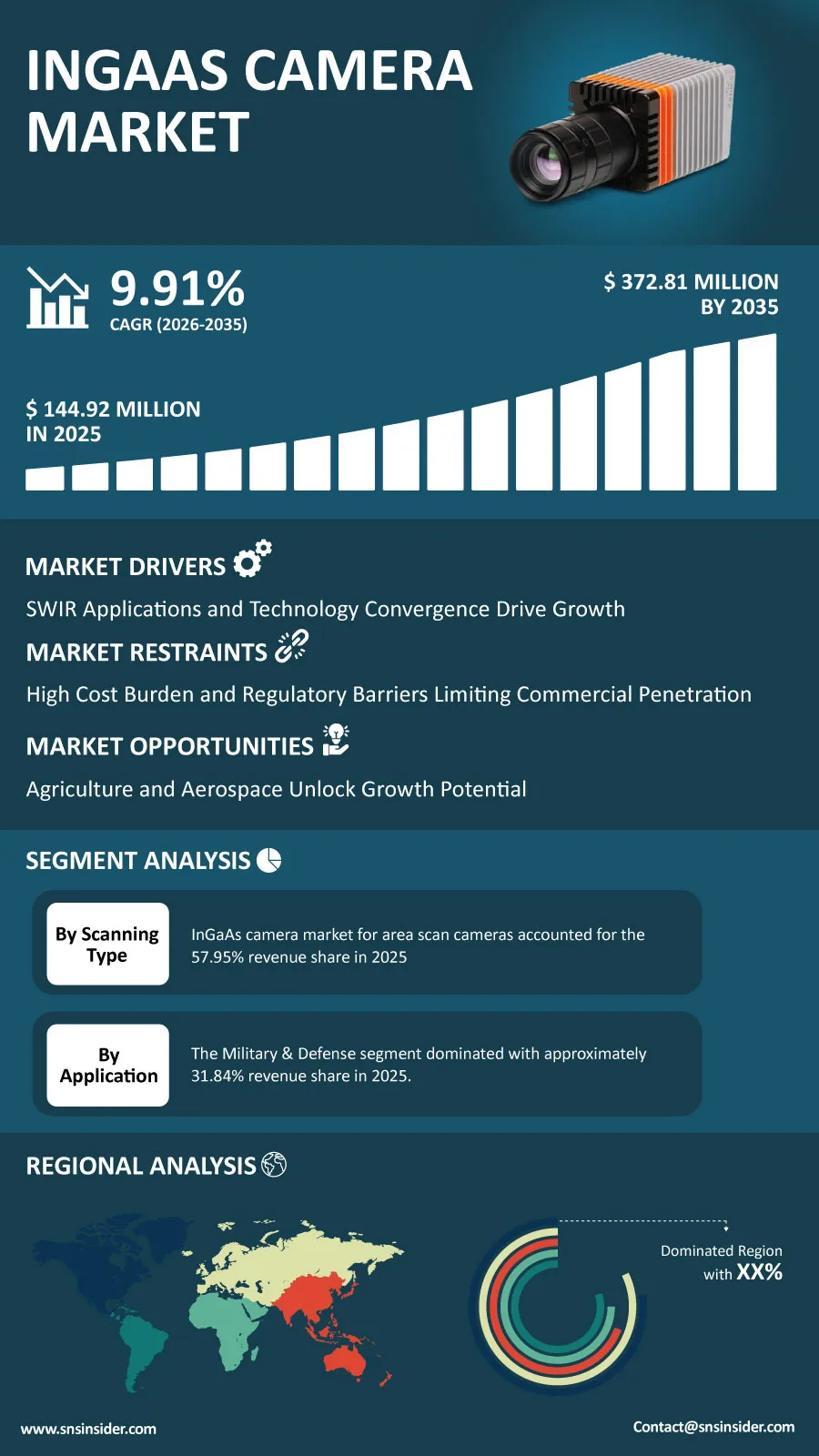
The global InGaAs Camera Market is entering a strong growth phase as demand rises for advanced short-wave infrared imaging across defense, manufacturing, scientific research, and high-precision inspection applications. According to a recent study by SNS Insider, the global InGaAs Camera Market size valued at USD 144.92 million in 2025, is anticipated to grow to USD 372.81 million by 2035, registering a CAGR of 9.91% over the 2026–2035 forecast period.
The technology has been receiving significant consideration due to its capability to obtain data from beyond the visual spectrum range and thereby allow people to determine the materials, defects and keep track of items under difficult conditions of lighting or visibility. With the rise of automation and machine vision, InGaAs cameras have become a critical part of imaging in many areas.
There have also been advancements in the development of sensors, miniature cameras, and AI-based image processing techniques, which are contributing to increased usage of SWIR imaging in semiconductor fabrication, agriculture, pharmaceuticals, food processing, and aerospace.
To Get Detailed Insights on the InGaAs Camera Market – Request a Sample Report
Uncooled SWIR Technology Opens New Commercial Growth Opportunities
The commercialization of smaller and cheaper uncooled InGaAs cameras opens up new opportunities outside of their classical applications in defense and science. Due to lower system complexity and higher portability, SWIR imaging becomes increasingly applicable for industrial inspection, agricultural sorting, and mobile monitoring solutions.
Furthermore, manufacturers equip such cameras with advanced processing technologies that enable automated recognition of defects, spectral classification, and real-time decision making. The synergy between infrared imaging and artificial intelligence will increase demand for intelligent vision systems in the Industry 4.0 environment.
In addition, miniaturized camera modules are finding applications in unmanned aerial vehicles and handheld inspection equipment, creating new deployment possibilities in infrastructure monitoring, environmental assessment, and remote sensing.
Key Market Insights Highlight Shifting Demand Patterns
By scanning type, area scan cameras segment accounted for 57.95% of global market revenue in 2025, supported by their extensive use in defense surveillance, scientific imaging, and industrial inspection. Meanwhile, line scan cameras are projected to register the fastest growth at a CAGR of 10.80% through 2035 as manufacturers increasingly require continuous imaging for conveyor-based production, web inspection, and high-speed quality control.
Based on cooling technology, cooled InGaAs cameras held around 73.88% of market revenue in 2025 due to their high sensitivity and low-noise performance in demanding scientific and defense applications. Uncooled cameras are forecast to be the fastest-growing segment, expanding at a CAGR of 11.33%, as lower-cost and compact SWIR solutions gain traction in commercial machine vision and food inspection.
In terms of application, military and defense segment was holding around 31.84% of market revenue in 2025, reflecting continued demand for night vision, surveillance, target identification, and threat detection. Industrial automation is projected to be the fastest-growing application at a CAGR of 11.01%, driven by rising adoption of automated inspection across semiconductor, electronics, pharmaceutical, and manufacturing facilities.
AI-Enabled Imaging Strengthens Industrial Inspection and Quality Control
The growing use of artificial intelligence in SWIR imaging technology is revolutionizing the way different industries detect defects and classify materials. Complex algorithms are capable of examining spectral data on a real-time basis, thus enabling companies to identify any defects which would not be visible using traditional cameras.
Manufacturers of semiconductors and electronics are implementing such technologies to ensure accuracy of their inspections. Manufacturers in the pharmaceutical industry are looking into using SWIR imaging for quality assurance purposes. The agricultural industry is also considering this technology for its products.
These applications are expected to support the transition of InGaAs cameras from specialized imaging equipment toward broader commercial and industrial vision platforms.
North America Maintains Regional Leadership While Asia Pacific Drives InGaAs Camera Market Growth
North America holds promise to stay in the front position in terms of the global InGaAs Camera Market on account of the presence of substantial defense expenditure, advanced aerospace applications, and increasing demand for high-quality industrial imaging solutions. The US continues to contribute majorly on account of growing expenditure in terms of advanced surveillance systems and semiconductor industry and research.
Asia Pacific is estimated to experience rapid growth on account of the increasing automation in industries in countries, such as China, Japan, South Korea, and India. Increasing investments in smart manufacturing and defense and electronics industry present a positive outlook for the adoption of SWIR imaging solutions.
European demand is also supported by applications in industrial automation, food inspection, pharmaceutical quality control, agriculture, and advanced security systems.
Industry Participants Focus on Sensor Innovation and Commercial Expansion
The competitive landscape remains technology-driven, with manufacturers concentrating on improving sensitivity, reducing system size, lowering costs, and expanding camera capabilities. Companies are increasingly developing solutions designed for specialized applications while pursuing broader commercialization through compact and uncooled architectures.
Key companies operating in the global InGaAs Camera Market include Teledyne FLIR, Hamamatsu Photonics K.K., Sensors Unlimited (Collins Aerospace), Xenics NV, Princeton Instruments, Allied Vision Technologies GmbH, Raptor Photonics Ltd., First Sensor AG (TE Connectivity), Jenoptik AG, New Imaging Technologies (NIT), Photon Etc., Infrared Laboratories, Inc., Lynred, SCD (SemiConductor Devices), i3system Inc., CETC (No. 44 Research Institute), Teledyne Imaging Sensors, Photonic Science Ltd., Lumenera Corporation, and Adimec Advanced Image Systems.
An SNS Insider analyst Sushant Kadam commented, “The convergence of SWIR imaging, artificial intelligence, and miniaturized sensor technology is creating new commercial pathways for InGaAs cameras. As industrial automation, semiconductor inspection, defense modernization, and precision agriculture continue advancing, companies that deliver cost-effective, compact, and application-specific imaging platforms will be well positioned to capture emerging opportunities.”
About the Author

Get in touch




