
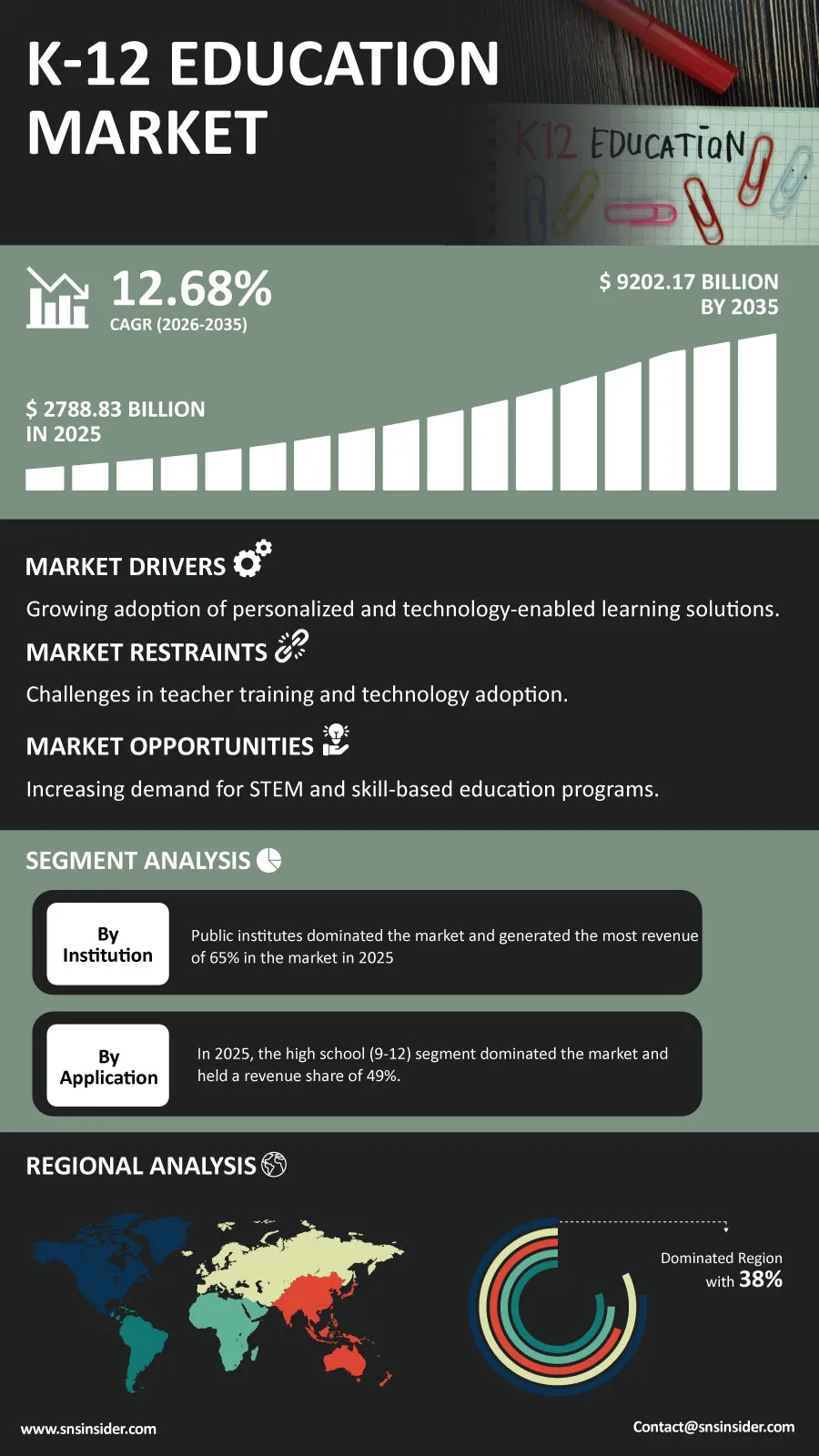
The global K-12 Education Market is entering a new phase of transformation as governments, educational institutions, and technology providers accelerate investments in modern learning ecosystems. “According to a recent study by SNS Insider, the global K-12 Education Market size valued at USD 2,788.83 billion in 2025, is anticipated to grow to USD 9,202.17 billion by 2035, registering a CAGR of 12.68% over the 2026–2035 forecast period.”
There has been an unprecedented adoption of digital strategies in the education industry aimed at boosting engagement levels, learning outcomes, and efficiency in class. Education institutions are increasingly adopting cloud-learning platforms, interactive learning materials, and AI-powered learning tools that offer personalized learning while providing teachers with innovative teaching aids.
There has been an increasing trend towards fostering future-oriented skills in classrooms such as STEM learning and digital literacy, thus changing the nature of classrooms. Investments in smart classroom, smart campuses, and curriculum innovation have presented education technology players with long-term prospects in both developed and developing markets.
To Get Detailed Insights on the K-12 Education Market – Request a Sample Report
Digital Learning Investments Create Long-Term Growth Opportunities
These educational establishments are making use of artificial intelligence, adaptive assessment solutions, and virtual collaboration solutions in their teaching processes. It allows teachers to assess the performance of the students in real time while customizing their lessons according to their learning needs.
With the increasing reach of internet connectivity and affordability of digital devices, education has been made accessible to disadvantaged areas. With hybrid models now permanently in place in many schooling institutions, there has been an increased need for learning management software, content distribution platforms, cybersecurity solutions, and classroom collaboration tools.
Key Market Insights Highlight Changing Education Priorities
Based on institution, public institutes accounted for 65% of global market revenue in 2025, supported by continued government funding, curriculum development initiatives, and broad access to affordable education. The private school segment is anticipated to register the fastest growth through 2035 as parents increasingly seek technology-enabled learning environments and specialized academic programs.
By application, high school (9–12) represented 49% of market revenue in 2025 due to strong demand for college readiness programs, vocational education, and digital learning resources. The middle school (6–8) segment is projected to expand at the highest growth rate during the forecast period, driven by increasing emphasis on STEM education and personalized learning strategies introduced at earlier academic stages.
Artificial Intelligence and Smart Classrooms Reshape Learning Experiences
Education providers are making faster use of AI-assisted tutors, intelligent content recommendations, automated marking, and prediction analytics, which will increase their learning effectiveness and lessen the administrative burden. Interactive learning platforms based on augmented reality, virtual labs, and gamified education content are also becoming popular.
The tech companies are increasingly developing all-round education platforms which integrate communication, assessment, content management, and analytics. The result is increased efficiency for schools and improved learning experience for students.
North America Held 38% of the K-12 Education Market Share in 2025; Asia Pacific Projected to Register the Fastest CAGR Through 2035
The North American region held a market share of 38% of the global market in 2025 owing to high usage of technology for education, sophisticated digital infrastructure, and huge investment in cloud-based learning platforms. North America will sustain its leadership with the ongoing modernization of the education system in both the private and public sector.
The Asia Pacific region is anticipated to experience rapid growth until 2035 owing to the constant investments made in schools' infrastructure, teachers, digitization of the education system, and reforms of the curriculum in countries such as India and China. There is a growing population of students and supportive government initiatives for technology-based education.
Europe is another region that holds strong market positions due to continuous investment in the digitalization of the education system and interactive classroom technology, whereas Latin America and the Middle East & Africa are continuously expanding education access via digital transformation.
Industry Participants Expand Digital Education Ecosystems
Leading companies are focusing on artificial intelligence, cloud-based collaboration, adaptive learning platforms, and student engagement technologies to strengthen their competitive positions. Strategic product innovation, platform integration, and partnerships with educational institutions remain key priorities as organizations respond to evolving classroom requirements.
Key companies operating in the global K-12 Education Market include Google for Education, Microsoft Education, Pearson, Apple Education, Khan Academy, Blackboard, Chegg, Duolingo, Coursera, Edmodo, Schoology, Canvas by Instructure, SMART Technologies, PowerSchool, Edmentum, Nearpod, DreamBox Learning, Newsela, Panorama Education, and ClassLink.
An SNS Insider analyst Sakshi Kale commented, "The continued convergence of artificial intelligence, cloud technologies, and personalized learning models is redefining K-12 education globally. Organizations investing in intelligent education platforms, digital content, and connected classroom solutions are expected to benefit from sustained long-term market growth as schools accelerate digital transformation."
About the Author

Get in touch




