
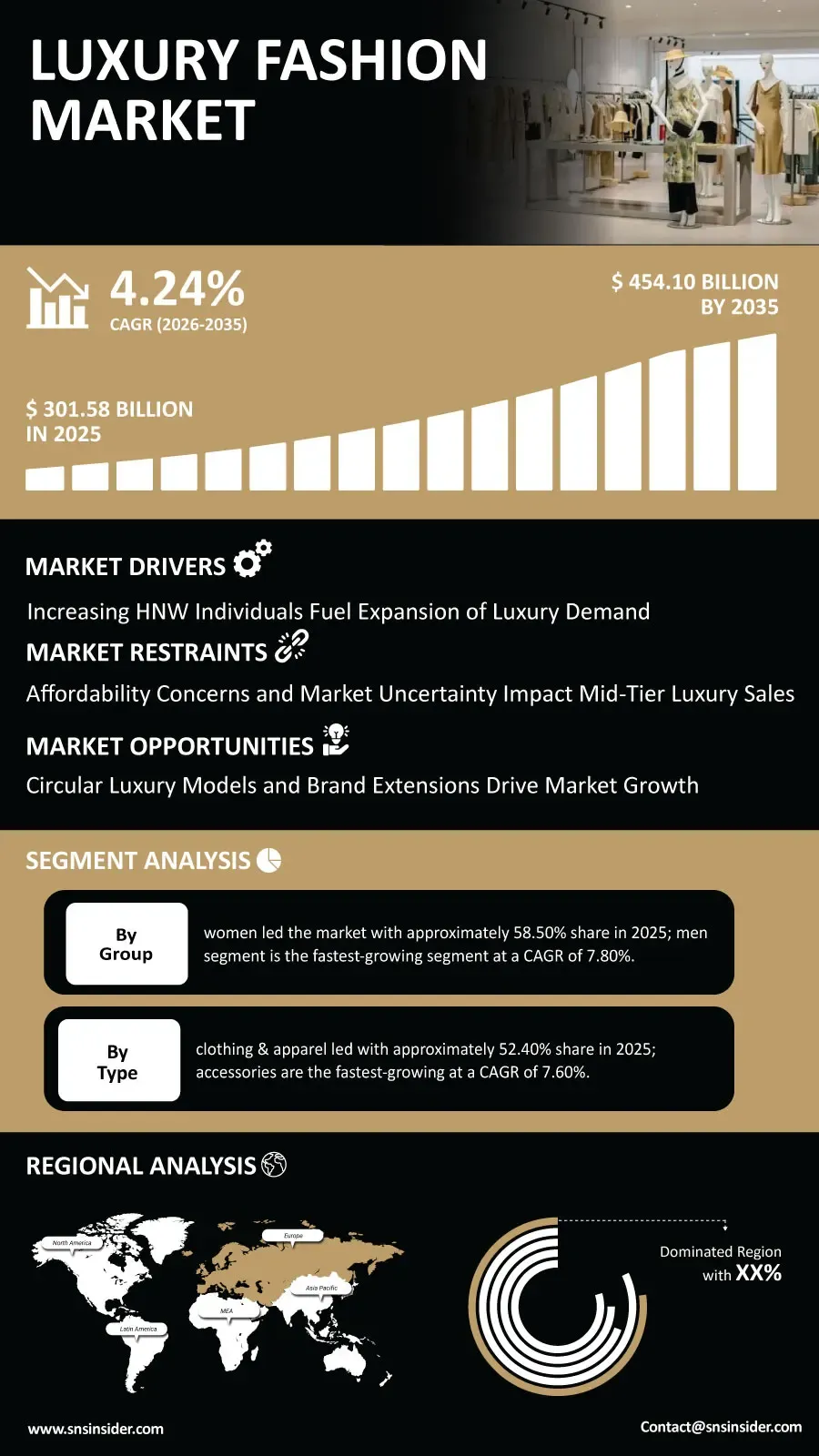
Global Luxury Fashion Market is experiencing growth due to the increasing presence of luxury brands through online transactions, exclusive retailing, and increasing demand from wealthy customers across the globe. “According to a recent study by SNS Insider, the global Luxury Fashion Market size valued at USD 301.58 Billion in 2025, is anticipated to grow to USD 454.10 Billion by 2035, registering a CAGR of 4.24% over the 2026–2035 forecast period.”
The luxury fashion industry is continuously changing its course by going beyond clothing through creativity, exclusivity, and personalization of the consumer experience. The increase in disposable income, wealth creation, and spending on luxury in Asia Pacific is shaping the new demands of the world. Additionally, the luxury houses are adopting the omnichannel approach where they combine physical flagship stores with digital platforms to reach out to consumers.
To Get Detailed Insights on the Luxury Fashion Market – Request a Sample Report
Digital Innovation and Premium Experiences Create Long-Term Opportunities
Luxury brands have begun focusing on technology to enhance their connections with customers and provide an extremely personalized experience. Styling suggestions based on artificial intelligence, virtual appointments, product visualization using augmented reality, and private online shopping events enable luxury brands to connect with their customers without losing their prestige.
Additionally, the growing number of authenticated resale sites opens up new avenues for revenue generation within the luxury industry. The luxury brands' secondhand products, repair and refurbishment services, and circular fashion practices not only contribute towards sustainability but also allow luxury brands to attract younger luxury consumers by connecting them to well-known fashion houses through resale sites.
Key Market Insights Reflect Changing Consumer Preferences
Based on the group, women accounted for 58.50% of global market revenue in 2025 thanks to robust demand for luxury bags, ready-to-wear collections, jewelry and premium accessories segment With young luxury consumers increasingly opting for luxury menswear, footwear and designer accessories, the men segment is set to be fastest-growing through 2035.
On the basis of type, Clothing & Apparel captured approximately 52.40% market share in 2025 owing to an ever-increasing seasonal demand and constant product innovation by key luxury brands. Over the forecast period, accessories are anticipated to register the fastest growth as handbags, leather goods, eyewear and premium accessories continue to provide accessible entry points into luxury ownership.
By application, personal luxury accounted for nearly 68.70% of revenue across the global in 2025 At the same time, experiential luxury is projected to expand at an unprecedented speed as luxury consumers place more premium on unique travel experiences, private events and high-end lifestyle products. By distribution channel, the store-based retail share of the market was 62.50%, while the non-store-based channels continue to expand via premium e-commerce platforms and digital luxury services.
Technology and Sustainability Transform Luxury Brand Strategies
Not to the detriment of an industry that trades on heritage, technology is becoming interwoven into the luxury retail process. Brands are combining AI clienteling, predictive inventory management, digital authentication and data analytics to enable better customer engagement and operational efficiencies. Brands are finding new ways to reach consumers with virtual fashion shows and online-only launches which allow them to remain relevant while retaining prestige.
Sustainability have emerged over the last few years of being a mainstay in competitive strategy. As the luxury consumer is changing and consumers become more environmentally responsible, companies are investing heavily in responsible sourcing of raw materials, regenerating resources with recyclable substitute materials while offering material traceability tracing to each batch fueling repair programs with transparent supply chains along with circular fashion business models.
Regional Markets Maintain Strong Global Momentum
Europe represented the largest regional market in 2025, as its historic wealth of luxury fashion houses remains unrivaled, while artisanal craftsmanship traditions ongoing for centuries and advanced manufacturing capabilities add to the credentials of premium/uper-premium producers. France remains key with its world-famous luxury brands and established fashion system.
Asia pacific is going to have the fastest Growth through 2035 due to rising affluent populations, luxury expenditure and digital engagement across China, India, South Korea and southeast Asia. Investments that follow other global luxury companies looking for long-term growth potential in the region.
With ample consumer purchasing power and an established luxury retail infrastructure, North America continues to be among the leading markets for luxury consumption globally. At the same time, pockets of continued opportunity for premium retail networks with developing wealthy consumer populations continue to emerge in both the Middle East and Latin America.
Leading Luxury Brands Focus on Exclusivity and Consumer Engagement
Competition in the Global Luxury Fashion Market continues to revolve around innovations, craftwork, legacy brands, and unique customer experiences. Big luxury brands are still pouring their investments in flagship stores, e-commerce channels, sustainable business practices, limited edition collections, and customized services for clients.
Key companies operating in the global Luxury Fashion Market include LVMH Moët Hennessy Louis Vuitton SE, Kering SA, Compagnie Financière Richemont SA, Chanel S.A., Hermès International S.A., Prada S.p.A., Burberry Group plc, Capri Holdings Limited, Tapestry Inc., Ralph Lauren Corporation, Moncler S.p.A., Hugo Boss AG, Salvatore Ferragamo S.p.A., Ermenegildo Zegna, Tod's S.p.A., Versace, Dolce & Gabbana S.r.l., Balenciaga, Saint Laurent, and Bottega Veneta.
An SNS Insider analyst Himanshu Sharma commented, "Luxury fashion continues to demonstrate remarkable resilience as premium brands balance heritage craftsmanship with digital innovation and sustainability. Companies investing in personalized consumer experiences, circular luxury initiatives, and high-value product innovation are expected to strengthen their competitive position as global affluent populations and premium lifestyle spending continue to expand."
About the Author

Get in touch




