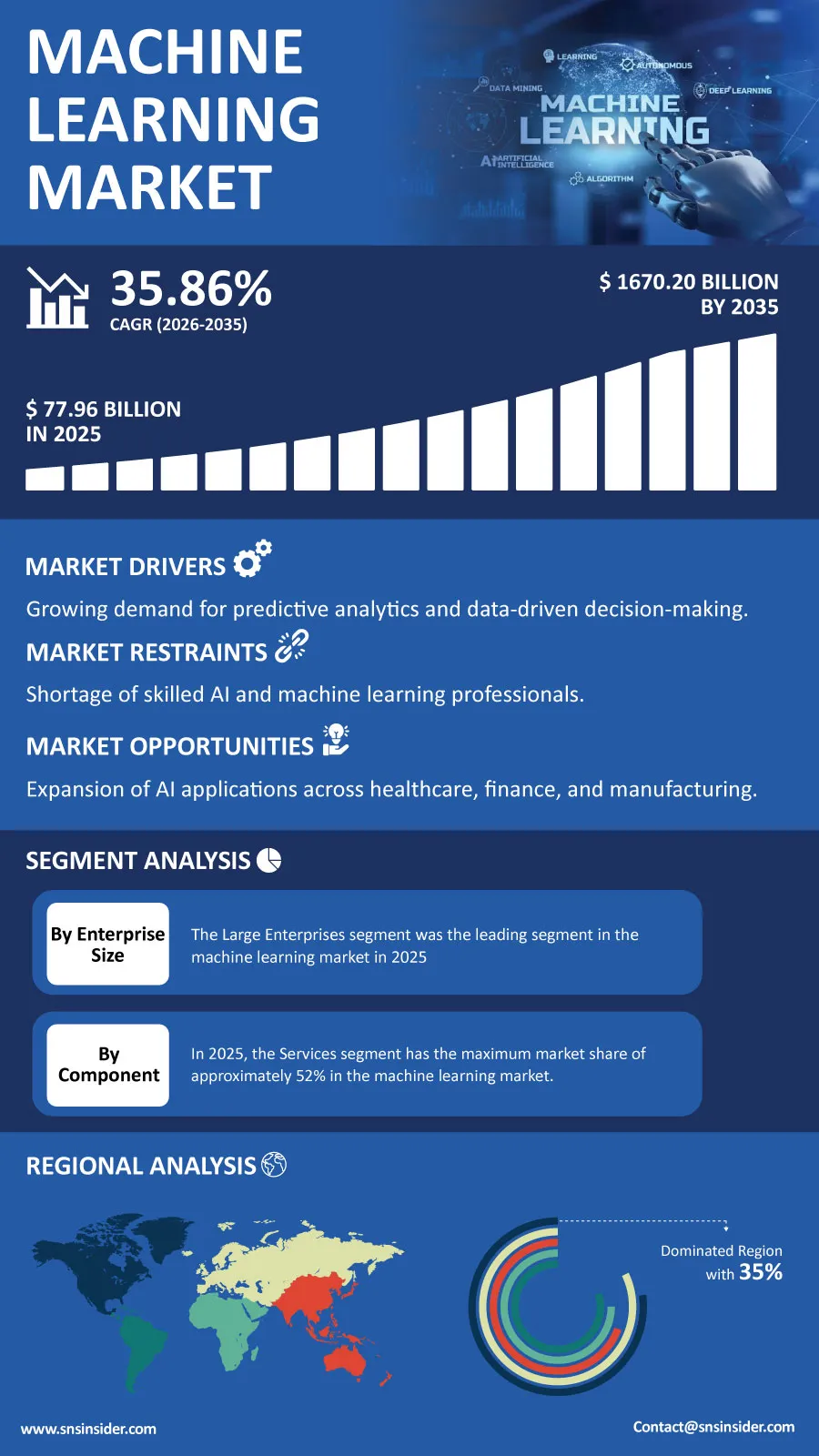
The global Machine Learning Market is entering a new phase of expansion as organizations increasingly deploy intelligent algorithms to improve decision-making, automate workflows, and extract greater value from enterprise data. “According to a recent study by SNS Insider, the Machine Learning Market size valued at USD 77.96 billion in 2025, is anticipated to grow to USD 1,670.20 billion by 2035, registering a CAGR of 35.86% over the 2026–2035 forecast period.”
The importance of machine learning is growing as part of companies' strategies for digital transformation, due to the need for fast analysis and increased operational efficiency. With the amount of information gathered by businesses growing every day, and with the development of cloud infrastructure and computing power, businesses are getting inspired to use intelligent technologies within their daily operations. Machine learning is used in industries for optimizing production, improving cybersecurity, enhancing supply chain planning, and engaging customers.
Increasing access to scalable AI platforms, open-source software frameworks, and automated tooling for model development is making it even easier to adopt AI systems. Companies that lack the specific knowledge and experience needed to develop AI models can now do so much more quickly and easily.
To Get Detailed Insights on the Machine Learning Market – Request a Sample Report
Enterprise AI Investments Create Significant Long-Term Growth Opportunities
Organizations across the globe are continuously making more and more investments in the implementation of artificial intelligence programs that yield positive results. Machine learning technology is becoming very important for those businesses that want to make accurate forecasts, automatize certain processes, and make better decisions thanks to sophisticated analytics.
Intelligent systems are being used by healthcare organizations for medical imaging, personalized treatment planning, and scientific studies; by financial firms for fraud detection, credit scoring, and regulation compliance with the help of predictive technologies. Manufacturers can use machine learning for improving equipment reliability, scheduling the production process, and saving money through predictive analytics.
As organizations prioritize responsible AI deployment, growing emphasis on explainable models, governance frameworks, and ethical AI practices is expected to strengthen confidence in machine learning adoption across highly regulated industries.
Key Market Insights Highlight Evolving Enterprise Adoption
Based on enterprise size, large enterprises accounted for approximately 69% of global market revenue in 2025 due to their extensive digital infrastructure, larger AI budgets, and broad implementation of intelligent business applications. Small and medium enterprises (SMEs) are expected to register the fastest expansion through 2035 as affordable cloud-based AI platforms become increasingly accessible.
By component, services represented nearly 52% of market revenue in 2025 as organizations continued investing in consulting, deployment, and system integration. Meanwhile, the software segment is projected to record the highest growth over the forecast period with increasing demand for AI-driven analytics platforms and automation solutions.
Among end users, the BFSI sector generated approximately 24.56% of total market revenue in 2025 owing to rising adoption of predictive analytics, fraud prevention, and intelligent customer service solutions. Healthcare and life sciences are anticipated to witness the fastest growth through 2035 as AI becomes increasingly integrated into diagnostics, research, and personalized care. Cloud deployment segment maintained market leadership with nearly 74% revenue share while continuing to demonstrate the strongest growth trajectory.
Next-Generation AI Technologies Continue Transforming Global Industries
With rapid advancements being made in areas, such as generative AI, foundation models, edge intelligence, and natural language processing, there have been new possibilities for the commercial uses of machine learning in different sectors. Businesses are now looking to integrate machine learning with Internet of Things (IoT), robotics, digital twins, and intelligent automation.
Advancements in high-performance computing, specialized AI chips, and cloud-native AI services are enabling faster model training and large-scale deployment. As businesses continue modernizing digital infrastructure, machine learning is expected to play a central role in improving productivity, operational resilience, and customer engagement across multiple sectors.
North America Held 35% of the Machine Learning Market Share in 2025; Asia Pacific Projected to Register the Fastest 39.52% CAGR Through 2035
North America generated a 35% share of market revenue in 2025 on account of high investments in artificial intelligence research, superior cloud infrastructure, and adoption in the enterprise. Regional supremacy of North America in terms of technology, healthcare, finance, manufacturing, and retail sectors has been a major reason for market dominance.
The region of Asia Pacific will demonstrate rapid growth, having a 39.52% CAGR until 2035. The increase in government initiative towards AI, along with innovations from technology companies and startups, are responsible for such rapid growth. There are many countries in the Asia Pacific region, including China, India, Japan, and Southeast Asia, which have huge potential for machine learning solution providers.
Growing digital transformation initiatives across Europe, Latin America, and the Middle East are also expected to contribute to sustained global market expansion as organizations invest in AI-enabled business modernization.
Industry Participants Expand AI Platforms and Enterprise Machine Learning Capabilities
Competition continues to intensify as technology providers strengthen investments in cloud AI infrastructure, generative AI platforms, enterprise automation, and specialized computing hardware. Strategic partnerships, product innovation, and AI platform expansion remain key priorities as vendors compete to address growing enterprise demand for scalable machine learning solutions.
Key companies operating in the global Machine Learning Market include Google Inc., Amazon, Intel Corporation, Meta Platforms, Microsoft Corporation, IBM Corporation, Wipro Limited, Nuance Communications, Apple Inc., Cisco Systems, Amazon Web Services (AWS), Baidu Inc., H2O.ai, Hewlett Packard Enterprise Development LP, SAS Institute Inc., SAP SE, NVIDIA Corporation, Oracle Corporation, Salesforce, Accenture, Alibaba Group, and Qualcomm Incorporated.
An SNS Insider analyst commented, "Machine learning is rapidly evolving from an emerging technology into a foundational business capability. Organizations that invest in scalable AI infrastructure, responsible AI governance, and industry-specific intelligent applications will be better positioned to drive innovation, operational efficiency, and long-term competitive advantage."
About the Author

Get in touch