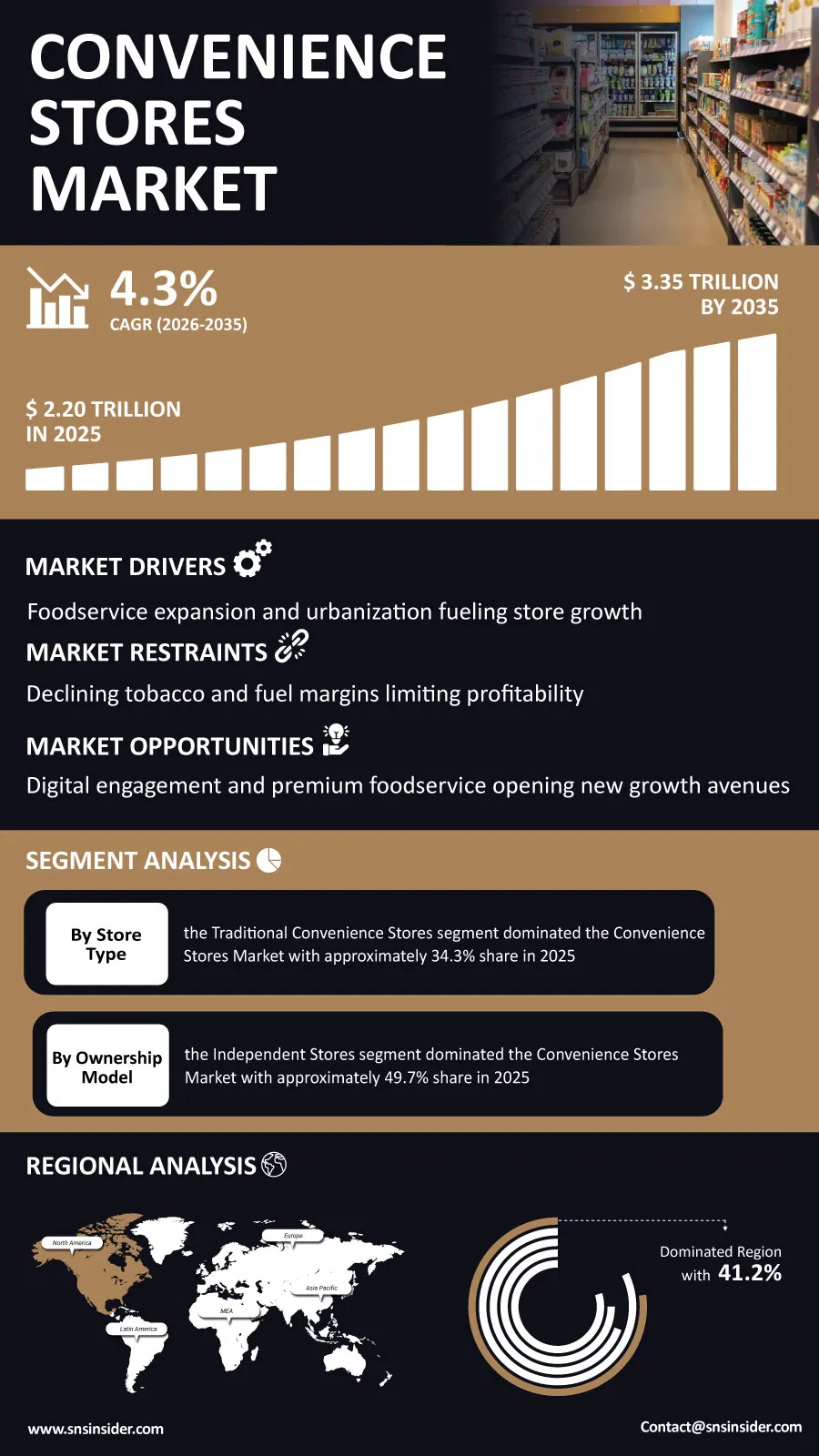
The global Convenience Stores Market continues its steady climb as chains reposition around foodservice and digital engagement to capture a broader share of daily consumer spending. “According to a recent study by SNS Insider, the global Convenience Stores Market size valued at USD 2.20 trillion in 2025, is anticipated to grow to USD 3.35 trillion by 2035, registering a CAGR of 4.3% over the 2026-2035 forecast period.”
There have been steady changes within foodservice and digital retail technology over time, due to which many operators aiming at improved margins and customer loyalty can take advantage of this trend. This includes the need for more integrated app-based ordering, loyalty, and delivery platforms that give buyers confidence in a chain's convenience proposition, across a wide range of formats from traditional corner stores to large-format food-focused locations. This applies in situations where convenience stores are used across urban, suburban, and rural retail applications.
Operators are constantly working to improve foodservice quality and digital engagement in order to meet various needs of time-pressed consumers worldwide.
To Get Detailed Insights on the Convenience Stores Market – Request a Sample Report
Foodservice and Digital Engagement Ecosystems Create New Demand
The convenience stores market has evolved from basic fuel-and-snack offerings into a broader mix of foodservice-forward, digitally integrated retail formats. The growing investment in kitchen infrastructure, mobile app technology, and multi-format store development has required the development of more efficient and reliable operating systems.
New foodservice and digital approaches can improve customer retention, reduce checkout friction, and expand the range of occasions convenience stores can serve. This gives operators the possibility to be more effective when reaching time-pressed consumers and strengthening claims around speed and reliability.
Convenience store chains, foodservice suppliers, and payment technology providers are increasingly cooperating due to the growing interest in developing future solutions for fast, digitally integrated daily retail.
Key Market Findings Highlight High-Growth Segments
The traditional convenience stores segment dominated all categories in the convenience stores market share with a market revenue share of approximately 34.3% in 2025 due to its broad geographic presence across urban and suburban neighborhoods.
The fastest growing category is expected to be the non-fuel convenience stores segment, which will grow at a CAGR of approximately 6.4% through 2035. This will be possible owing to expanding standalone urban and transit-adjacent store formats.
By product type, food & beverages held the largest share of total market revenue at approximately 34.6% in 2025 due to high purchase frequency and improving margins on fresh and prepared items. The personal care & health products segment will see the fastest growth in revenue generation at a CAGR of approximately 6.8%.
Regional trends show North America leading with approximately 41.2% revenue share in 2025, while Asia Pacific is expected to register a fast growth trajectory driven by rapid urbanization and rising disposable incomes across the region.
Foodservice Quality, Digital Payment, and Format Diversification Gain Importance
In this regard, operators have been looking at convenience store formats that would make their offerings more foodservice-forward, more digitally integrated, and more format-diverse.
Innovation in kitchen infrastructure, mobile app technology, and multi-format development has been making it possible for companies to come up with store formats that can meet increasingly demanding consumer and regulatory expectations. In addition to that, increasing emphasis on private label expansion is also making it possible for companies to find solutions that optimize margin resilience.
Such trends are likely to become even more prominent in the future.
North America Leads Amid Deep Chain Concentration and Fuel-Linked Retail
North America represented approximately 41.2% share of global market revenue in 2025 and was the largest regional market, owing to the United States' deep concentration of national chains and a commuter culture built heavily around car travel and fuel-linked retail. In addition, Asia Pacific is expected to register a fast growth trajectory during the forecast period, propelled by rapid urbanization and rising disposable incomes across the region's fast-growing economies.
On the other hand, Europe represented a meaningful share of global market revenue in 2025, aided by a long tradition of small independent grocers alongside established fuel-linked convenience formats.
Leading Companies Drive Innovation and Competition
The environment continues to stay very dynamic since players continue innovating on foodservice and digital retail technology as well as forming partnerships in order to enhance their position in the industry.
Some of the major companies that operate in the global convenience stores market are 7-Eleven, Inc. (Seven & i Holdings), Alimentation Couche-Tard Inc. (Circle K), FamilyMart Co., Ltd., Lawson, Inc., GS Retail Co., Ltd. (GS25), Casey’s General Stores, Inc., OXXO (FEMSA), Wawa, Inc., QuikTrip Corporation, Speedway LLC, Sheetz, Inc., Murphy USA Inc., EG Group Ltd., SPAR International, Indomaret (PT Indomarco Prismatama).
An SNS Insider Analyst Parry Kardani commented, “The steady shift toward foodservice-forward, digitally integrated convenience retail is creating consistent demand for flexible, technology-enabled store formats. Operators that successfully combine kitchen investment, mobile app engagement, industry consolidation, and disciplined store expansion will be best positioned to capitalize on emerging opportunities across urban, suburban, and rural convenience retail applications.”
About the Author

Get in touch