
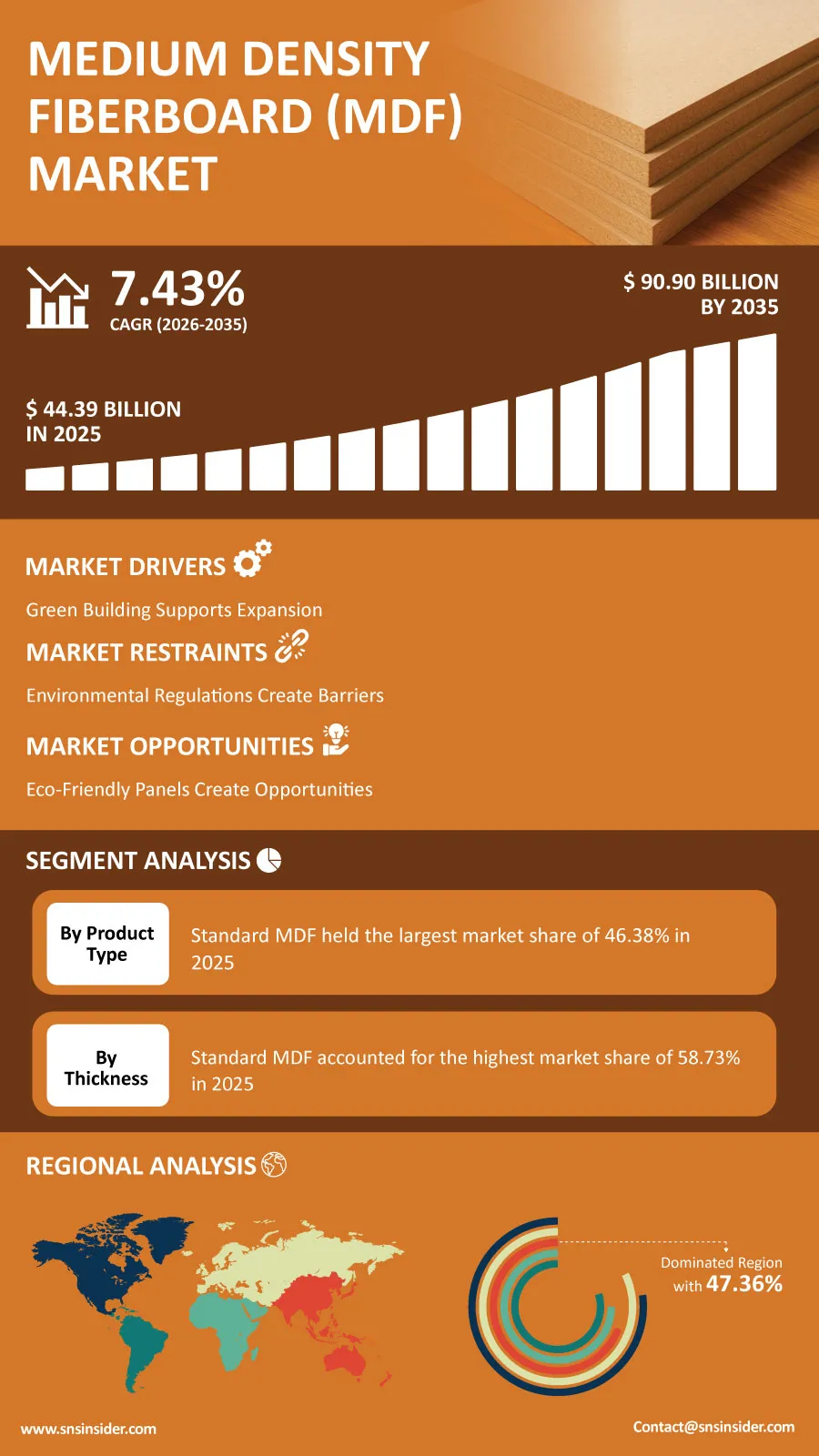
The MDF Market at the global level is likely to witness significant growth due to increasing demand for cost-effective engineered wood-based products used in residential constructions, commercial interior design, and furniture making. “According to a recent study by SNS Insider, the global Medium Density Fiberboard (MDF) Market size valued at USD 44.39 Billion in 2025, is anticipated to grow to USD 90.90 Billion by 2035, registering a CAGR of 7.43% over the 2026–2035 forecast period.”
Increasing investments in urban housing projects, renovation activities and contemporary interior solutions are offering lucrative scenario for the growth of MDF manufacturers globally. The material is benefits from consistent surface quality and flexibility in machining, compatibility with decorative finishes, and is suitable for both residential and commercial applications.
Manufacturers are also complementing the production process with automated and digital panel processing, along with sustainable manufacturing. These innovations promote production efficiency and will also support the industry's transition towards products with lower emissions intensity and sustainable use of resources.
To Get Detailed Insights on the Medium Density Fiberboard Market – Request a Sample Report
Sustainable Manufacturing and Modern Construction Expand Market Opportunities
The global shift towards sustainable and ecologically responsible construction materials seek to pave the way for MDF production companies. As such, builders, architects and furniture manufacturers are beginning to look for engineered wood products that meet desired green building initiatives without sacrificing performance or design flexibility.
New adhesive technologies, use of recycled fibers and surface treatments are contributing to create more durable, waterproof and environmentally friendly products. Increasing investments in prefabricated housing, modular construction and made-to-order furniture manufacturing are likely to strengthen long-term demand across developed and developing economies.
Advancing digital manufacturing technologies are also ensuring enhanced design accuracy, expedited production cycles and is facilitating improved material efficiency which allows manufacturers to respond more effectively to changing customer needs.
Key Market Insights Highlight Evolving Product Demand
On the basis of product type, Standard MDF dominated global market revenue in 2025, with an estimated market volume share of 46.38% owing to its high usage into cabinetry, furniture manufacturing and decorative interior applications. Due to the rising demand for durable materials from kitchens, bathrooms, and humid areas, Moisture-Resistant MDF will continue its dominant form over 2035 and is anticipated to register fastest growth.
In 2025, the Furniture segment accounted for 54.62% of market revenue based on application, driven by growing production of modular & ready-to-assemble furniture around the world. The Construction segment will have the fastest growth rate in the forecast period as engineered wood products become more popular and replace traditional materials on modern building projects.
In 2025, Standard MDF held the market share of 58.73% in terms of thickness owing to its versatility for several industrial applications; however Thin MDF is expected to exhibit maximum growth on account increasing use in decorative panels, lightweight furniture and interior finishing solutions.
Advanced Production Technologies Drive Product Innovation
Businesses are committing enormous amounts in advanced processing machinery, automated compression systems and new-age resin technologies that enhance production uniformity and cut down material failure. These technological advancements are allowing for greater efficiency while providing improved quality of the product.
The industry is also seeing increased uptake of low-emission factories and renewable feedstock as companies bolster sustainability initiatives. Advancements in surface finishing, engineered coatings and precision machining are likely to improve the performance of the products while catering to the ever-evolving architectural and furniture design requirements.
Asia Pacific Maintains 47.36% Market Leadership in 2025, Middle East & Africa to Deliver the Fastest Regional Growth by 2035
Asia Pacific held a market share of 47.36% in the year 2025 owing to the rising furniture manufacturing, high urbanization, and construction of residential buildings in China, India, and Southeast Asia. The continuous investment in eco-friendly houses and the wood-processing industry for export purposes helps the region retain its dominance.
The Middle East & Africa is expected to experience the highest growth till 2035 owing to the development of infrastructural facilities and urbanization, along with investments in commercial and residential constructions. The modernization of building techniques and the increased demand for engineered wood are anticipated to aid in the growth of the regional market.
Industry Participants Strengthen Competitive Position Through Sustainable Innovation
The level of competition is very high as the prominent firms continue to invest in increased production capacity, efficient manufacturing processes, and environmentally friendly products. The use of automation, recycled materials, and novel technologies in panels is ensuring that firms enhance their global market share in line with changing customer needs.
Key companies operating in the global Medium Density Fiberboard (MDF) Market include Kronospan, ARAUCO, EGGER Group, Kastamonu Entegre, Swiss Krono Group, Duratex (Dexco), Daiken Corporation, Sonae Indústria, Finsa, Eucatex, Masisa, Nelson Pine Industries, Century Plyboards, Greenpanel Industries, VRG Dongwha MDF, Yonglin Group, West Fraser Timber Co., Roseburg Forest Products, Georgia-Pacific Wood Products, and Kaindl KG.
An SNS Insider analyst Himanshu Sharma commented, "The growing preference for sustainable engineered wood products, combined with expanding construction activity and continuous manufacturing innovation, is creating long-term opportunities across the global MDF industry. Companies investing in environmentally responsible production technologies, product quality improvements, and advanced processing capabilities are expected to strengthen their competitive position throughout the forecast period."
About the Author

Get in touch




