
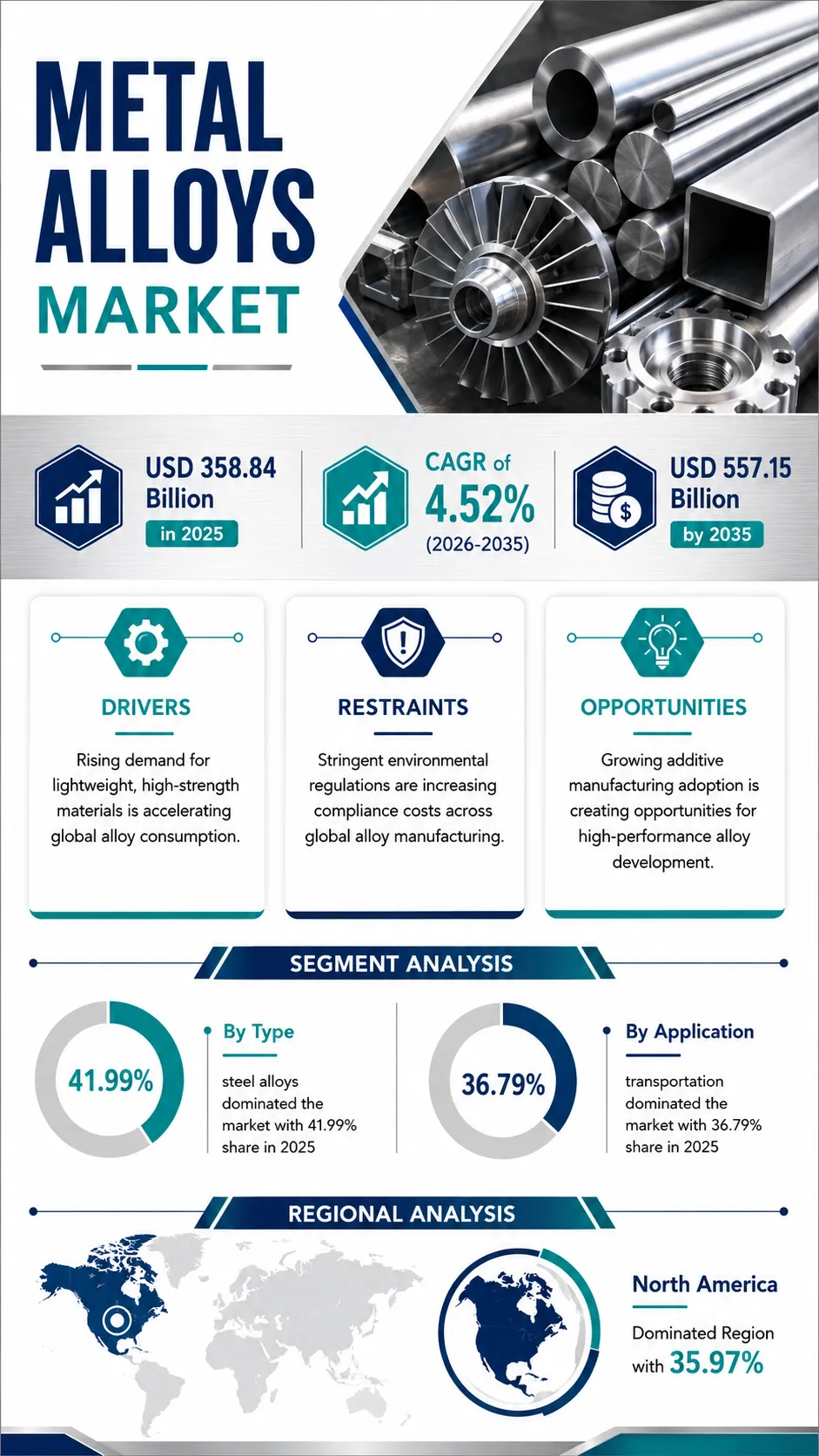
The global Metal Alloys Market is entering a period of sustained expansion as manufacturers across transportation, aerospace, construction, energy, and electrical industries seek materials with superior strength, durability, and performance. “According to a recent study by SNS Insider, the global Metal Alloys Market size valued at USD 358.84 Billion in 2025, is anticipated to grow to USD 557.15 Billion by 2035, registering a CAGR of 4.52% over the 2026–2035 forecast period.”
There has been a shift in demand towards engineered alloys that can fulfill stringent specifications regarding weight reduction, thermal stability, corrosion resistance, and mechanical reliability. Auto makers and aircraft companies have been using more aluminum and titanium alloys, whereas manufacturers have been using alloys in their machinery and power generation applications.
Global production of steel continued to be an important indicator of industrial materials demand in 2025. As per reports by the World Steel Association, the global output of crude steel was 1,849.4 million tons, out of which India produced 164.9 million tons, representing a 10.4 percent growth.
To Get Detailed Insights on the Metal Alloys Market – Request a Sample Report
Advanced Manufacturing and Lightweight Materials Create New Opportunities
The transition toward lighter and more efficient products is creating significant opportunities for alloy producers. Automotive manufacturers are increasing the use of lightweight metals to improve vehicle efficiency, while aerospace companies require materials that can withstand demanding temperature and mechanical conditions without adding excessive weight.
Additive manufacturing has opened a new route for market development. Manufacturers can make use of alloys' powders to make geometrically complex parts with reduced waste and custom-made parts. The industry applications include the aerospace industry, medical industry, energy sector, and automotive industry.
In the meantime, the development of alloy has been influenced by artificial intelligence and computational materials engineering. The digital simulation will give the manufacturers the ability to assess the composition and predict the material properties prior to actual production.
Key Market Insights Highlight Strong Demand for Specialized Alloys
Steel alloys constituted the largest segment in terms of types, having a share of 41.99% in 2025 owing to its extensive application in the construction, transport, machinery, marine, and energy industry. Titanium alloy is estimated to witness the highest growth rate of 8.54% during the review period of 2026 to 2035 due to its strength, high corrosion resistance, and engineering applications in the aerospace, defense, and medical industry.
Transportation applications comprised the largest segment of the share, contributing 36.79% of the revenue in 2025 because of extensive utilization of alloys in automobiles, airplanes, trains, and marine equipment. The electrical application is anticipated to experience the highest growth rate, registering CAGR of 9.20% owing to grid modernization, renewable energy projects, electric cars, and increased output of electrical equipment.
The sheet category held a 31.97% share of the market in 2025, while the powders category is anticipated to experience the highest CAGR of 8.04% during the forecast period owing to increasing adoption of additive manufacturing and powder metallurgy in various industries. The low-alloy category contributed 43.39% of the revenues in 2025, while the superalloys category is projected to experience the highest growth rate, recording CAGR of 8.58%.
Sustainable Metallurgy Accelerates Industry Transformation
Metal manufacturers are now looking into options like recycling, efficient metal processing, and reduced-emission production because of the tightening environmental regulations. Increased utilization of recycled metals will enhance efficiency while solving problems associated with raw material scarcity and increased production costs.
Some of the investments include the latest from Alcoa that has unveiled its plan of investing 65 million USD for 2026 for expansion of its recycling capacity at its Mosjøen smelter in Norway. Norsk Hydro is also constructing an aluminum recycling plant in Spain worth €180 million.
Regional Markets Demonstrate Diverse Growth Patterns
The North American region dominated the global market with the highest regional share of 35.97% in 2025 owing to the existence of matured industries such as aerospace, automotive, construction, defense, and advanced manufacturing industries. Metallurgical competence and continuous investments in high performance materials drive the market share of this region.
Asia Pacific is expected to be the region growing at the fastest rate, with a CAGR of around 5.84% during 2026-2035, driven by rapid industrialization, infrastructural development, increased automobile production, and the increasing manufacture of steel, aluminum, and alloys.
Metallurgy in Europe focuses on recycling and lower carbon emissions, whereas the Middle East & Africa and Latin America benefit from development in infrastructure and industries.
Industry Participants Focus on Innovation and Recycling
Competition in the Metal Alloys Market is centered on advanced material development, recycling capabilities, manufacturing efficiency, and supply-chain resilience. Major companies are increasing investments in specialty alloys, digital manufacturing, sustainable metallurgy, and high-performance materials to address changing industrial requirements.
Key companies operating in the global Metal Alloys Market include Alcoa Corporation, Aluminium Corporation of China Limited, Aperam S.A., ArcelorMittal, ATI Inc., Carpenter Technology Corporation, China Baowu Steel Group, Constellium SE, Jindal Stainless Limited, Kaiser Aluminum Corporation, Kobe Steel, Ltd., Nippon Steel Corporation, Norsk Hydro ASA, Novelis Inc., Outokumpu Oyj, POSCO Holdings, Sandvik AB, Thyssenkrupp AG, United Company RUSAL, and VSMPO-AVISMA Corporation.
An SNS Insider analyst Himanshu Sharma commented, “The growing need for lighter, stronger, and more durable materials is reshaping alloy consumption across transportation, aerospace, electrical, and energy industries. Continued advances in additive manufacturing, AI-assisted material design, and metal recycling are expected to create new opportunities for producers focused on high-performance and sustainable alloy solutions.”
About the Author

Get in touch




