
Metal Alloys Market Report Scope & Overview:
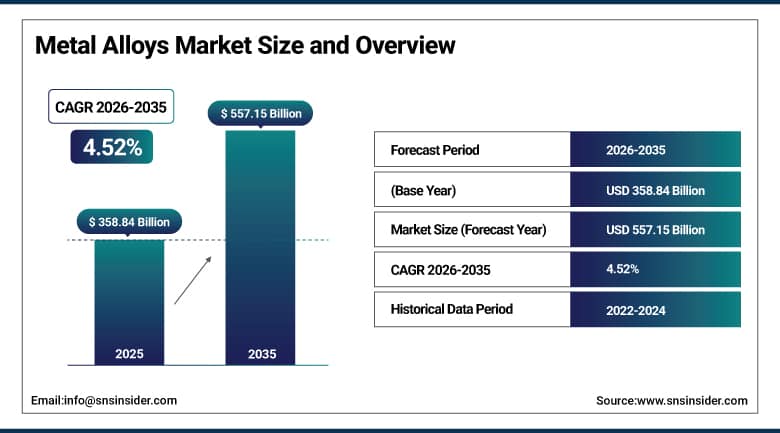
The Metal Alloys Market was valued at USD 358.84 billion in 2025 and is expected to reach USD 557.15 billion by 2035, growing at a CAGR of 4.52% from 2026–2035.
The global metal alloys market is witnessing steady growth in the global market owing to increasing demand for high-performance, lightweight, and durable materials. Rising adoption across automotive, aerospace, construction, energy, electrical, and industrial manufacturing applications is accelerating market expansion. Manufacturers are focusing on advanced alloy compositions, precision processing, additive manufacturing, AI-based material design, and digital quality control systems. Growing investments in sustainable metallurgy, recycled metal production, high-performance superalloys, and advanced processing technologies are supporting technology advancement. Increasing demand for corrosion resistance, thermal stability, lightweight structures, and high-strength engineering materials is further driving market adoption.
The World Steel Association, the total amount of world crude steel production in 2025 is 1,849.4 million tons, indicating a fall of 2.0% compared to 2024. The amount of production in China is 960.8 million tons, indicating a fall of 4.4%, while that of India increased by 10.4% to 164.9 million tons. Total production in America is 82.0 million tons, indicating a rise of 3.1%, while in Japan it fell by 4.0%.
Market Size and Forecast:
-
Market Size 2026E: USD 374.34 billion
-
Market Size 2035: USD 557.15 billion
-
CAGR: 4.52% from 2026 to 2035
-
Fastest Growing Region: Asia Pacific
-
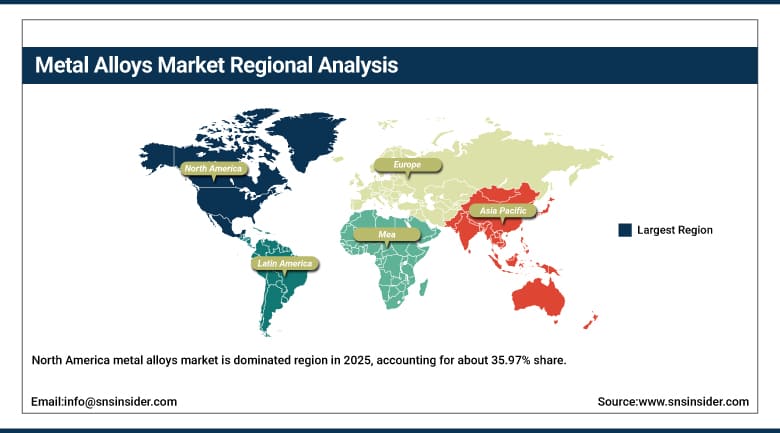
Largest Region: North America
To Get More Information On Metal Alloys Market - Request Free Sample Report
Metal Alloys Market Trends:
-
Increased use of lightweight aluminum and titanium alloy materials in automobile and aerospace industry applications worldwide.
-
Growing use of additive manufacturing technology in making complex and high-performance alloy materials.
-
Growth in the application of artificial intelligence in alloy design, optimization, and performance prediction process.
-
Increased global demand for corrosion-resistant and high-temperature alloy materials in energy and infrastructural industries.
-
Increased use of precision powder metallurgy techniques for making alloys and improving material performance.
-
Development of sustainable and high-strength alloys to improve fuel efficiency and durability and new engineering applications.
U.S. Metal Alloys Market Outlook:
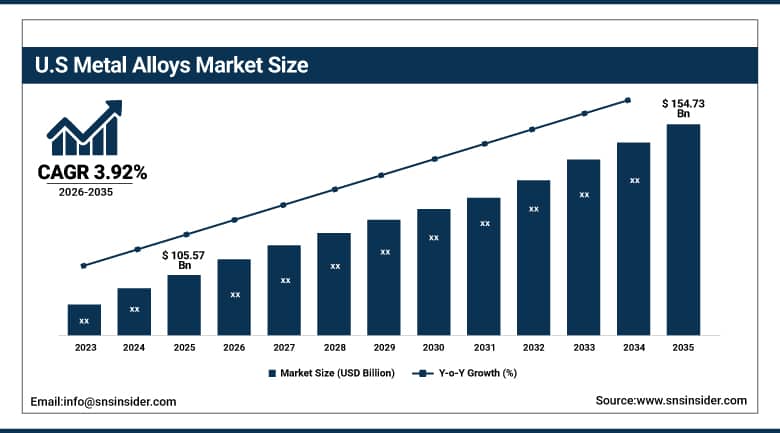
The U.S. Metal Alloys Market was valued at USD 105.57 billion in 2025 and is expected to reach around USD 154.73 billion by 2035, growing at a CAGR of 3.92% from 2026–2035.
The U.S. metal alloys market is expanding steadily owing to rising demand for advanced materials across automotive, aerospace, construction, and industrial manufacturing sectors. Increasing adoption by automotive manufacturers, aerospace companies, construction firms, electrical equipment producers, and machinery manufacturers is supporting market growth nationwide. Rising investments in lightweight aluminum alloys, high-strength steel alloys, titanium materials, precision manufacturing, and advanced metallurgical technologies are driving production efficiency and material performance. Growth in infrastructure development and domestic manufacturing initiatives is further accelerating alloy consumption across industries. Manufacturers are focusing on recycled metal processing, AI-based alloy development, additive manufacturing, and automated quality control systems across diverse production facilities. Increasing demand for corrosion-resistant materials, high-temperature performance, and lightweight engineering solutions is strengthening long-term market penetration.
In the Mineral Commodity Summaries 2025 prepared by the United States Geological Survey, foreign dependence in the metal and alloys chain is noted to be large due to the fact that 54 out of the 75 non-fuel mineral commodities have more than 50% reliance on imports, while 16 critical minerals have 100% reliance on imports. The updated list of critical minerals 2025 has a total of 60 key mineral commodities, and the domestic recycling industry managed to recover 48 million metric tons of iron and steel scrap.
Metal Alloys Market Segment Analysis:
-
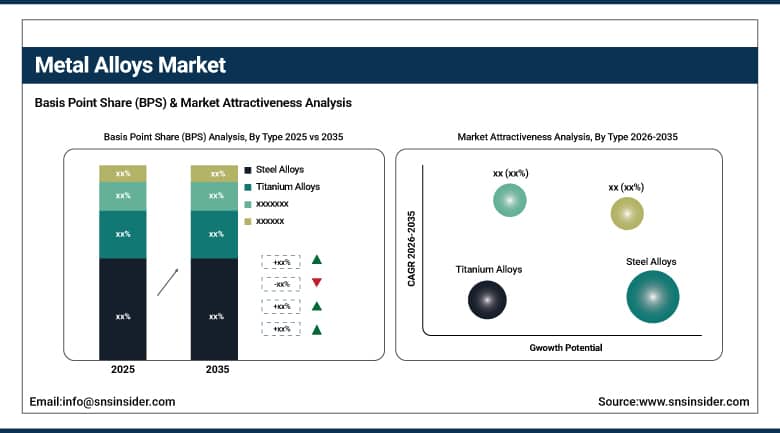
By Type, steel alloys dominated the market with 41.99% share in 2025; while titanium alloys are the fastest growing segment with CAGR of 8.54% during 2026 to 2035.
-
By Application, transportation dominated the market with 36.79% share in 2025; while electrical are the fastest growing segment with CAGR of 9.20% during 2026 to 2035.
-
By Product Form, sheets dominated the market with 31.97% share in 2025; while powders are the fastest growing segment with CAGR of 8.04% during 2026 to 2035.
-
By Grade, low-alloy dominated the market with 43.39% share in 2025; while superalloy is the fastest growing segment with CAGR of 8.58% during 2026 to 2035.
By Type, steel alloys dominated the metal alloys market, while titanium alloys are the fastest growing segment.
Steel Alloys Segment accounted for the dominated revenue share in the metal alloys market during 2025. The growth of this segment was fueled by wide-ranging applications in construction, automotive, infrastructure, machinery, ship building, and energy segments. High strength, durability, cost-effectiveness, welding capability, and recyclable properties of steel alloys were some major factors responsible for their wide applications in various industrial segments. Investments in infrastructure building, manufacturing activities, and high-strength steel were some other factors responsible for their leading position in the market.
The Titanium Alloys Segment is expected to witness a fastest CAGR during 2026-2035. Increasing applications in aerospace, medical, defense, electric vehicle, and industrial segments are some factors expected to boost the growth of this segment over the forecast period. Superior strength-to-weight ratio, corrosion resistance, biocompatibility, and high-temperature capability of titanium alloys are some factors responsible for their wide applications in engineering applications.
By Application, transportation dominated the metal alloys market, while electrical is the fastest growing segment.
The Transportation segment has been the dominated in the metal alloys market in terms of the maximum revenue share in 2025. The growing requirement in the automotive, aerospace, railways, and marine segments has considerably driven the need for metal alloys that have improved performance in terms of durability and safety. Lightweight aluminum, steel, and titanium alloys have been extensively used to enhance the performance of cars in terms of fuel efficiency and strength.
The Electrical segment is projected to witness the fastest CAGR during 2026-2035. Growing investments in renewable energy systems, electric vehicles, power transmission, and electronics equipment have boosted the use of metal alloys in the market. Copper, aluminum, and specialized alloys have been used in increasing quantities for their better electrical, thermal, and corrosion-resistant properties. Grid modernization projects and electrification programs are likely to drive the rapid market growth during the forecast period.
By Product Form, sheets dominated the metal alloys market, while powders are the fastest growing segment.
The sheets segment held the dominated revenue share in the metal alloys market in 2025 owing to their wide use in automotive, construction, shipbuilding, aerospace, and heavy manufacturing industries. Sheets made from metal alloys are strong, highly formable, resistant to corrosion, and easier to fabricate into parts. Increasing infrastructure expenditure, rising number of vehicles manufactured, and demand for durable and fabricated parts were other factors behind the continuous usage of metal alloy sheets in these end-use industries.
The powders segment is estimated to witness the fastest CAGR during 2026-2035. This can be attributed to growing application of additive manufacturing technology, powder metallurgy, and precision component manufacturing. Metal alloy powders allow for better material usage, manufacture of complex components, weight reduction, and less manufacturing wastage. Demand from aerospace, medical devices, automotive, and energy sectors is leading to higher investment in the production and processing of metal alloy powders.
By Grade, low-alloy dominated the metal alloys market, while superalloy is the fastest growing segment.
Low-Alloy held the dominated market share of revenue among the various types of metal alloys in 2025. This is due to the fact that the material has wide-ranging uses in the construction industry, the automotive sector, machinery and industrial manufacturing, as well as infrastructural projects. Low alloys are tough and have the same strength as high-quality metals but are cheap and can easily be produced and welded. Growth in infrastructure, transportation, and heavy engineering projects will continue to increase the demand for low alloy.
Superalloy segment is expected to hold the fastest CAGR from 2026 to 2035. Rising demand for superalloys in the aerospace, defense, energy, medicine, and advanced industries will boost segment growth. Superalloys have remarkable high-temperature strength, oxidation resistance, corrosion resistance, and mechanical stability under tough operating conditions. Increasing investment in aircraft engines, gas turbines, additive manufacturing, and power generation will propel the market growth.
Regional Analysis:
|
Region |
Major Country |
Share within Region, 2025(%) |
|---|---|---|
|
North America |
United States |
81.79% |
|
Europe |
Germany |
26.40% |
|
Asia Pacific |
China |
38.70% |
|
Middle East & Africa |
UAE |
12.60% |
|
Latin America |
Brazil |
42.30% |
North America Metal Alloys Market Insights
North America metal alloys market is dominated region in 2025, accounting for about 35.97% share, driven by increasing demand from aerospace, automotive, construction, and advanced manufacturing industries. The region benefits from strong industrial infrastructure, advanced metallurgical technologies, and established alloy manufacturing companies. Increasing adoption of lightweight aluminum alloys, high-performance titanium alloys, and corrosion-resistant specialty materials is strengthening market growth. Expansion of defense production and infrastructure modernization further reinforces the region’s dominant position in the market.
The U.S. Geological Survey Mineral Commodity Summaries 2025 states that more than 80% of alumina and 100% of bauxite were imported into North America. Canadian primary aluminum smelting produced 3.3 million metric tons of products, sending 90% to other destinations. In addition to this, the use of secondary alloys by regional steel producers increased as well, as recycled industrial minerals were used in more than 65% of strategic refining and metallurgy operations in 2025.
Get Customized Report as Per Your Business Requirement - Enquiry Now
Europe Metal Alloys Market Insights
Europe metal alloys market is characterized by stable growth in 2025 owing to increasing investments in sustainable metallurgy, lightweight materials, and advanced industrial manufacturing technologies. Key countries include Germany, France, United Kingdom, Italy, and Spain. Rising adoption of recycled alloys, high-strength steel, aluminum materials, and precision engineering technologies is supporting market expansion. Increasing focus on low-carbon manufacturing and circular economy initiatives is strengthening long-term industry development. Technological advancements continue encouraging efficient alloy production and high-performance material applications across the region.
According to the figures provided by the European Steel Association, the steel consumption in the EU has grown by 4.4% annually up to 134.4 million metric tons in 2025. However, the output of crude steel in the country decreased by 2.9% to 125.8 million metric tons while the imports of foreign metal goods grew by 14% and made up 30% of the total demand. In addition, the output in the downstream automobile industry dropped by 4.3%.
Asia Pacific Metal Alloys Market Insights
Asia Pacific is the fastest growing region in the metal alloys market, registering a CAGR of about 5.84% during 2026–2035. Rapid industrialization and increasing infrastructure development are driving strong market demand across China, Japan, India, South Korea, and Southeast Asia. Rising investments in steel manufacturing, aluminum processing, specialty alloy production, and advanced metallurgical technologies are accelerating regional market growth. Growing automotive manufacturing and renewable energy expansion continue supporting widespread metal alloy adoption across industrial applications.
According to the World Steel Association, total output of crude steel in the Asian and Oceania regions was at 1,324.5 million tons in 2025, representing more than 70% of the 1,849.4 million tons global production level. In the region, China maintained an output level of 960.8 million tons, despite having a fall of 4.4%, while India had an output level of 164.9 million tons after increasing by 10.4%.
Middle East & Africa and Latin America Metal Alloys Market Insights
The Middle East & Africa and Latin American regions have been experiencing consistent growth because of the growing capacity of industrial manufacturing and increasing investment in mining and metal processing industry. Some of the important contributors in this region are Saudi Arabia, UAE, South Africa, Brazil, Mexico, and Argentina. Increasing use of alloys, fabrication processes, and infrastructural development projects are aiding the market growth.
According to the report of world crude steel production 2025 by World Steel Association, the annual crude steel production in the Middle East was 56.9 million tonnes which indicates a rise of 4.3% compared to 2024. However, the annual steel production in Africa was 23.2 million tonnes which represents an increase of 3.8%, and the annual steel production in South America was 41.5 million tonnes which indicates a decline of 1.2%.
Market Dynamics:
Growth Drivers: Rising demand for lightweight, high-strength materials is accelerating global alloy consumption.
Growing focus on fuel economy, structural integrity, and enhanced mechanical performance is leading to the rising use of metal alloys. Car makers are using aluminum and steel alloys to build lighter vehicles by using these alloys instead of traditional materials. Titanium and nickel alloys are increasingly being used by aerospace companies to achieve better heat resistance and reliability. Construction of infrastructure continues to boost demand for metals which resist corrosion. Higher spending on machinery and engineering is aiding in the metal alloys market growth.
Global primary aluminum production in 2025 stood at 73.78 million metric tons, indicating an increment of 1.1% from the previous year 2024. Due to increased demand for light manufacturing materials, China's primary aluminum production saw an increase of 1.9% to 44.2 million metric tons, accounting for 60% of global primary aluminum production. In addition, five members of Gulf Cooperation Council produced 6.16 million metric tons, making up 8% of global primary aluminum material production.
Restraints:Stringent environmental regulations are increasing compliance costs across global alloy manufacturing.
Globally, governments have adopted more stringent environmental laws in an attempt to minimize the emissions produced by industries and enhance their resource efficiency. Metal alloy production companies have to incur additional costs through investing in technology that promotes environmental compliance, managing waste, minimizing emissions, and recycling. Environmental compliance has led to increased capital and operational costs for manufacturing operations. Small-scale producers may find themselves under financial stress as they upgrade their production facilities in order to meet the environmental requirements.
Opportunities: Growing additive manufacturing adoption is creating opportunities for high-performance alloy development.
The industry is demanding alloy materials that can offer better strength, light-weight performance, and component manufacturing. Additive manufacturing can be used efficiently for the production of aerospace, medical, automotive, and industrial components using metal alloys. Companies are now focusing on incorporating artificial intelligence technology in the design of alloys, as well as simulating and precision powder metallurgy technology to optimize the performance of materials. Continuous innovation is leading to the creation of alloys that have high thermal stability and corrosion resistance.
As per the list provided by the United States Geological Survey of the critical minerals in 2025, there are 60 primary mineral commodities such as titanium, beryllium, cobalt, and nickel that act as primary feedstocks for making advanced metal alloys. In addition, the technical documentation from the National Institute of Standards and Technology in 2025 emphasizes that the computational materials engineering approach along with material metrology is driving the use of alloy formulations.
Recent Developments:
-
2026: Alcoa Corporation announced a USD 65 million capital investment to expand foundry recycling capabilities at its Mosjøen smelter facility in Norway.
-
2025: Jindal Stainless Limited commissioned Odisha's largest captive industrial solar plant of 30-megawatt peak to generate clean electricity.
-
2025: Norsk Hydro began construction on its €180 million recycling facility in Torija, Spain, adding 120,000 tonnes of capacity.
-
2024: Novelis Inc. invested USD 90 million to expand used beverage can recycling capacity by 85 kilotonnes per year in Latchford.
Metal Alloys Market Key Players are:
-
Alcoa Corporation
-
Aluminium Corporation of China Limited
-
Aperam S.A.
-
ArcelorMittal
-
ATI Inc.
-
Carpenter Technology Corporation
-
China Baowu Steel Group
-
Constellium SE
-
Jindal Stainless Limited
-
Kaiser Aluminum Corporation
-
Kobe Steel, Ltd.
-
Nippon Steel Corporation
-
Norsk Hydro ASA
-
Novelis Inc.
-
Outokumpu Oyj
-
POSCO Holdings
-
Sandvik AB
-
Thyssenkrupp AG
-
United Company RUSAL
-
VSMPO-AVISMA Corporation
Metal Alloys Market Report Scope:
| Report Attributes | Details |
|---|---|
| Market Size in 2025 | USD 358.84 Billion |
| Market Size by 2035 | USD 557.15 Billion |
| CAGR | CAGR of 4.52% From 2026 to 2035 |
| Base Year | 2025 |
| Forecast Period | 2026-2035 |
| Historical Data | 2022-2024 |
| Report Scope & Coverage | Market Size, Segments Analysis, Competitive Landscape, Regional Analysis, DROC & SWOT Analysis, Forecast Outlook |
| Key Segments | • By Type (Steel Alloys, Aluminum Alloys, Titanium Alloys, Copper Alloys, Nickel Alloys, Others) • By Application (Transportation, Construction, Packaging, Machinery, Electrical, Others) • By Product Form (Ingots, Billets, Sheets, Tubes, Powders) • By Grade (Low-Alloy, Medium-Alloy, High-Alloy, Superalloy) |
| Regional Analysis/Coverage | North America (US, Canada), Europe (Germany, UK, France, Italy, Spain, Russia, Poland, Rest of Europe), Asia Pacific (China, India, Japan, South Korea, Australia, ASEAN Countries, Rest of Asia Pacific), Middle East & Africa (UAE, Saudi Arabia, Qatar, South Africa, Rest of Middle East & Africa), Latin America (Brazil, Argentina, Mexico, Colombia, Rest of Latin America). |
| Company Profiles | Alcoa Corporation, Aluminium Corporation of China Limited, Aperam S.A., ArcelorMittal, ATI Inc., Carpenter Technology Corporation, China Baowu Steel Group, Constellium SE, Jindal Stainless Limited, Kaiser Aluminum Corporation, Kobe Steel, Ltd., Nippon Steel Corporation, Norsk Hydro ASA, Novelis Inc., Outokumpu Oyj, POSCO Holdings, Sandvik AB, Thyssenkrupp AG, United Company RUSAL, VSMPO-AVISMA Corporation |

Frequently Asked Questions
The steel alloys dominated the market in 2025 owing to high strength, durability, cost-effectiveness, recyclability, and widespread industrial and construction applications.
North America dominated the metal alloys market in 2025.
The metal alloys market is expected to grow at a CAGR of 4.52% from 2026 to 2035.
The metal alloys market was valued at USD 358.84 billion in 2025.
The major growth factors include rising demand for lightweight materials, automotive and aerospace adoption, additive manufacturing, AI-based alloy design, recycled metals, and precision metallurgy advancements.
