
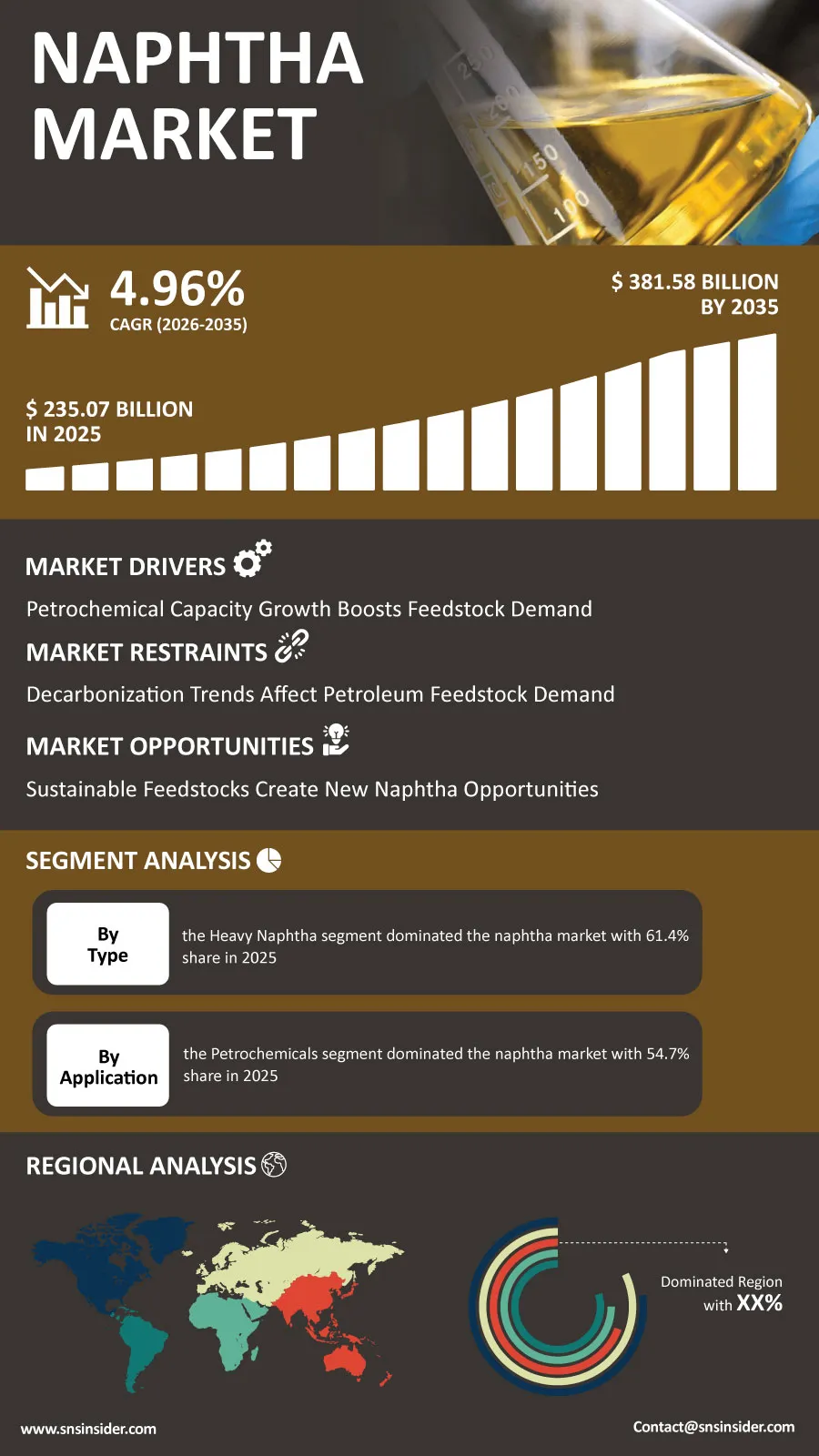
The global market for Naphtha is predicted to grow consistently as there is an increase in capacity to produce petrochemicals, and refineries develop integrated downstream value chains. “According to a recent study by SNS Insider, the global Naphtha Market size valued at USD 235.07 Billion in 2025, is anticipated to grow to USD 381.58 Billion by 2035, registering a CAGR of 4.96% over the 2026–2035 forecast period.”
Robust growth in the plastics, synthetic fibers, packaging materials and industrial chemicals sectors reinforces naphtha's importance as one of the key feedstocks for petrochemical production. As we rapidly industrialise in Asia, along with additional refining capacity dedicated to feedstock for these integrated cracker & petrochemical "complexes," naphtha as a steam-cracking feed is here to stay.
Refiners are also opting for more naphtha in gasoline-blending in an effort to enhance fuel quality and increase the refinery economics. Meanwhile, the rise in bio-based and recycled naphtha is also creating further commercial possibilities as chemical producers seek to decarbonise their feedstocks and get circular economy initiatives underway.
To Get Detailed Insights on the Naphtha Market – Request a Sample Report
Petrochemical Capacity Expansion Creates Long-Term Market Opportunities
Significant refinery-petrochemical integration investment worldwide is reshaping the global naphtha value chain. The significant increase in feedstock demands due to the commissioning of new steam crackers, chemical production facilities, and modernisation of refineries in emerging (and developing) economies.
Manufacturers are sprucing up on expanding production of ethylene, propylene, benzene and other key petrochemical intermediates needed in all automotive, consumer goods, electronics, construction and healthcare industries as Asia continues to dominate investment activity. Long-term products based on naphtha supply are also bolstered by the growing trend in urbanization and manufacturing output.
As well, the progress on producing recycled and bio-based naphtha are enabling more recycling and fulfiling sustainability goals which will help chemical producers reduce dependence on fossil based feedstock. Such innovations are expected to open more growth channels during the next ten years.
Key Market Insights Highlight Evolving Demand Trends
On the basis of type, global revenue from Heavy Naphtha reached 61.4% in 2025 due to its much better performance as a low-cost and preferred steam cracker feedstock for high-value olefins production Light Naphtha maintains is importance in gasoline blending, catalytic reforming and aromatic production.
Based on application, the Petrochemicals segment accounted for 54.7% of market revenue during 2025 owing to growing global demand for petrochemical feedstocks. With refiners continue refining the fuel formulations to meet with dynamic environmental regulations, Gasoline Blending continues to hold the second largest share among all applications.
By end-use industry, Chemical & Petrochemical accounted for 56.3% of the total market demand in 2025 due to continued capacity expansions at integrated refinery and chemical production facilities globally.
Sustainable Feedstocks and Refinery Innovation Reshape the Industry
Technology innovation across the naphtha market is becoming one of the major competitive differentiators. Producers are investing in advanced refining technologies, digital process optimization and integrated crude-to-chemicals platforms; swarm feedstock efficiency to enhance their profitability.
The partial commercialization of recycled naphtha (rNAPHTHA) recovered from plastic waste and bio-based naphtha built from renewable feedstocks is supporting the industry's move towards lower-carbon production models. Controlled polymer end-of-life options enable downstream chemical manufacturers (the petrochemical industry) to meet sustainability objectives without substantially compromising infrastructure compatibility.
Asia Pacific Led Global Naphtha Market Growth in 2025, While Middle East Expanded Refining Capacity
In 2025, Asia Pacific continued its position as the largest and fastest growing regional market, bolstered by rapid petrochemical expansion in China, India, South Korea and Southeast Asia. China does continue to invest heavily in integrated refinery and steam cracker complexes designed to support domestic manufacturing industries which are the longstanding source of regional consumption dominance.
North America continues to be largely relevant in terms of the global market especially with its large refining network and export-oriented supply chain. The plentiful availability of ethane has diminished demand for domestic naphtha cracking, but the area is still a large producer and exporter to international petrochemical markets.
Europe still provides a steady stream of demand through its mature chemical manufacturing, while the Middle East works towards establishing itself as a major supplier by enhancing refinery capacity and select downstream petrochemical investments that will facilitate exports and homegrown value contributions.
Industry Participants Focus on Integration and Sustainable Growth
Competitiveness in the international naphtha industry is determined by modernization of refining processes, integration of petrochemistry, efficiency of logistics operations, and investment in environmentally friendly raw materials. Large corporations keep developing their manufacturing capacities and improving their international trade networks to satisfy increasing demands of chemical companies.
Key companies operating in the global Naphtha Market include Saudi Aramco, Shell plc, ExxonMobil Corporation, BP plc, TotalEnergies SE, Sinopec Group, PetroChina Company Limited, ADNOC, Chevron Corporation, Reliance Industries Limited, INEOS Group Holdings S.A., LyondellBasell Industries N.V., SABIC, Hengli Petrochemical Co., Ltd., Rongsheng Petrochemical Co., Ltd., Petrobras, Kuwait Petroleum Corporation, Indian Oil Corporation Limited, Neste Corporation, and Vitol Group.
An SNS Insider analyst Himanshu Sharma commented, "Expanding petrochemical investments, refinery integration strategies, and growing demand for sustainable feedstocks are reshaping the global naphtha industry. Companies investing in advanced refining technologies, circular feedstock solutions, and integrated chemical production capabilities are expected to strengthen their competitive position as global petrochemical demand continues to rise."
About the Author

Get in touch




