
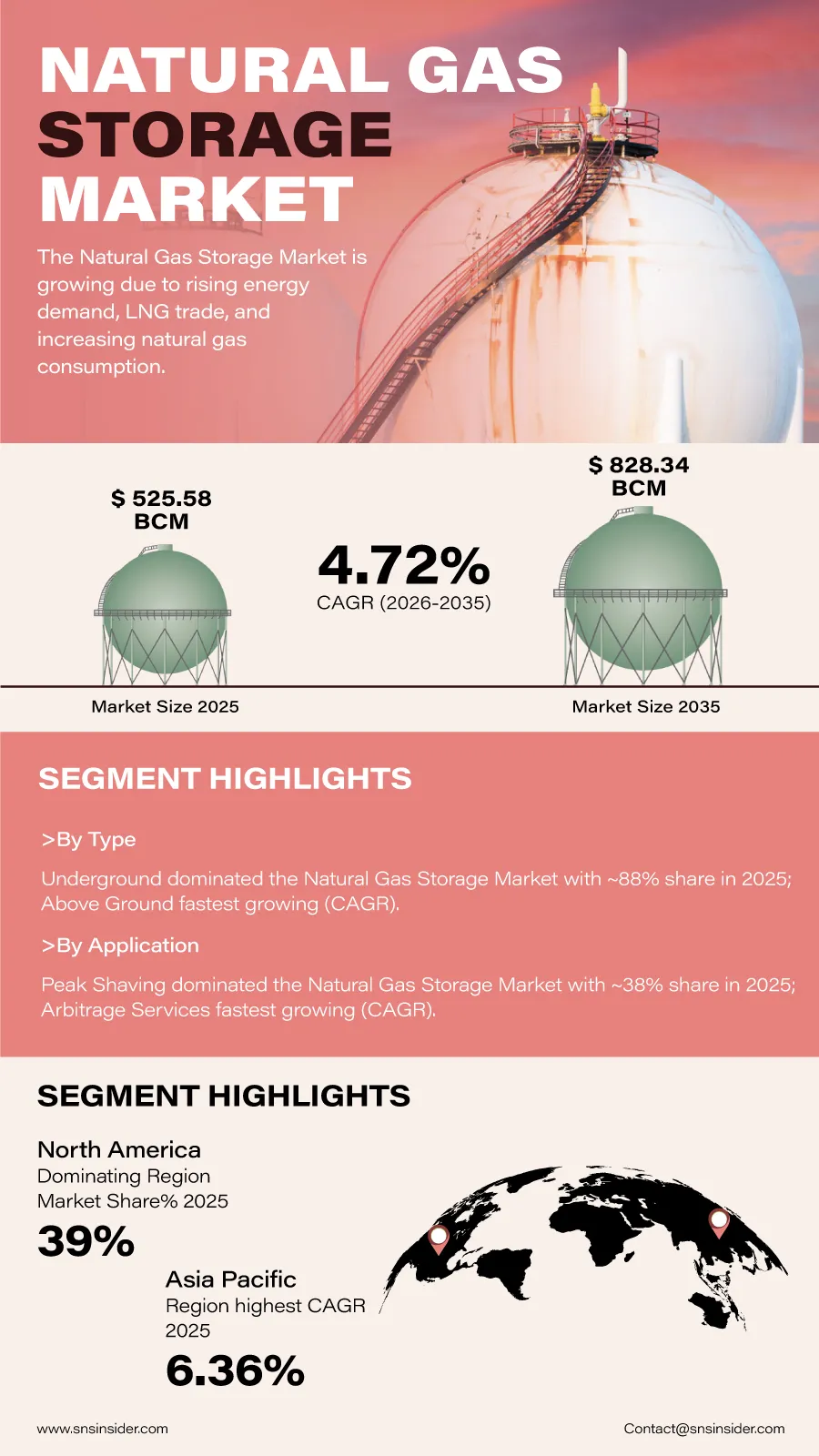
The global Natural Gas Storage Market is poised for steady expansion as countries strengthen energy security strategies, expand liquefied natural gas (LNG) infrastructure, and invest in resilient energy supply systems. According to a recent study by SNS Insider, the global Natural Gas Storage Market Size was valued at 525.58 BCM in 2025 and is projected to reach 828.34 BCM by 2035, registering a CAGR of 4.72% during the 2026–2035 forecast period.
Growing global demand for reliable energy supplies, coupled with rising natural gas consumption across residential, industrial, and power generation sectors, continues to reinforce the importance of storage infrastructure. Governments and energy companies are expanding storage capacity to improve supply reliability during seasonal demand peaks, mitigate market volatility, and support long-term energy planning.
The rapid expansion of LNG trade, evolving geopolitical dynamics, and increasing dependence on natural gas as a transition fuel are further accelerating investments in underground storage facilities, pipeline infrastructure, and advanced storage technologies. As renewable energy deployment increases worldwide, natural gas storage is also playing a critical role in maintaining grid stability and balancing intermittent power generation.
Energy Security Initiatives Continue to Create New Growth Opportunities
The global energy landscape is placing greater emphasis on supply resilience and infrastructure modernization. Storage facilities are becoming increasingly important for maintaining uninterrupted energy availability during periods of fluctuating demand, unexpected supply disruptions, and extreme weather events.
Growing investments in LNG terminals, cross-border pipeline networks, and strategic gas reserves are creating favorable conditions for market expansion. At the same time, digital monitoring systems, advanced reservoir management technologies, and storage optimization solutions are improving operational efficiency while reducing environmental risks.
Hybrid energy systems that integrate renewable electricity generation with natural gas storage are also gaining attention as utilities seek greater flexibility in balancing electricity supply and demand while supporting decarbonization objectives.
Key Market Insights Highlight Shifting Demand Patterns
By application, peak shaving is expected to account for approximately 38% of global market revenue in 2025, driven by the need to maintain uninterrupted gas supplies during periods of elevated seasonal demand. Meanwhile, arbitrage services are projected to register the fastest growth through 2035 as increasing price volatility and expanding LNG trade create new commercial opportunities for storage operators.
Based on storage type, underground storage is forecast to dominate the global market with nearly 88% of revenue share in 2025 due to its large storage capacity, cost efficiency, and long-term reliability. Above-ground storage is anticipated to witness the fastest growth over the forecast period as LNG infrastructure expands and demand increases for flexible, rapidly deployable storage solutions.
Among end users, gas utilities are expected to generate around 34% of market revenue in 2025 owing to their critical role in ensuring continuous natural gas supply across residential, commercial, and industrial sectors. Power generation companies are projected to emerge as the fastest-growing end-user segment as gas-fired power plants continue supporting electricity grid stability alongside renewable energy deployment.
An Infographic Representation of the Global Natural Gas Storage Market
Storage Infrastructure Becomes Central to the Energy Transition
Natural gas storage is increasingly serving as a strategic asset within modern energy systems by enabling greater operational flexibility and improving overall supply resilience. Storage facilities help stabilize energy markets by reducing exposure to short-term supply disruptions while supporting long-term infrastructure planning.
Technology providers are also introducing more sophisticated monitoring systems, predictive maintenance tools, and digital asset management platforms to improve storage efficiency, optimize inventory management, and strengthen environmental compliance. These innovations are helping operators maximize storage utilization while enhancing safety and operational performance.
As global energy systems continue evolving, investments in integrated storage infrastructure are expected to play an increasingly important role in supporting both conventional natural gas operations and emerging low-carbon energy strategies.
Regional Markets Demonstrate Strong Growth Potential
North America is expected to account for approximately 39% of global market revenue in 2025, supported by extensive underground storage infrastructure, abundant shale gas production, and a highly developed pipeline network. Continued investments in LNG exports and seasonal supply management continue to reinforce the region's leadership position.
Asia Pacific is projected to be the fastest-growing regional market, expanding at a CAGR of 6.36% through 2035. Rapid industrialization, growing LNG imports, expanding gas infrastructure, and government initiatives aimed at strengthening energy security are driving significant investments across major regional economies.
As countries continue diversifying their energy portfolios while enhancing supply reliability, demand for modern natural gas storage facilities is expected to remain robust across both developed and emerging markets.
Industry Participants Focus on Capacity Expansion and Infrastructure Modernization
The competitive landscape continues to evolve as major energy companies invest in storage expansion, digital asset optimization, LNG infrastructure, and integrated pipeline networks. Companies are prioritizing operational efficiency, infrastructure resilience, and advanced storage technologies to strengthen their competitive positioning amid changing global energy dynamics.
Key companies operating in the global Natural Gas Storage Market include Gazprom PJSC, China National Petroleum Corporation (CNPC), Engie SA, TC Energy Corporation, Kinder Morgan Inc., Enbridge Inc., Sempra Infrastructure, National Grid plc, Equinor ASA, Uniper SE, Dominion Energy, Korea Gas Corporation, Tokyo Gas Co., Ltd., PetroChina Company Limited, Royal Vopak N.V., Chiyoda Corporation, Worley Limited, Technip Energies, Niska Gas Storage Partners, and Energy Transfer LP.
An SNS Insider analyst Santosh Bhul commented, “Growing emphasis on energy security, expanding LNG trade, and increasing integration of renewable energy systems are reinforcing the strategic importance of natural gas storage worldwide. Companies investing in infrastructure modernization, digital optimization, and flexible storage capabilities will be well positioned to capitalize on long-term market opportunities.”
About the Author

Get in touch




