
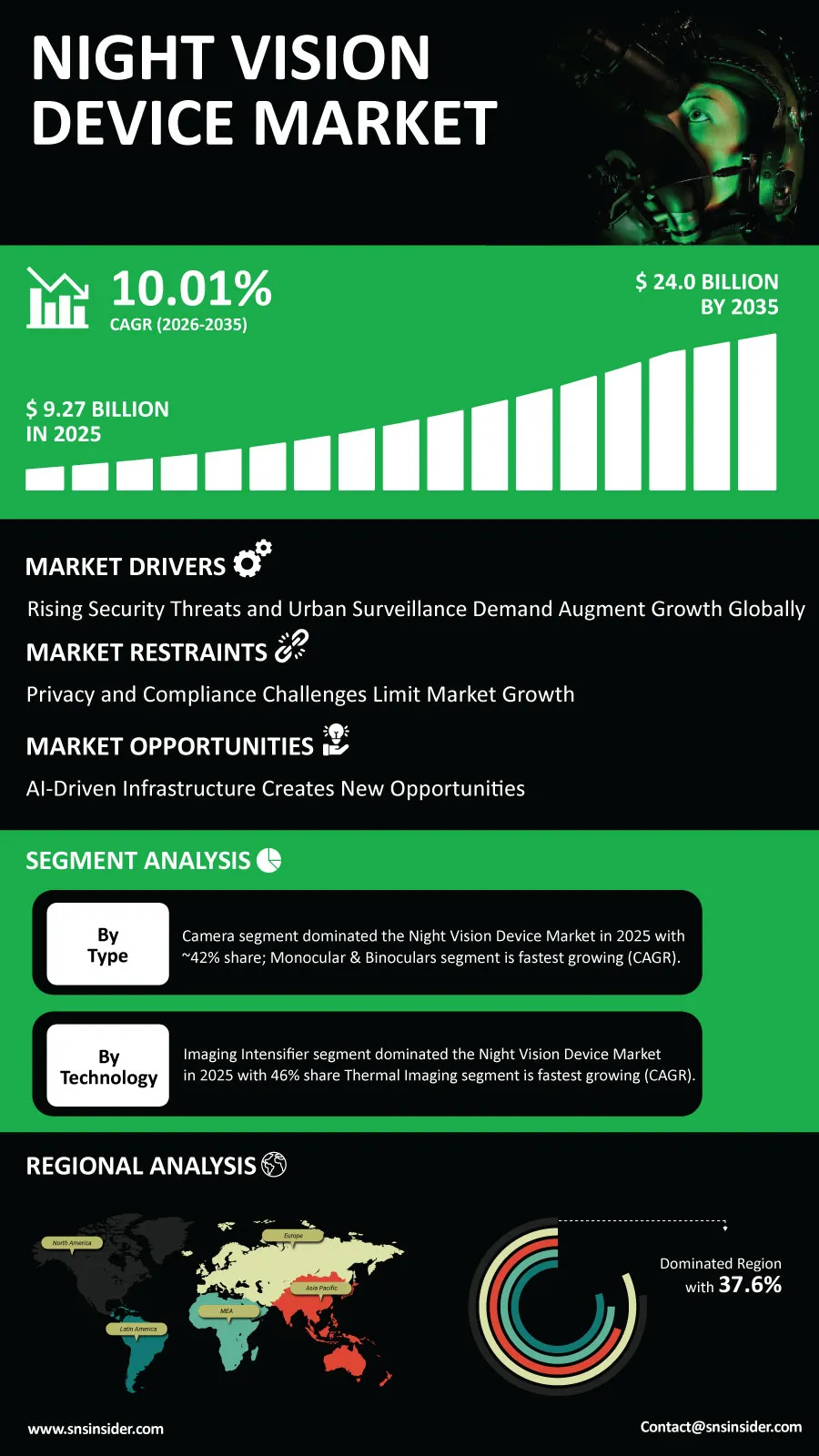
The global Night Vision Device Market is experiencing strong expansion as defense agencies, security organizations, and commercial users increase investments in advanced low-light imaging technologies. According to a recent study by SNS Insider, the global Night Vision Device Market size valued at USD 9.27 billion in 2025, is anticipated to grow to USD 24.0 billion by 2035, registering a CAGR of 10.01% over the 2026–2035 forecast period.
Geopolitical instability, increased border security needs, and military upgrade initiatives are prompting countries to increase their capacity for nighttime operations. Meanwhile, the advancements in thermal imaging, infrared detection, and digital image processing are enhancing the flexibility of night vision technology for use in surveillance, rescue operations, industrial testing, and outdoor activities.
Moreover, the further advancement of small-size and portable devices for image processing is broadening the market reach. With advancements in image quality, battery performance, and ergonomic design, night vision technology is increasingly transitioning from its conventional defense applications to commercial and recreational fields.
To Get Detailed Insights on the Night Vision Device Market – Request a Sample Report
Defense Modernization and Intelligent Imaging Create New Growth Opportunities
Equipment upgrade efforts of military establishments around the world are currently focusing on providing their staffs with improved situational awareness in low-visibility scenarios. Night vision technologies are being incorporated into infantry, surveillance, border patrol systems, and other areas of military operations. This has resulted in a rise in demand for advanced optical and thermal technologies.
Moreover, growth in investments in homeland security and infrastructure protection creates further prospects for development. Various law enforcement agencies are increasingly employing night vision equipment for perimeter protection, search and rescue, and nighttime surveillance applications.
On the other hand, there is the advent of innovation brought about by the fusion between artificial intelligence and the usage of thermal and infrared imaging. The application of artificial intelligence to improve night-time surveillance will aid in increasing the speed and efficiency of the process.
Key Market Insights Highlight Shifting Demand Patterns
By type, camera-based night vision devices are expected to account for approximately 42% of global market revenue in 2025, supported by extensive use in security, surveillance, and inspection activities. Monocular and binocular devices are projected to register the fastest growth as demand increases for lightweight, portable systems used in defense, wildlife observation, outdoor recreation, and emergency response.
Based on technology, image intensifier systems are anticipated to lead the market with approximately 46% of revenue in 2025. Their established use across military and security applications, combined with reliable low-light performance, continues to support widespread adoption. Thermal imaging is expected to be the fastest-growing technology segment as demand rises for visibility in complete darkness and challenging environmental conditions.
By end use, security and surveillance are projected to represent around 39% of market revenue in 2025, driven by growing requirements for continuous monitoring of borders, infrastructure, and public facilities. Wildlife conservation is forecast to experience the fastest growth as agencies and researchers increasingly use portable imaging systems for habitat monitoring, anti-poaching operations, and nocturnal animal studies.
By vertical, government, military, and defense applications are expected to dominate with approximately 68% of market revenue in 2025. Meanwhile, the consumer segment is anticipated to grow at the fastest pace as more affordable devices gain popularity among outdoor enthusiasts, hunters, campers, and adventure users.
AI and Sensor Fusion Reshape Nighttime Surveillance
The integration of technologies such as thermal imaging, infrared sensing, image processing, and analytics using artificial intelligence will enable greater intelligence in future night vision devices. High-end night vision systems could use multiple feeds of data to enhance the ability to detect targets and help operators gain better situational awareness.
Manufacturers are also focusing on compact designs and improved power efficiency, enabling longer field operations without significantly increasing equipment weight. These advances are expected to encourage adoption across military, law enforcement, industrial, and recreational markets.
North America Holds 37.6% Market Share in 2025 as Asia Pacific Emerges as the Fastest-Growing Region
North America is poised to retain its dominant share with an estimated market revenue of 37.6% in 2025. High levels of defense expenditure, defense modernization efforts, research and development activities, and continuous need for surveillance systems are key drivers behind market growth in the region.
Asia-Pacific region is anticipated to be the fastest growing one on account of increased defense spending by nations, border surveillance needs, and modernization of military capabilities in the region. Increased investments in thermal imaging and image intensification technologies in the developing nations are providing lucrative market opportunities.
Europe is witnessing robust demand for thermal imaging and image intensification technologies driven by defense modernization, border protection, and increasing use of imaging systems in law enforcement and emergencies. At the same time, markets in the Middle East, Africa, and Latin American regions are growing steadily with rising security needs.
Industry Participants Focus on Next-Generation Imaging Innovation
The competitive landscape remains dynamic as defense contractors and imaging specialists invest in improved sensor performance, compact device architectures, AI-assisted detection, and multi-sensor fusion. Strategic collaborations with military organizations and government agencies are also helping companies accelerate technology development and secure large-scale procurement opportunities.
Key companies operating in the global Night Vision Device Market include L3Harris Technologies Inc., RTX Corporation (Raytheon), BAE Systems plc, Elbit Systems Ltd., Teledyne FLIR LLC, Thales Group, Northrop Grumman Corporation, Collins Aerospace (RTX), Hensoldt AG, ATN Corp., Photonis Group, Photon Dynamics Inc., Harris Night Vision, Night Optics USA Inc., SIGHTMARK LLC, Pulsar, Hikvision Digital Technology Co. Ltd., FLIR Systems, Leonardo DRS, and DRS Technologies.
An SNS Insider analyst Sushant Kadam commented, “Defense modernization, growing nighttime surveillance requirements, and rapid advances in thermal and AI-enabled imaging are creating a strong foundation for market expansion. Companies that combine superior low-light performance with compact designs, intelligent analytics, and multi-sensor capabilities will be well positioned to benefit from the next phase of growth.”
About the Author

Get in touch




