
Image Intensifier Market Report Scope & Overview:
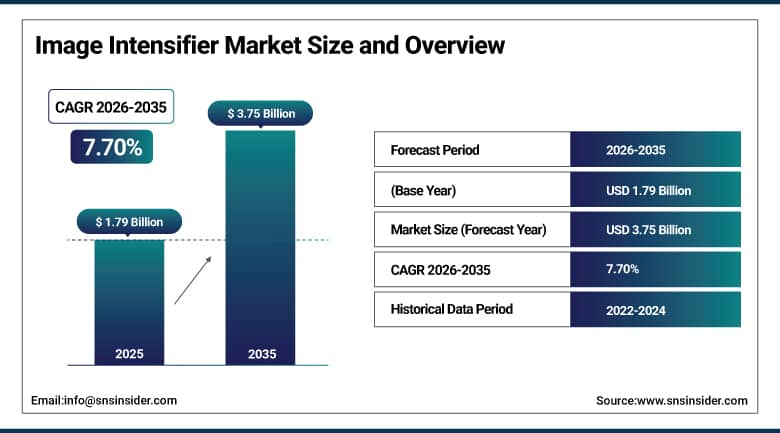
The Image Intensifier Market size was USD 1.79 Billion in 2025 and is expected to reach USD 3.75 Billion by 2035, growing at a CAGR of 7.70% from 2026–2035.
The Image Intensifier Market is growing steadily owing to increasing demand for image intensifiers from the defense, surveillance, and security industries. The increasing geopolitical instability coupled with the modernization of defense equipment has led to an increase in the adoption of image intensifier tubes in goggles, scopes, and cameras. Besides, the increasing applications in the medical imaging and industrial inspection fields have contributed significantly to the growth of the market. Advancements in technology like increased resolution, smaller size, and durability have helped improve the efficiency of the products.
Supporting this trend, the U.S. Department of Defense reports annual defense spending exceeding USD 840 billion (FY2024), with significant allocations toward soldier modernization, night vision systems, and ISR technologies. The Stockholm International Peace Research Institute (SIPRI) reports that Asia accounted for over 50% of global military expenditure growth in recent years, reflecting aggressive defense modernization efforts.
To Get More Information On Image Intensifier Market - Request Free Sample Report
Image Intensifier Market Trends:
-
Rising demand for low-light and night vision imaging in military and defense applications driving adoption of image intensifier technologies
-
Growing use in surveillance and security systems to enhance visibility in darkness and challenging environmental conditions
-
Increasing integration in medical imaging and diagnostic equipment supporting real-time visualization during minimally invasive procedures
-
Expanding application in scientific research, industrial inspection, and aerospace sectors requiring high-sensitivity image amplification
-
Continuous advancements in photocathode materials and microchannel plate technologies improving image resolution, sensitivity, and overall device performance
U.S. Image Intensifier Market Outlook:
The U.S. Image Intensifier Market was valued at approximately USD 0.51 Billion in 2025. It is expected to reach approximately USD 1.06 Billion by 2035, growing at a CAGR of approximately 7.53%.
The growth of the U.S. image intensifier market is due to increasing demand for advanced night vision systems, especially in military and defense applications. U.S. military personnel are using more advanced equipment including the Enhanced Night Vision Goggle-Binocular for surveillance and reconnaissance. Law enforcement agencies and industrial sectors are also adopting image intensifiers as they enhance safety and operational efficiency in low-light conditions. Increasing application in medical imaging, aerospace, and automotive is expected to further spur U.S. market growth. Development of solid-state technologies, greater energy efficiency, and incorporation of digital systems are further fueling domestic market expansion.
The U.S. Army Night Vision and Electronic Sensors Directorate confirms ongoing upgrades to image intensifier goggles, helmet-mounted night vision systems, and weapon-mounted low-light scopes.
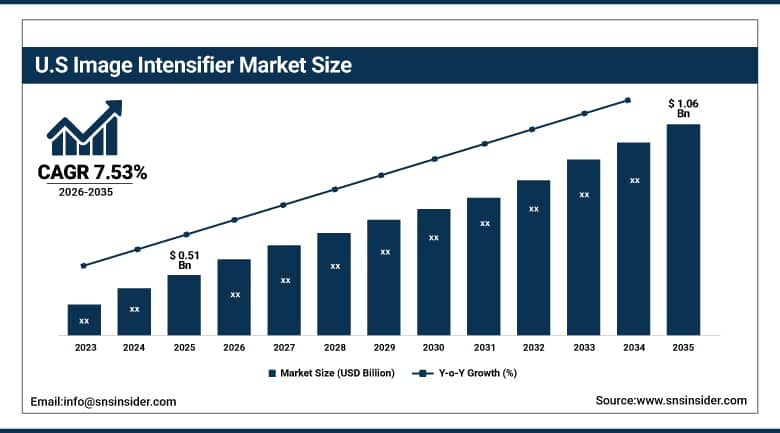
Image Intensifier Market Segment Analysis:
-
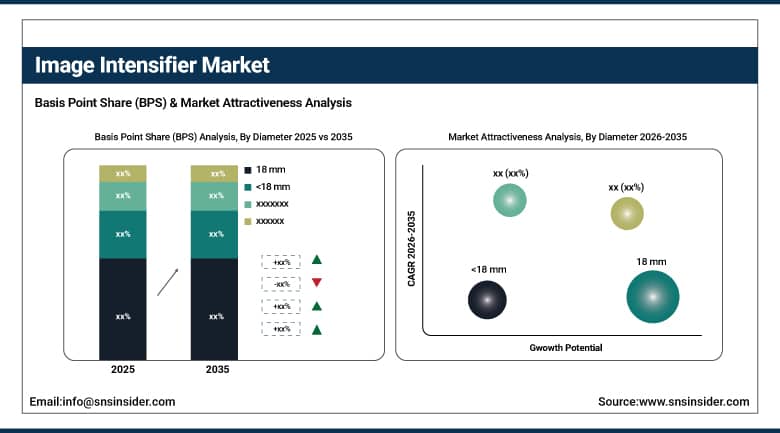
By Diameter, 18 mm segment dominated the Image Intensifier Market in 2025 with 34% share; <18 mm segment is the fastest growing segment.
-
By Application, Goggles segment dominated the market in 2025 with 38% share; X-Ray Detectors segment is the fastest growing segment.
-
By Vertical, Defense and Surveillance segment dominated the market in 2025 with 52% share; Medical segment is the fastest growing segment.
By Diameter, 18 mm segment dominates the Image Intensifier Market, <18 mm segment expected to grow fastest
The 18 mm segment dominated the Image Intensifier Market because of its popularized combination of compact nature, higher resolution, and efficient performance in low-light imaging. They are widely employed in night vision systems, surveillance systems, and defense applications where efficiency and accuracy of the image matter most. Moreover, being integrated into military devices along with being highly effective makes 18 mm image intensifiers more popular. Also, their wide range of applicability in various imaging applications and demand from the defense and security sectors contributes to their market dominance.
The <18 mm segment is the fastest growing owing to increasing demand for small-sized and lightweight imaging equipment for defense, surveillance, and even medical uses. With increased advancements in the field of miniaturization and sensor efficiency, better performance in smaller formats is becoming feasible now. These imaging systems find use in portable night vision equipment, wearables, and advanced medical diagnostic instruments. The growing focus on portability and higher imaging precision is fueling its adoption.
By Application, Goggles segment dominates the Image Intensifier Market, X-Ray Detectors segment expected to grow fastest
The Goggles segment dominated the Image Intensifier Market owing to the wide application of night vision goggles in the areas of defense, law enforcement, and tactical purposes. The night vision goggles offer real-time visibility enhancement during low light and dark conditions. Thus, they become a must-have tool for military operations and surveillance. The high-quality of imaging, durability, and reliability have fueled the demand for such gadgets. Constantly evolving technology and increased attention to securing borders and nighttime operations add to the dominance of this category in the market.
The X-Ray Detectors segment is the fastest growing because of the growing application of the advanced imaging technologies in the health care and industrial sectors. The image intensifiers help to improve image quality and ensure real-time visualization during diagnostic procedures. The increasing need for non-invasive diagnostics, the development of health care facilities, and the application in radiology and fluoroscopy are the factors driving the category's growth. Moreover, technological development and precision of imaging contribute to the growth of this category.
By Vertical, Defense & Surveillance segment dominates the Image Intensifier Market, Medical segment expected to grow fastest
The Defense and Surveillance segment dominated the Image Intensifier Market owing to high demand for night vision devices for use in military missions, border security, reconnaissance, and surveillance. Governments around the world are focusing on acquiring sophisticated imaging technologies in order to enhance situational awareness and increase efficiency in the low light conditions. Increasing need for security, modernization of the military equipment, and geopolitical tension are some other reasons for adoption which are contributing towards maintaining the leadership of the segment.
The Medical segment is the fastest growing due to increasing applications of image intensifiers in various medical imaging procedures like fluoroscopy and interventional radiology. Growing prevalence of chronic diseases and demand for accurate and timely imaging are boosting the adoption of image intensifiers. Growth of the healthcare sector and emphasis on minimal invasive procedures are providing a boost to the adoption of image intensifiers in the healthcare industry.
Regional Analysis:
|
Region |
Major Country |
Share within Region, 2025 (%) |
|---|---|---|
|
North America |
United States |
82.5% |
|
Europe |
Germany |
24.6% |
|
Asia Pacific |
China |
40.6% |
|
Middle East & Africa |
UAE |
22.8% |
|
Latin America |
Brazil |
43.8% |
North America Image Intensifier Market Insights
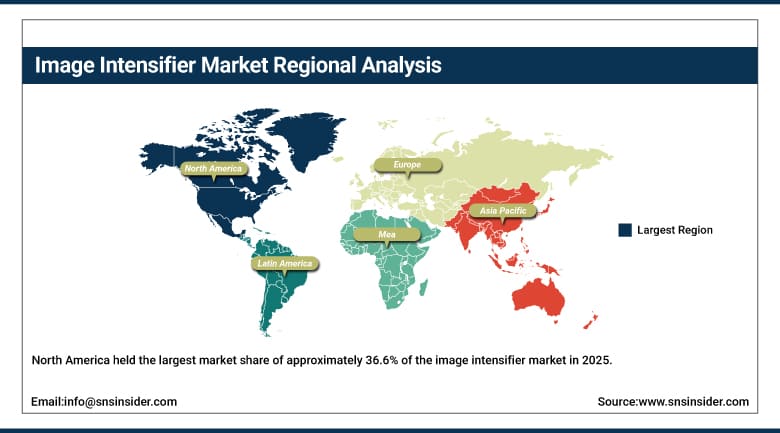
North America held the largest market share of approximately 36.6% of the image intensifier market in 2025. The United States is the major force in this dominance, with its massive military spending and investments in sophisticated surveillance and weapons systems. The U.S. military relies heavily on night vision goggles, scopes, and other imaging systems for global operations, sustaining consistent procurement demand. Early adoption of X-ray detectors in medical imaging within the U.S. healthcare sector provides stability to the regional market.
The United States accounts for approximately 82.5% of North American revenue. Major companies including L3Harris Technologies, Teledyne, and Excelitas are involved in the innovation of new image intensifiers, reinforcing the U.S. position. This combination of military procurement and technological leadership keeps North America firmly in the lead.
Get Customized Report as Per Your Business Requirement - Enquiry Now
Europe Image Intensifier Market Insights
Europe represents a meaningful image intensifier market, supported by NATO defense investment and strong medical imaging infrastructure. Germany leads the regional market, backed by strong defense electronics manufacturing and medical technology investment. France and the UK contribute meaningful demand through their own defense procurement programs and healthcare imaging needs.
Germany accounts for approximately 24.6% of European revenue. Thales Group and other European defense electronics companies maintain significant regional image intensifier manufacturing capacity. Rising NATO defense spending commitments are reinforcing European military night vision procurement.
European Commission highlights increased investment in border surveillance systems under Frontex, which manages operations across more than 13,000 km of external EU borders, thereby driving demand for low-light imaging technologies. Additionally, NATO forces are actively upgrading infantry vision systems, replacing legacy optics with Gen-3+ night vision devices and image intensifier-based goggles and scopes to enhance night operational capabilities.
Asia Pacific Image Intensifier Market Insights
Asia Pacific is projected to experience the highest CAGR through the forecast period. Guided by increasing defense budgets in China, India, and Japan, there is a growing requirement and procurement of sophisticated night vision and surveillance systems. China is increasingly using the latest technologies for national defense and border security. India's rising security concerns are contributing to demand for night vision devices as part of military modernization.
China accounts for approximately 40.6% of Asia Pacific revenue. Companies including Tianjin Zhongke and Hikvision are expanding their presence in the growing regional market. Growing investments in infrastructure and healthcare in Asia Pacific are also fueling regional growth in industrial and medical applications.
China’s Ministry of National Defense continues to expand investment in border surveillance systems, night operations capability, and electro-optical reconnaissance platforms. India’s Ministry of Defence has also allocated approximately INR 5.94 trillion in FY2025, with increased emphasis on night vision equipment and soldier modernization programs.
MEA & Latin America Image Intensifier Market Insights
The UAE leads MEA revenue at approximately 22.8%. Growing defense and security investment and expanding healthcare infrastructure both support regional demand. Saudi Arabia is also expanding its defense modernization investment significantly.
Brazil leads Latin American revenue at approximately 43.8%. Growing security and defense spending and expanding medical imaging access drive regional demand. Mexico and Argentina contribute secondary demand through their own expanding defense and healthcare sectors.
Market Dynamics:
Growth Drivers: Rising defense budgets and technological advancements fueling demand
The increased need for night vision devices in a variety of defense and surveillance applications is the key factor influencing market growth. Growing defense budgets of the major economies due to escalating geopolitical uncertainties will help boost the adoption of sophisticated night vision technologies, such as image intensifiers in goggles, scopes, and cameras used by militaries. The use of X-ray detectors in various applications like medical imaging, industrial inspection, and security screening helps drive market growth.
Developments like high resolution, high signal-to-noise ratio, and increased sensitivity through technological innovations make the products more appealing for various applications. As geopolitical uncertainty continues to fuel defense spending across the globe, this factor will continue to remain influential throughout the forecast period.
Restraints: Competition from alternative technologies and regulatory hurdles
The stiff competition from other technologies such as CMOS and CCDs is one of the major threats. The products that use digital imaging are superior to image intensifiers in terms of sensitivity to light, durability and longevity. The short life span of the image intensifier tube due to burnout of the phosphor screen and cathode wear out is a serious threat to reliability.
Strict regulations in regards to the acceptance and export of night vision and image intensified systems especially in defense applications is another factor that causes concern for manufacturers working across different geographic locations. The market geography is limited for U.S manufacturers owing to the export control regulations of ITAR (International Traffic in Arms Regulations).
Opportunities: Miniaturization, AR integration, and hybrid technology creating new growth
Market opportunities are arising due to miniaturization and lightweight image intensifiers, particularly for wearable Gen III night vision. The increase in adoption of augmented reality and AI-integrated imaging solutions offers attractive opportunities in military and industrial sectors. R&D investments to improve low-light image capture technology and the development of hybrid systems that blend digital and analog technologies will create additional growth opportunities.
The growing application of wearable computing and AR headsets is creating fresh market opportunities for ultra-compact image intensifier tubes. Growing defense budgets and industrial growth in Asia Pacific provide expansion prospects for market players. As AR and hybrid imaging technology keep maturing, this opportunity should keep expanding through the forecast period.
Recent Developments:
-
2025: Excelitas Technologies launched the pco.edge 9.4 bi CLHS sCMOS camera in January 2025, offering high-resolution imaging with photon-counting capabilities and ultra-low readout noise for scientific imaging.
-
2025: L3Harris Technologies secured a USD 263 million contract from the U.S. Army in January 2025 for continued production of its Enhanced Night Vision Goggle-Binocular (ENVG-B) systems.
-
2024: Teledyne Technologies expanded its scientific imaging portfolio with new image-intensified sCMOS systems for spectroscopy and ultrafast imaging research applications.
Image Intensifier Market Key Players are:
-
Photonis Technologies
-
Hamamatsu Photonics K.K.
-
L3Harris Technologies
-
Teledyne Technologies Incorporated
-
Elbit Systems Ltd.
-
BAE Systems plc
-
Thales Group
-
Leonardo S.p.A.
-
RTX Corporation (Raytheon Technologies)
-
Excelitas Technologies Corp.
-
Xenics (Exosens Group)
-
FLIR Systems (Teledyne FLIR)
-
Newcon Optik
-
KATOD Ltd.
-
Bharat Electronics Limited (BEL)
-
Ophir Optronics Solutions
-
Night Vision Devices (NVD) Inc.
-
ACTinBlack
-
Harder Digital GmbH
-
DEP Photonics
Image Intensifier Market Report Scope:
| Report Attributes | Details |
|---|---|
| Market Size in 2025 | USD 1.79 Billion |
| Market Size by 2035 | USD 3.75 Billion |
| CAGR | CAGR of 7.70% From 2026 to 2035 |
| Base Year | 2025 |
| Forecast Period | 2026-2035 |
| Historical Data | 2022-2024 |
| Report Scope & Coverage | Market Size, Segments Analysis, Competitive Landscape, Regional Analysis, DROC & SWOT Analysis, Forecast Outlook |
| Key Segments | • By Diameter (<18 mm, 18 mm, 25 mm, >25 mm, <6 inch, 6 inch, 9 inch, 12 inch, 16 inch) • By Application (Cameras, Scopes, Googles, X-Ray Detectors) • By Vertical (Medical, Defense and Surveillance, Industrial, Others) |
| Regional Analysis/Coverage | North America (US, Canada), Europe (Germany, UK, France, Italy, Spain, Russia, Poland, Rest of Europe), Asia Pacific (China, India, Japan, South Korea, Australia, ASEAN Countries, Rest of Asia Pacific), Middle East & Africa (UAE, Saudi Arabia, Qatar, South Africa, Rest of Middle East & Africa), Latin America (Brazil, Argentina, Mexico, Colombia, Rest of Latin America). |
| Company Profiles | Photonis Technologies, Hamamatsu Photonics K.K., L3Harris Technologies, Teledyne Technologies Incorporated, Elbit Systems Ltd., BAE Systems plc, Thales Group, Leonardo S.p.A., RTX Corporation (Raytheon Technologies), Excelitas Technologies Corp., Xenics (Exosens Group), FLIR Systems (Teledyne FLIR), Newcon Optik, KATOD Ltd., Bharat Electronics Limited (BEL), Ophir Optronics Solutions, Night Vision Devices (NVD) Inc., ACTinBlack, Harder Digital GmbH, DEP Photonics. |
Frequently Asked Questions
The Image Intensifier Market is expected to grow at a CAGR of 7.70% from 2026 to 2035.
The Image Intensifier Market was valued at USD 1.79 Billion in 2025.
Rising defense budgets, increasing demand for night vision systems, and growing X-ray detector adoption in medical imaging are the primary growth factors.
The Defense and Surveillance segment dominated the market.
North America dominated the Image Intensifier Market.
