
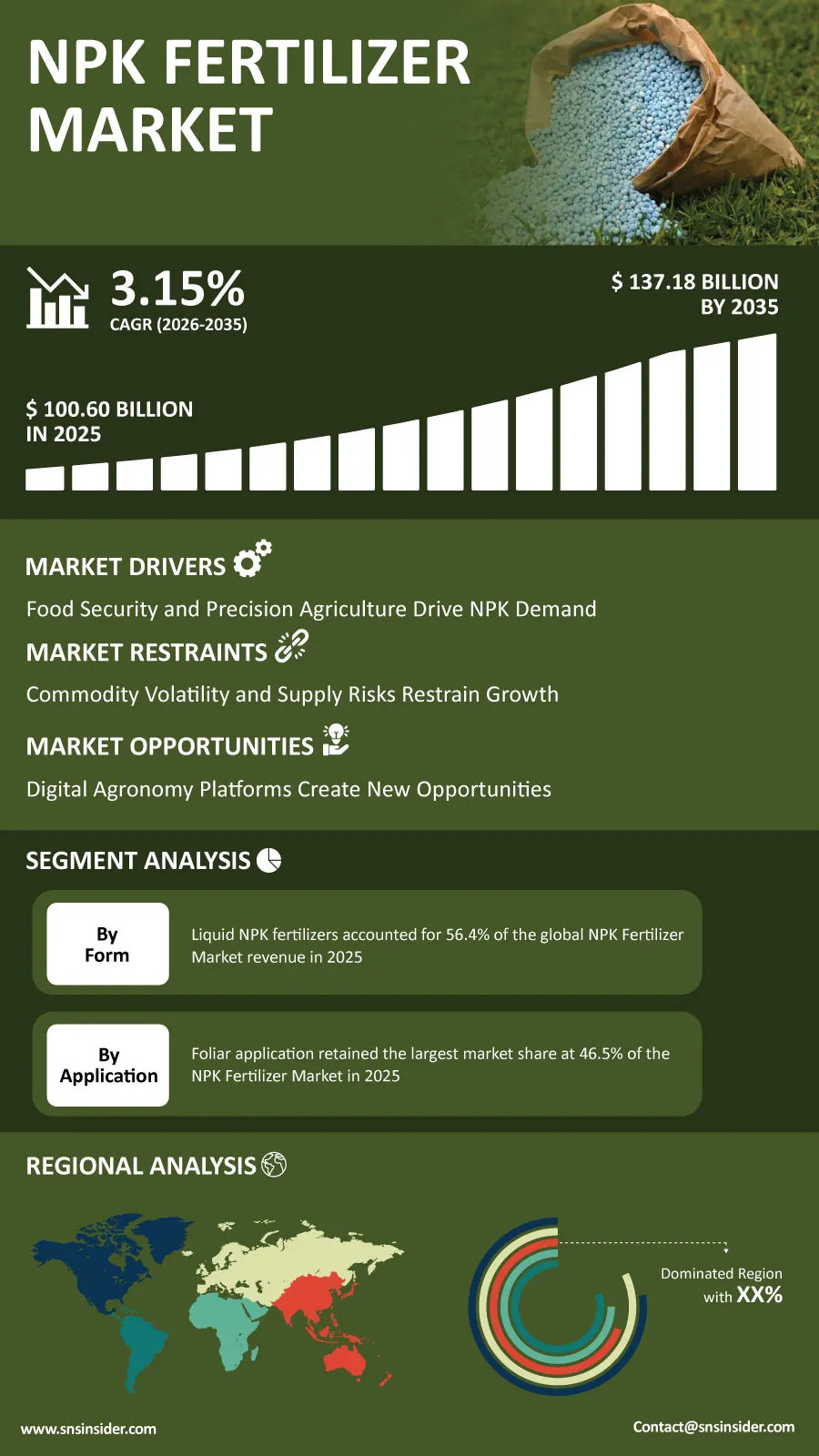
The global NPK Fertilizer Market is forecasted to grow steadily in future, driven by the need for increased production of crops and effective nutrient management among agricultural producers around the world. “According to a recent study by SNS Insider, the global NPK Fertilizer Market size valued at USD 100.60 Billion in 2025, is anticipated to grow to USD 137.18 Billion by 2035, registering a CAGR of 3.15% over the 2026–2035 forecast period.”
Increased need for increased agricultural productivity while maintaining soil fertility has been leading to increased use of balanced nutrients. Advanced fertilizer technology that increases nutrient availability, improves the performance of crops, and reduces nutrient loss is increasingly being adopted by farmers. Continued advancement in the field of precision farming technologies, through the help of digital agronomy platforms and intelligent nutrient applications, is revolutionizing the fertilizer industry both in developed and developing agricultural economies.
Increased modernization of farming processes together with increased irrigation facilities and nutrient application facilities is leading to increased demand in the future. Manufacturers have also increased efforts towards development of enhanced efficiency fertilizers that increase nutrient efficiency and meet environmental targets.
To Get Detailed Insights on the NPK Fertilizer Market – Request a Sample Report
Precision Agriculture and Sustainable Farming Create Long-Term Growth Opportunities
Governments and private ostentatiously are still placing investments in technologies that positively influence agricultural productivity and resource efficiency. By using satellite imagery, soil analysis coupled with GPS-guided equipment and real-time crop monitoring, precision agriculture helps growers apply fertilizer during the optimal window of opportunity without sacrificing input costs.
Increasing demand for controlled-release and specialty fertilisers is opening room for manufacturers to tap into new commercial opportunities. The development of coat technologies enhanced by crop-specific nutrient blends is speeding up advances in minimizing leaching and volatilization as well as promoting regulatory compliance for water quality and greenhouse gas emissions.
Increasing focus on expanding adoption of fertigation systems, greenhouse cultivation, and high-value horticultural production is fuelling growth in demand for water-soluble nutrient formulations. These technologies allow for a more flexible and advanced approach with regard to nutrient management, while also enhancing irrigation efficiency and supporting other sustainable agricultural production goals.
Key Market Insights Highlight Shifting Demand Patterns
By the form Liquid NPK fertilizers held 56.4% of global market revenue in 2025 due to their fast availability of nutrients and can be used with precision irrigation systems. The Dry and Granular NPK products are likely to retain robust demand in support of large dryland/cereal production over the long term because these products can be stored indefinitely, cost-effective and appropriate for mechanized farming processes.
Cereals & Grains accounted for 39.1% of total market demand by crop type in 2025, underscoring the importance of staple crop production on global food security. Fruits & Vegetables are expected to achieve the highest growth through 2035 as growers turn to tailored nutrient programs to optimise quality and yield.
Based on the method of application, Foliar Application segment accounted for 46.5% market share in 2025 owing to its fast absorption of nutrients during critical crop growth periods. As precision irrigation systems are rolled out among commercial farming practices, fertigation is expected to register the highest growth rate over the forecast period.
Advanced Nutrient Technologies Accelerate Agricultural Transformation
Ongoing innovations in technology disrupt the fertiliser sector, including digital nutrient management platforms, controlled-release formulations and agronomic solutions driven by big data. Agribusinesses are using artificial intelligence, remote sensing, weather analytics, and precision application technologies in order to optimize nutrients while mitigating environmental externalities.
The next-generation fertilizer products are being developed based on research into polymer-coated fertilizers, bio-based nutrient carriers and customized crop nutrition programs. With these innovative products, the producers can timely deliver nutrients based on crop needs, leading to improved fertilization while reducing the cost of operation for growers.
Asia Pacific Accounted for the Largest Share of the NPK Fertilizer Market in 2025; North America Forecast to Grow at the Fastest CAGR During 2026–2035
The NPK Fertilizer Market in 2025 was dominated by Asia Pacific, owing to large scale agriculture across China, India, Indonesia and Southeast Asia. This reliance is fortified by continued strong government support for food security, possibly expanding fertilizer subsidy programs and greater adoption of modern farming practices.
North America region is estimated to be the one of the fastest growing region in the market, during forecast period. Some of the factors which have initiated sustain market growth across the region includes growing penetration of precision agriculture, investments in controlled-release fertilizer technologies, expansion of fertigation infrastructure and development of advanced digital farm management systems.
Stable demand remains in Europe as sustainable farming regulations create incentives to use eco-friendly fertilizer products. On the other hand, Latin America and Middle East & Africa continue to show rising fertilizer use supported by increasing commercial agriculture, irrigation development along with government-supported agricultural modernization programs.
Industry Participants Focus on Innovation and Sustainable Crop Nutrition
The environment continues to be very competitive because the top producers increase their production capacities, enhance their digital agronomy systems, and develop new fertilizer technologies with higher efficiency. Investments in efficient nutrient management, customized formulations, and sustainable production processes help producers to meet the changing needs of agriculture and ensure global food supply in the future.
Key companies operating in the global NPK Fertilizer Market include Yara International ASA, Nutrien Ltd., The Mosaic Company, EuroChem Group AG, ICL Group Ltd., K+S Aktiengesellschaft, OCI N.V., PhosAgro PJSC, Coromandel International Ltd., Haifa Group, SQM S.A., Israel Chemicals Ltd., Sinofert Holdings Limited, National Fertilizers Limited, Gujarat State Fertilizers & Chemicals Ltd., Rashtriya Chemicals & Fertilizers Ltd., Chambal Fertilisers & Chemicals Ltd., and Bunge Limited.
An SNS Insider analyst Himanshu Sharma commented, "The increasing convergence of precision agriculture, digital nutrient management, and sustainable fertilizer technologies is creating long-term opportunities across the global NPK fertilizer industry. Companies investing in crop-specific formulations, controlled-release technologies, and integrated agronomic solutions are expected to strengthen their competitive position as agricultural productivity and environmental stewardship become equally important priorities."
About the Author

Get in touch




