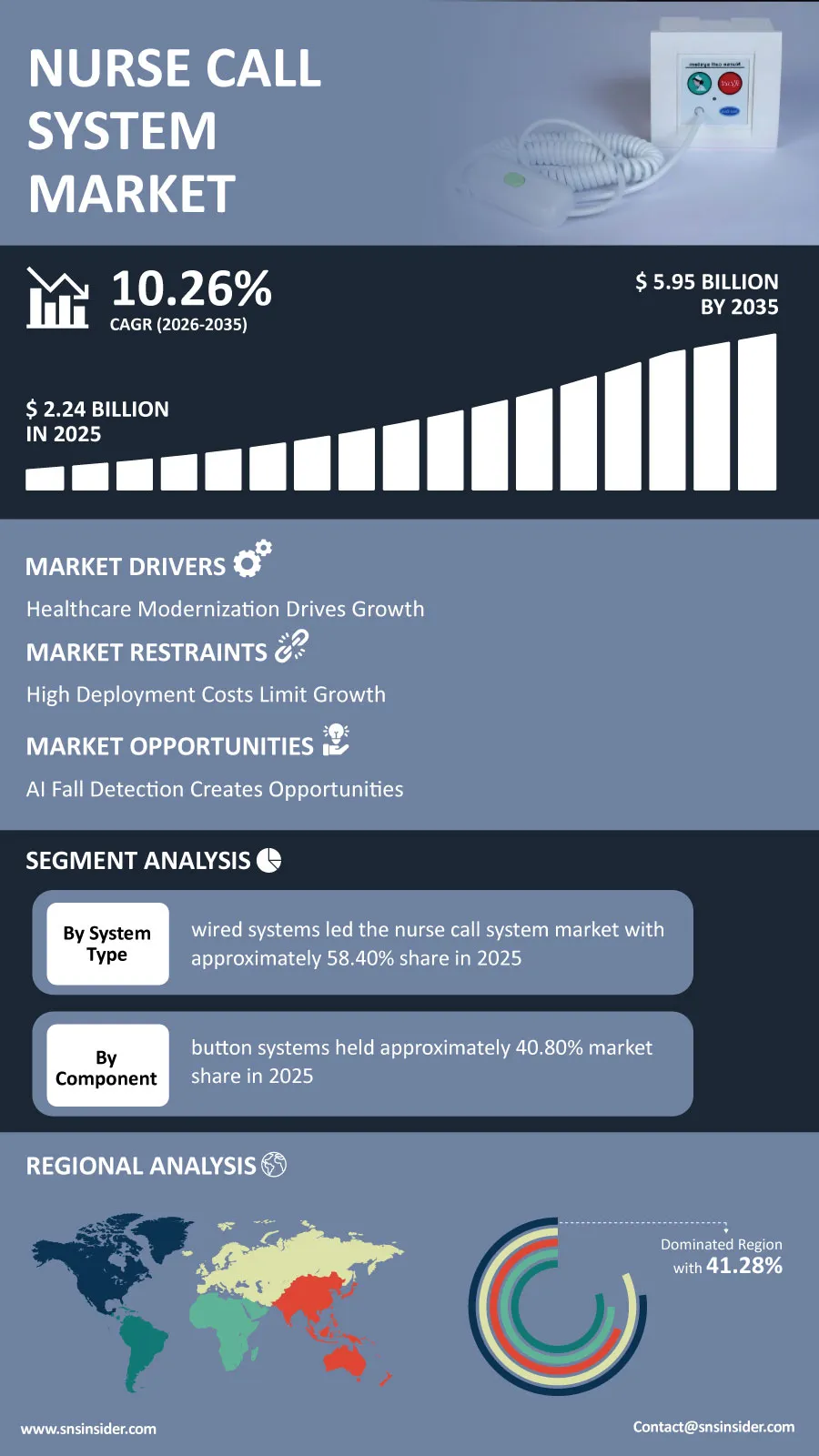
The global Nurse Call System Market is expected to witness sustained expansion as healthcare providers continue investing in connected communication technologies that improve patient care quality, staff coordination, and operational efficiency. “According to a recent study by SNS Insider, the global Nurse Call System Market size valued at USD 2.24 billion in 2025, is anticipated to grow to USD 5.95 billion by 2035, registering a CAGR of 10.26% over the 2026–2035 forecast period.”
All healthcare institutions are upgrading their traditional communication networks by integrating them with more advanced technologies to facilitate quick reactions and better coordination among the health care practitioners. The increasing necessity to improve patient experiences as well as to overcome labor shortages is prompting hospitals and nursing homes to invest in intelligent nurse call solutions that will be compatible with other systems within the healthcare industry.
Recent rapid developments in such areas as wireless technology, mobile applications, artificial intelligence, and digital patient monitoring are changing nurse call systems from simple alerting devices into more sophisticated workflow management tools.
To Get Detailed Insights on the Nurse Call System Market – Request a Sample Report
Digital Healthcare Investments Create Long-Term Growth Opportunities
The government and healthcare industry stakeholders keep investing in modernization projects focused on building connected systems and patient safety technology in hospitals. Modern nurse call systems represent one of the components of digital health systems that enable communication among patients, nurses, physicians, and other support staff via integrated network.
The growth in the number of long-term care centers, assisted living, and hospital-at-home systems creates even more possibilities for communication solutions advancement. Providers look for solutions that will help them to streamline their operations by providing scalability and efficient responses and remote monitoring and mobility capabilities.
Meanwhile, continuous innovation in artificial intelligence, real-time location technologies, mobile communication platforms, and predictive patient monitoring is allowing healthcare organizations to improve workflow efficiency while reducing operational complexity and enhancing patient outcomes.
Key Market Insights Highlight Shifting Demand Patterns
Based on system type, wired systems segment held 58.40% share of the global market revenue in 2025 owing to their proven reliability and widespread deployment across established healthcare facilities. The wireless systems segment will experience the highest growth till 2035 due to increasing demand for flexible installation, scalability, and seamless mobile connectivity.
By component, button systems generated around 40.80% of total market revenue by 2025 due to their dependable performance and extensive use in patient care environments. Mobile systems are predicted to show the fastest growth over the forecast period as healthcare professionals increasingly rely on smartphones and wireless communication devices.
In terms of application, the emergency medical alarms segment held 36.70% market share in 2025 due to the continued need for rapid emergency communication across hospitals and critical care facilities. The workflow support segment will be growing at the fastest rate up until 2035 as healthcare organizations adopt intelligent communication platforms that streamline staff coordination and clinical operations.
By end user, hospitals and clinics accounted for 46.50% of market revenue in 2025 owing to continuous investments in patient communication infrastructure. Nursing homes and assisted living centers are projected to register the fastest growth through 2035 as aging populations increase demand for long-term care services.
Intelligent Communication Technologies Accelerate Industry Transformation
This industry in the communication sector is experiencing great innovation as AI technology, cloud computing, real-time location services, and predictive analytics are becoming part of communication platforms for nurse call systems. Through these technologies, healthcare facilities can be able to prioritize alerts, coordinate caregivers, and improve patient safety due to the quick clinical response.
Integration with the use of EHRs, patient monitoring systems, and mobile communication tools is enhancing clinical decision making and streamlining workflow in hospitals. With continued digital transformations by healthcare facilities, intelligent communication systems will play a more critical role in connected healthcare.
North America Held 41.28% of the Nurse Call System Market Share in 2025; Asia Pacific Projected to Register the Fastest CAGR Through 2035
Market revenue shares are forecasted to be held by North America at 41.28% by 2025 due to the availability of advanced healthcare facilities, substantial investments in technological advancement, presence of stringent patient safety regulations, and extensive hospital communications system modernizations. The U.S. has been leading the regional markets in terms of demand for its continuous advancements within hospitals, nursing homes, and ambulatory care centers.
The Asia-Pacific region is expected to register high growth rates within the regional markets until 2035. Increasing healthcare investments, hospital constructions, aging populations, and use of digital healthcare facilities within China, Japan, South Korea, and India have been driving the market.
As governments continue strengthening healthcare infrastructure while promoting digital health initiatives, demand for intelligent nurse call systems is expected to increase across both mature healthcare markets and emerging economies.
Industry Participants Focus on Innovation and Intelligent Healthcare Communication Solutions
The competitive landscape remains highly dynamic as leading companies continue investing in artificial intelligence, cloud-enabled communication platforms, wireless connectivity, and integrated clinical workflow technologies. Continuous research and development efforts are enabling manufacturers to deliver next-generation nurse call systems that improve caregiver responsiveness, enhance patient safety, and support seamless interoperability with hospital information systems. Strategic collaborations with healthcare providers and long-term care facilities are further accelerating the adoption of intelligent communication solutions across modern healthcare environments.
Key companies operating in the global Nurse Call System Market include Rauland-Borg Corporation, Ascom Holding AG, Hill-Rom Holdings Inc. (Baxter International), STANLEY Healthcare (Securitas Technology), Philips Healthcare, Honeywell Life Safety, Azure Healthcare Ltd., Critical Alert Systems LLC, Telequip Labs Inc., Austco Healthcare, Intercall Systems Inc., Ametek Inc., Jeron Electronic Systems Inc., Cornell Communications, VS Systems, Nurse Call Corporation, Aiphone Corporation, Wandsworth Group, Curbell Medical Products, and Sensio AS.
An SNS Insider analyst Sakshi Kale commented, “Healthcare providers are increasingly prioritizing intelligent communication technologies that improve patient response times while supporting efficient clinical workflows. As hospitals and long-term care facilities continue expanding digital health infrastructure, advanced nurse call platforms integrating mobility, AI, and real-time connectivity will play an increasingly important role in strengthening patient safety and operational performance.”
About the Author

Get in touch