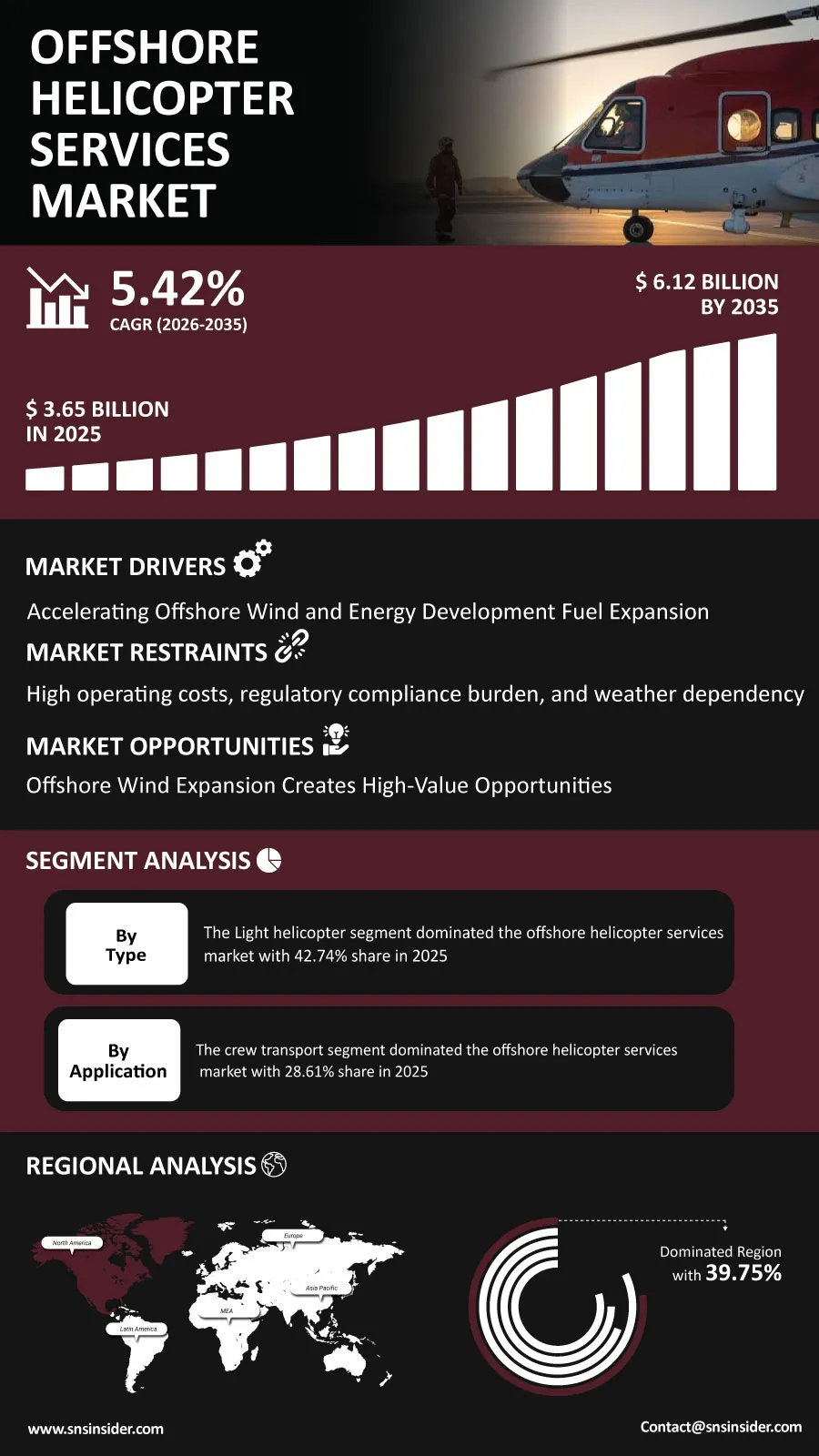
The global Offshore Helicopter Services Market is gaining momentum as energy companies expand operations farther from shore and offshore wind developers build increasingly complex marine assets. “According to a recent study by SNS Insider, the global Offshore Helicopter Services Market size valued at USD 3.65 Billion in 2025, is anticipated to grow to USD 6.12 Billion by 2035, registering a CAGR of 5.42% over the 2026–2035 forecast period.”
Helicopters will continue to play an important role in offshore activities due to the ability of helicopters to transport personnel, cargo, and medics from coastal facilities to offshore facilities in tight time windows. The ongoing activities in the oil and gas basins will ensure a consistent customer base, while offshore wind farms bring in new challenges.
Operators are also working to upgrade their fleets and incorporate flight planning, aircraft health monitoring, and weather technologies. Such innovations have been beneficial in ensuring that service providers cope with challenges related to safety, availability, and efficiency.
To Get Detailed Insights on This Market – Request a Sample Report
Offshore Energy Expansion Opens New Revenue Opportunities
With ongoing developments in deep-water and ultra-deep-water operations, there will be a steady need for aircraft services. The further an offshore structure is from shore, the more reliable its transportation system needs to be to manage constant crew changeovers and logistical needs.
Offshore wind is also expanding the target market of the industry. There is going to be maintenance work that needs to be done to the turbines and structures in their lifetimes, which is going to offer opportunities to helicopter companies other than oil-based ones. Helicopters can provide rapid access to installations when vessel-based transportation is less practical or weather and scheduling constraints make conventional approaches inefficient.
Emergency evacuation for medical purposes is another emerging area. As oil operations become increasingly distant from shore, more attention is being paid to efficient medical evacuation and emergency procedures.
Key Market Insights Highlight Shifting Offshore Aviation Demand
Based on type, Light Helicopters accounted for 42.74% of market revenue in 2025, reflecting their broad deployment across passenger movement, inspections, and nearshore assignments. Heavy Helicopters are expected to register the fastest growth through 2035, supported by longer missions and increasing activity at remote offshore installations.
By application, Crew Transport held 28.61% market share in 2025 as recurring personnel rotations remain fundamental to offshore operations. Inspection is projected to be the fastest-growing application as offshore wind assets and aging energy infrastructure require increasingly frequent technical assessments.
In terms of end user, the Oil & Gas Industry represented 30.59% of market revenue in 2025. However, the Offshore Wind Industry is forecast to expand at the fastest pace as renewable developers increase investment in offshore generation capacity and long-term maintenance programs.
By service type, Scheduled Services captured 38.45% share in 2025, supported by recurring crew-change programs and contracted flight schedules. Emergency Medical Services are expected to experience the strongest growth as offshore safety frameworks place greater emphasis on rapid evacuation and medical response.
Fleet Modernization and Digital Aviation Transform Offshore Operations
Offshore helicopter companies are now turning to the application of avionics and predictive maintenance systems for enhancing their operational efficiency. Aircraft monitoring systems will enable an operator to foresee possible maintenance needs before any problem interferes with availability. Weather intelligence will aid the decision-making processes regarding the routing and dispatching of the helicopters.
Another strategic area that has begun gaining significance is fleet renewal. Newer aircraft provide a higher range, passenger carrying capacity, improved navigation systems, and versatility. This is quite relevant for deepwater oil field ventures and offshore wind energy zones.
North America Accounted for 39.75% Market Share in 2025; Asia Pacific Forecast to Expand at a 6.41% CAGR by 2035
North America was the dominant regional market, accounting for about 39.75% of the global market revenue in 2025. It is dominated by the United States owing to the high presence of offshore activities in the Gulf of Mexico region and existing helicopter transportation network.
The Asia Pacific market is expected to experience the highest growth rate among all regions, growing at a CAGR of 6.41% till 2035. Growing offshore energy activities in countries such as Australia, China, Malaysia, Indonesia, Vietnam, and Thailand have created a need for offshore helicopter transportations.
Europe continues to dominate as an important market for the helicopter transport due to the presence of offshore operations in the North Sea region. In addition, Latin America and Middle East & Africa regions have been benefiting from the deepwater development.
Industry Participants Prioritize Fleet Expansion and Service Diversification
The competitive landscape continues to be dynamic with players investing in fleet upgrades, niche offerings, technology, and long-term customer agreements. They are also gearing up to benefit from the opportunities arising out of offshore wind energy alongside their existing presence within the oil and gas industry.
Key companies operating in the global Offshore Helicopter Services Market include Bristow Group Inc., PHI Inc. (Petroleum Helicopters), Babcock International Group, Milestone Aviation Group, Omniflight LLC, Gama Aviation, Offshore Logistics Inc., Airbus Helicopters, Leonardo S.p.A., Sikorsky Aircraft Corporation (Lockheed Martin), Bell Textron Inc., Air Methods Corporation, CHC Helicopter, Era Group Inc., Norsk Helikopter AS, Lobo Leasing Ltd., Offshore Helicopter Services Ltd., Starspeed Ltd., PTC Helicopter Inc., Titan Helicopter Group, and Vertical Aerospace Ltd.
An SNS Insider analyst Santosh Bhul commented, “The offshore aviation sector is moving beyond its traditional energy foundation as offshore wind, advanced aircraft, and digital operational technologies create new avenues for service expansion. Providers capable of combining fleet reliability, safety performance, and flexible mission capabilities will be positioned to capture the next wave of offshore transportation demand.”
About the Author

Get in touch