
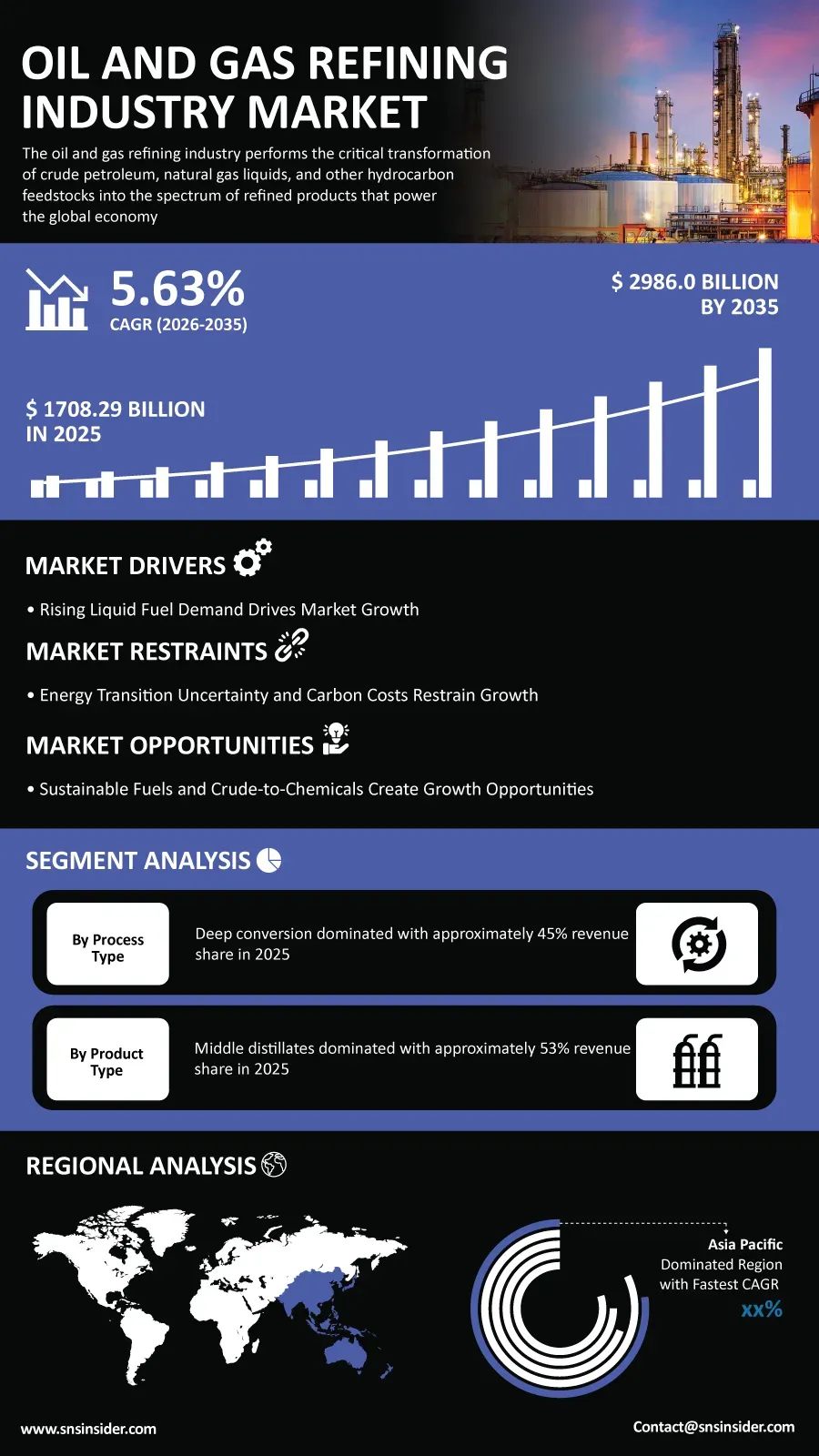
The global Oil and Gas Refining Industry Market is entering a new investment cycle as refiners accelerate modernization projects to improve operational efficiency, support cleaner fuel production, and meet evolving industrial energy requirements. “According to the latest study by SNS Insider, the global Oil and Gas Refining Industry Market was valued at USD 1,708.29 billion in 2025 is anticipated to grow to USD 2,986.0 billion by 2035, registering a CAGR of 5.63% during the 2026–2035 forecast period.”
Security of energy is still the key strategic focus of government and business organizations globally, leading to steady investments in refining technologies and other related infrastructure. In addition, the growing demand from the airline industry, heavy transport, petrochemical sector, and industrial manufacturing is adding further emphasis to modern refineries as an essential part of the global energy value chain.
Another feature of modern refineries is that they are developing not only in terms of their function to produce fuels but also by introducing automation technology, intelligent control systems, and environmentally friendly processing methods.
To Get Detailed Insights on the Oil and Gas Refining Industry Market – Request a Sample Report
Digital Refinery Investments and Cleaner Fuel Production Create New Growth Opportunities
Operators of refineries in both advanced and developing countries have embraced modern technologies that not only increase the capacity of their operations but also cut down emissions and cost of operation. AI, predictive maintenance, and digital process control systems are aiding these organizations in achieving maximum efficiency through continuous optimization.
Increasing investment in sustainable aviation fuel, renewable diesel, and integration in petrochemicals is another area where refineries are shifting their business strategy towards. Refineries are developing their downstream operations to generate more value from their operations amid changes in demand patterns for energy.
Advanced catalyst technologies, residue upgrading technologies, and flexibility in feedstock processing have become key factors that will boost future opportunities for these organizations to process diverse crude oil sources efficiently.
Key Market Insights Reflect Changing Industry Priorities
By process type, Deep Conversion accounted for approximately 45% of global market revenue in 2025, supported by increasing investments in residue upgrading and higher-value fuel production. The Conversion segment is expected to witness the fastest growth through 2035, expanding at a 9.78% CAGR as refineries modernize existing facilities.
Based on product type, Middle Distillates represented nearly 53% of total market revenue in 2025 owing to sustained demand for diesel, jet fuel, and kerosene across transportation and industrial applications. Petrochemicals are projected to record the strongest growth during the forecast period as integrated refinery-chemical complexes continue expanding worldwide.
By application, the Transportation segment generated approximately 36% of market revenue in 2025 due to ongoing global mobility requirements. Meanwhile, the Aviation segment is forecast to register the highest growth rate, achieving a 10.99% CAGR through 2035 as international air travel and sustainable aviation fuel production continue expanding.
Advanced Refining Technologies Accelerate Industry Transformation
The refining industry is rapidly embracing digital transformation to enhance plant reliability, improve production efficiency, and strengthen environmental performance. AI-powered analytics, real-time operational monitoring, digital twins, and predictive asset management are enabling companies to optimize complex refinery operations while minimizing downtime.
Manufacturers are also investing in integrated refinery-petrochemical facilities that maximize resource utilization and generate higher-value chemical feedstocks. Combined with advanced emissions monitoring and energy optimization systems, these innovations are supporting both operational competitiveness and long-term sustainability objectives.
As global energy systems become increasingly diversified, refining companies are balancing conventional fuel production with investments in lower-carbon technologies that enhance flexibility across future energy markets.
Asia Pacific Accounted for the Largest Market Share in 2025; Asia Pacific Expected to Maintain the Fastest Growth Through 2035
The Asia Pacific region was the dominant region in 2025, owing to expanding refinery capacities, industrialization, increased consumption of transportation fuels, and investments in integrated refinery and petrochemical operations. China's domination within the region is attributed to massive refining capacities whereas India's rapidly growing downstream industry is driving regional growth.
North America has maintained its dominant position in the refinery market owing to its well-developed refinery infrastructure, capability in refining processes, and constant investments in digital technology and biofuels.
Europe continues to concentrate on enhancing efficiencies in refineries and producing low-carbon fuels owing to changing environmental regulations. On the other hand, Middle East, Africa, and Latin American regions continue to invest in refineries through their downstream diversification initiatives and increased production of petrochemicals.
Industry Participants Focus on Efficiency, Integration, and Sustainable Operations
Competition within the global refining sector continues to intensify as leading companies prioritize operational excellence, digital innovation, refinery integration, and cleaner fuel technologies. Investments in advanced catalysts, intelligent process optimization, renewable fuel production, and petrochemical expansion are expected to strengthen competitive positioning while improving long-term profitability.
Key companies operating in the global Oil and Gas Refining Industry Market include Saudi Aramco, Sinopec Group, China National Petroleum Corporation (CNPC), ExxonMobil Corporation, Shell plc, BP plc, Valero Energy Corporation, Marathon Petroleum Corporation, Phillips 66 Company, TotalEnergies SE, Chevron Corporation, Indian Oil Corporation Ltd., Reliance Industries Limited, Petrobras (Petróleo Brasileiro S.A.), Rosneft Oil Company, Kuwait Petroleum Corporation, Abu Dhabi National Oil Company (ADNOC), PBF Energy Inc., HF Sinclair Corporation, LyondellBasell Industries, and Mahindra Powerol.
An SNS Insider analyst Santosh Bhul commented, “Refinery modernization, digital process optimization, and expanding investments in integrated petrochemical production are reshaping the competitive landscape of the global refining industry. Companies that strengthen operational efficiency while adapting to evolving fuel and chemical demand are expected to capture significant long-term growth opportunities throughout the forecast period.”
About the Author

Get in touch




