
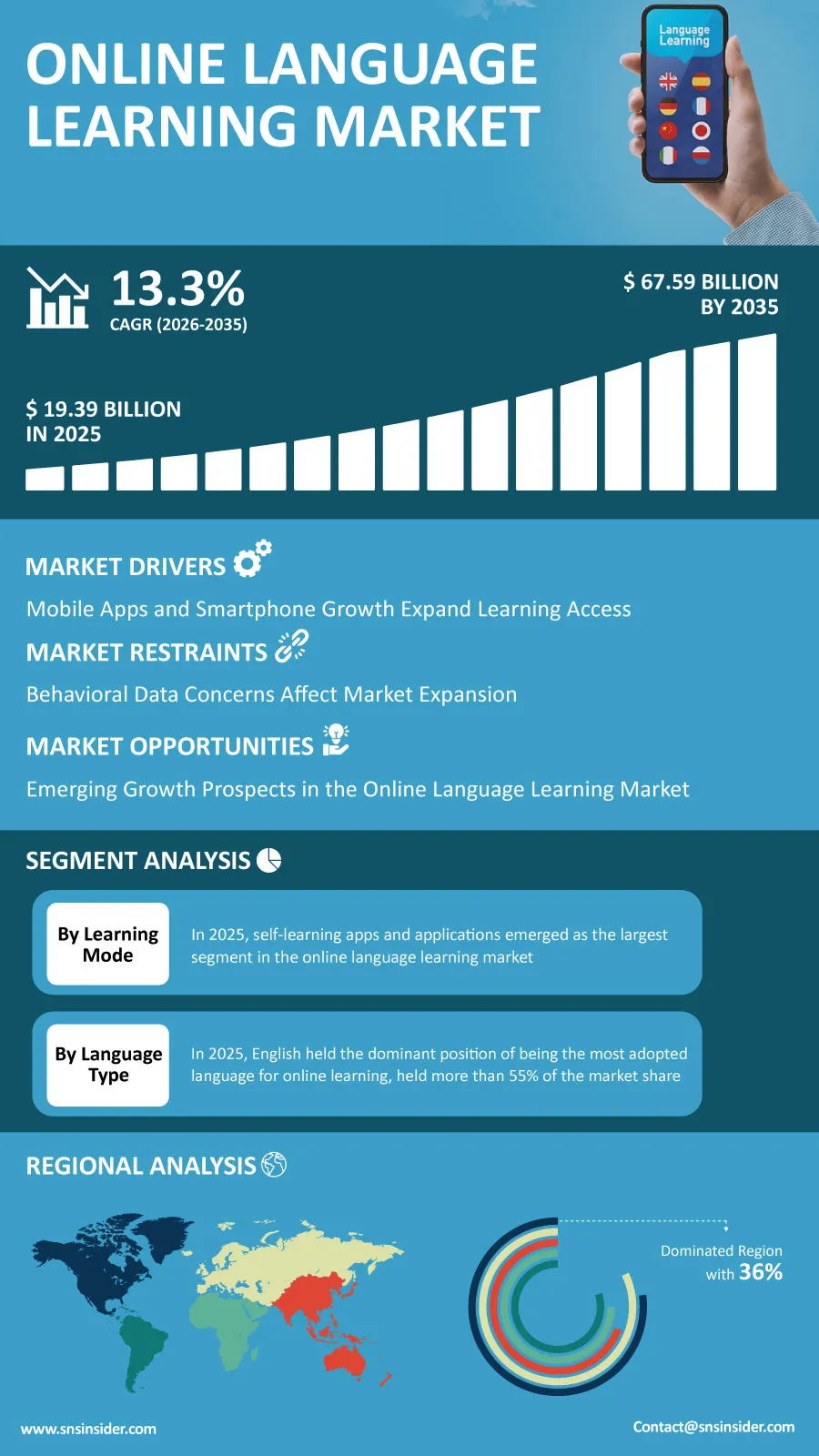
The global Online Language Learning Market is entering a new phase of digital education growth as institutions, businesses, and individual learners increasingly adopt technology-enabled language training solutions. “According to a recent study by SNS Insider, the Online Language Learning Market size valued at USD 19.39 billion in 2025, is anticipated to grow to USD 67.59 billion by 2035, registering a CAGR of 13.3% over the 2026–2035 forecast period.”
There is a rising need for language learning tools because of globalization and remote work due to the rise in business transactions across borders, international education and training, and remote work. Digital technologies that provide flexibility in scheduling, interactivity in content, and personalized learning methods are gradually becoming an integral part of educational systems.
With the help of technologies such as AI, speech recognition, adaptive assessments, and digital immersive learning, there has been a transformation in the process of language learning. Educational institutions, companies, and government entities have started incorporating language learning programs into their workforce and educational programs.
To Get Detailed Insights on the Online Language Learning Market – Request a Sample Report
AI Innovation and Enterprise Learning Open New Growth Opportunities
The technology companies have been designing intelligent learning solutions that provide personalized courses, pronunciation correction, and conversational training according to performance levels of students. The advancements are not only enhancing the engagement of learners but are providing scalable learning models as well for both consumers and enterprises.
Moreover, there is growing interest in developing multilingual workforces in corporate companies due to expansion of their international operations. Language software solutions are being utilized in employee training programs to facilitate communication and collaboration across borders. There will be new opportunities due to rising demand for certification programs, professional language training, and industry specific courses.
Key Market Insights Highlight Changing Learning Preferences
Based on learning mode, self-learning applications accounted for nearly 58% of global market revenue in 2025 due to widespread smartphone usage, affordable subscription models, and the popularity of flexible digital education. Instructor-led virtual learning is anticipated to register the fastest expansion through 2035 as learners increasingly seek structured guidance and live interaction.
By language type, English learning represented more than 55% of the market in 2025, reflecting its continued importance across international business, higher education, technology, and professional communication. Demand for Asian and European language programs is expected to accelerate during the forecast period as international mobility and regional business partnerships continue expanding.
Advanced Learning Technologies Transform Digital Education
Adaptive learning pathways, automatic testing mechanisms, and conversation-driven virtual assistants have continued to revolutionize the process of learning language on the internet. Developers are adopting technologies such as natural language processing, automatic speech recognition, and simulation that will make the learning experience fun and promote information retention.
Moreover, the platform developers are making use of augmented reality technology and virtual classroom models that will foster an environment of engagement. The combination of cloud computing and mobile technologies has made it possible for individuals to learn personalized courses from anywhere.
North America Held 36% of the Online Language Learning Market Share in 2025; Asia Pacific Projected to Register the Fastest CAGR Through 2035
The market share held by North America was estimated at about 36% in 2025 owing to well-developed digital infrastructure, adoption of educational technology and significant investment in artificial intelligence-based learning solutions. Demand for professional development, corporate learning, and life-long learning is driving further developments in the region.
Asia Pacific will continue to show the highest CAGR over the forecast period because of growing internet penetration, high usage of smartphones and implementation of digital education policies, making it possible to reach online learning. Increasing urbanization, growing number of students and focus on multilingual education provide positive market conditions in a few emerging markets.
Europe remains an important region owing to well-developed foreign languages education programs and digital transformation of schools, universities, and corporate learning. Latin America and the Middle East and Africa regions are experiencing growing use of artificial intelligence-based solutions due to affordable mobile solutions.
Industry Participants Strengthen AI Capabilities and Global Reach
Competition within the Online Language Learning Market continues to intensify as providers expand artificial intelligence capabilities, introduce personalized subscription services, and strengthen enterprise learning portfolios. Companies are pursuing strategic partnerships with educational institutions, employers, and technology providers while investing in immersive learning experiences to improve customer retention and global market presence.
Key companies operating in the global Online Language Learning Market include Duolingo, Babbel, Rosetta Stone, Busuu, Memrise, Preply, italki, Lingoda, Pimsleur, FluentU, Mango Languages, Clozemaster, Open English, Voxy, HelloTalk, Yabla, Cambly, Speexx, Lingvist, and Mondly.
An SNS Insider analyst Sakshi Kale commented, "Digital education continues to evolve as artificial intelligence, mobile connectivity, and personalized learning experiences reshape language acquisition worldwide. Organizations investing in intelligent learning platforms, enterprise education solutions, and immersive technologies are expected to benefit from sustained long-term market expansion."
About the Author

Get in touch




