
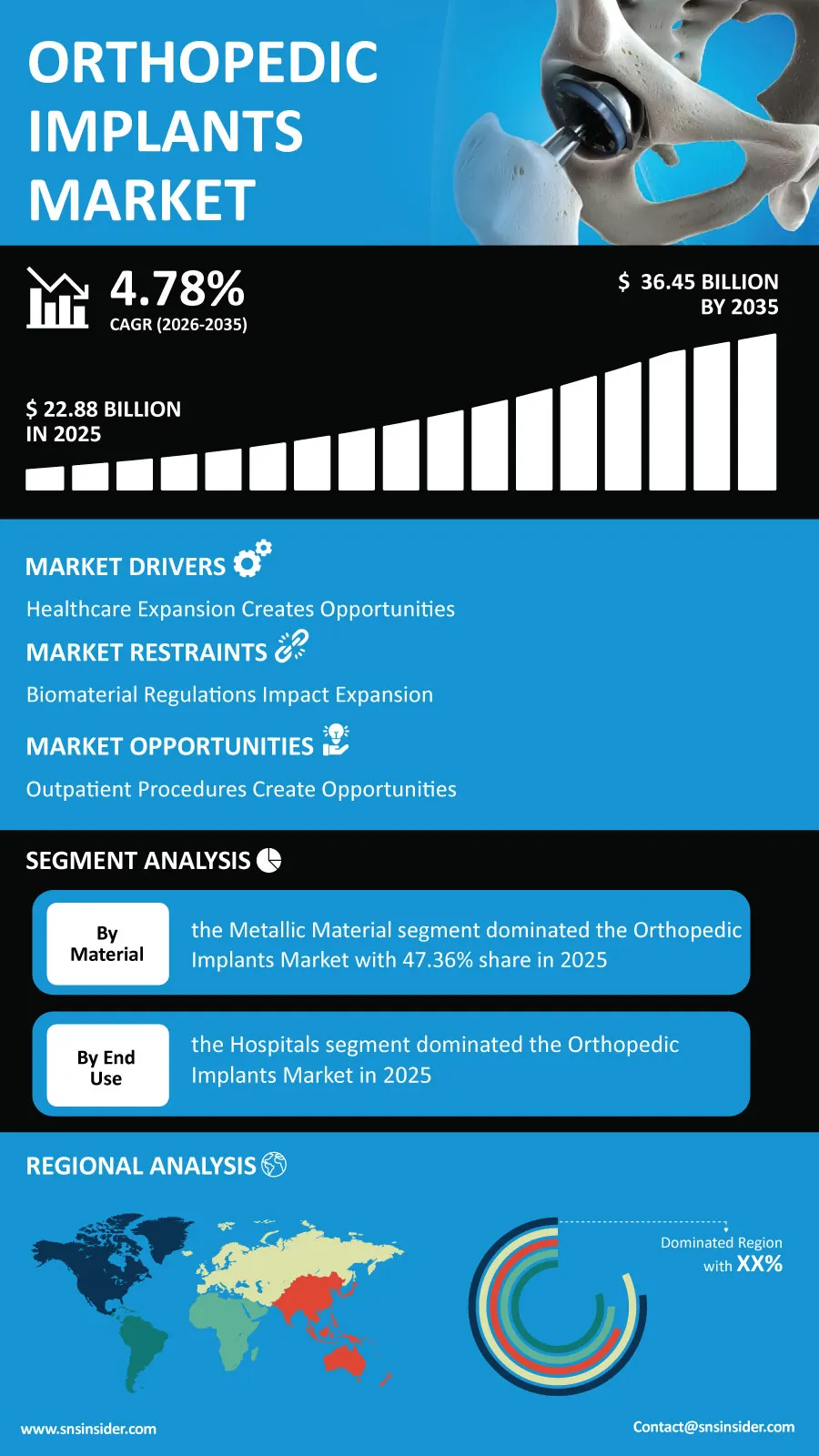
The global Orthopedic Implants Market is witnessing steady expansion as healthcare providers increase investments in advanced musculoskeletal treatments and modern surgical technologies. "According to a recent study by SNS Insider, the global Orthopedic Implants Market size valued at USD 22.88 billion in 2025, is anticipated to grow to USD 36.45 billion by 2035, registering a CAGR of 4.78% over the 2026–2035 forecast period."
Increasing frequency of orthopedic ailments, sports injuries, and joint deterioration with aging is leading to an increased demand for surgical procedures using implants. Meanwhile, hospitals and specialized orthopedic clinics are adopting advanced implant devices that allow greater surgical accuracy, reduce recovery time, and promote enhanced mobility for patients. This trend has prompted manufacturers to develop advanced solutions to facilitate improved results in a variety of orthopedic cases.
To Get Detailed Insights on the Orthopedic Implants Market – Request a Sample Report
Innovation in Orthopedic Care Strengthens Market Outlook
Orthopedics is experiencing a major paradigm shift due to advancements in technology that have made surgery more digitized, personalized, and better planned. Surgeons are performing more complex surgeries owing to the robotic surgeries, AI-based surgery planning tools, and customized implants.
Implant manufacturers have also increased research into developing implants that are more durable, biocompatible, and designed to fit anatomically. There has been increased adoption of the additive manufacturing technique and biomaterials, which are projected to increase performance of products while allowing for individualized approaches to the orthopedic needs of patients.
Key Market Findings Highlight Strong Segment Performance
Lower extremity implants remained the largest product category, accounting for 51.15% of market revenue in 2025, supported by the growing number of knee and hip replacement procedures performed worldwide. Dental implants are projected to deliver the fastest growth through 2035, expanding at a 6.98% CAGR as awareness of advanced restorative treatments continues to increase.
Metallic materials represented the leading material segment with a 47.36% market share in 2025, reflecting their established reliability, strength, and long-term clinical performance. Meanwhile, polymeric biomaterials are anticipated to record the highest growth rate at a 7.24% CAGR, driven by innovation in lightweight and bioactive implant technologies.
Offline distribution channels continued to dominate the market, contributing 83.64% of total revenue during 2025 through established hospital procurement networks. However, online procurement platforms are expected to gain momentum as digital purchasing systems become increasingly integrated into healthcare supply chains.
Hospitals remained the largest end-use segment, benefiting from high surgical volumes and comprehensive orthopedic care capabilities. Outpatient facilities are expected to register the fastest expansion as minimally invasive procedures and same-day orthopedic surgeries become more widely adopted.
Advanced Technologies Improve Patient Outcomes
The increasing emphasis from healthcare professionals on technology is being geared towards making surgeries more efficient while ensuring that the patients have an easier recovery process. This is through the introduction of robotics, navigation, and digital workflow that helps surgeons place the implant accurately.
On the other hand, the increasing adoption of minimally invasive procedures is leading to shortened hospital stays and speedy recovery processes. This has increased the popularity of the implants in the market due to improved performance.
Regional Markets Continue Expanding Across Healthcare Systems
The region dominated the global orthopedic implants market in 2025, owing to factors such as advanced healthcare infrastructure, use of innovative surgical technologies and higher demand for joint replacement procedures. In terms of revenue share, US constituted 87.4% of regional revenue, due to high number of procedures performed along with the presence of prominent orthopedic device manufacturers.
Asia Pacific is expected to become the fastest-growing region over the forecast period, owing to increased investments in the healthcare industry in developing countries. APAC was the second largest regional market by revenue, with 44.8% revenue share in 2025. Expanding infrastructure of hospitals along with increased access to orthopedic procedures in India and other developing countries will help in boosting the demand.
Other prominent contributors to the market include Europe, where Germany constituted 22.3% revenue share of the regional market owing to its strict regulatory norms and increasing investment in orthopedic devices. The Middle East & Africa region, where Saudi Arabia accounted for 31.2% revenue share of the regional market, along with Latin America where Brazil accounted for 44.2% revenue share of the regional market.
Leading Companies Accelerate Product Innovation
Competition remains strong as manufacturers continue investing in advanced implant materials, digital surgical technologies, and personalized orthopedic solutions. Strategic product launches, technology partnerships, and regional expansion initiatives are strengthening competitive positioning while supporting broader access to innovative orthopedic care.
Some of the leading companies operating in the global orthopedic implants market include Zimmer Biomet Holdings, Stryker Corporation, Johnson & Johnson MedTech, Smith+Nephew, Medtronic, Wright Medical Group, NuVasive, Arthrex, DJO Global, CONMED Corporation, Integra LifeSciences, B. Braun SE, Corin Group, ConforMIS, and MicroPort Scientific Corporation.
An SNS Insider analyst Parry Kardani commented, "The orthopedic implants market is entering a new phase where innovation extends beyond implant design to include digital surgical ecosystems, patient-specific technologies, and minimally invasive procedures. Companies that successfully combine advanced materials with precision-driven surgical solutions are expected to strengthen their competitive position as demand for orthopedic care continues to expand globally."
About the Author

Get in touch




