
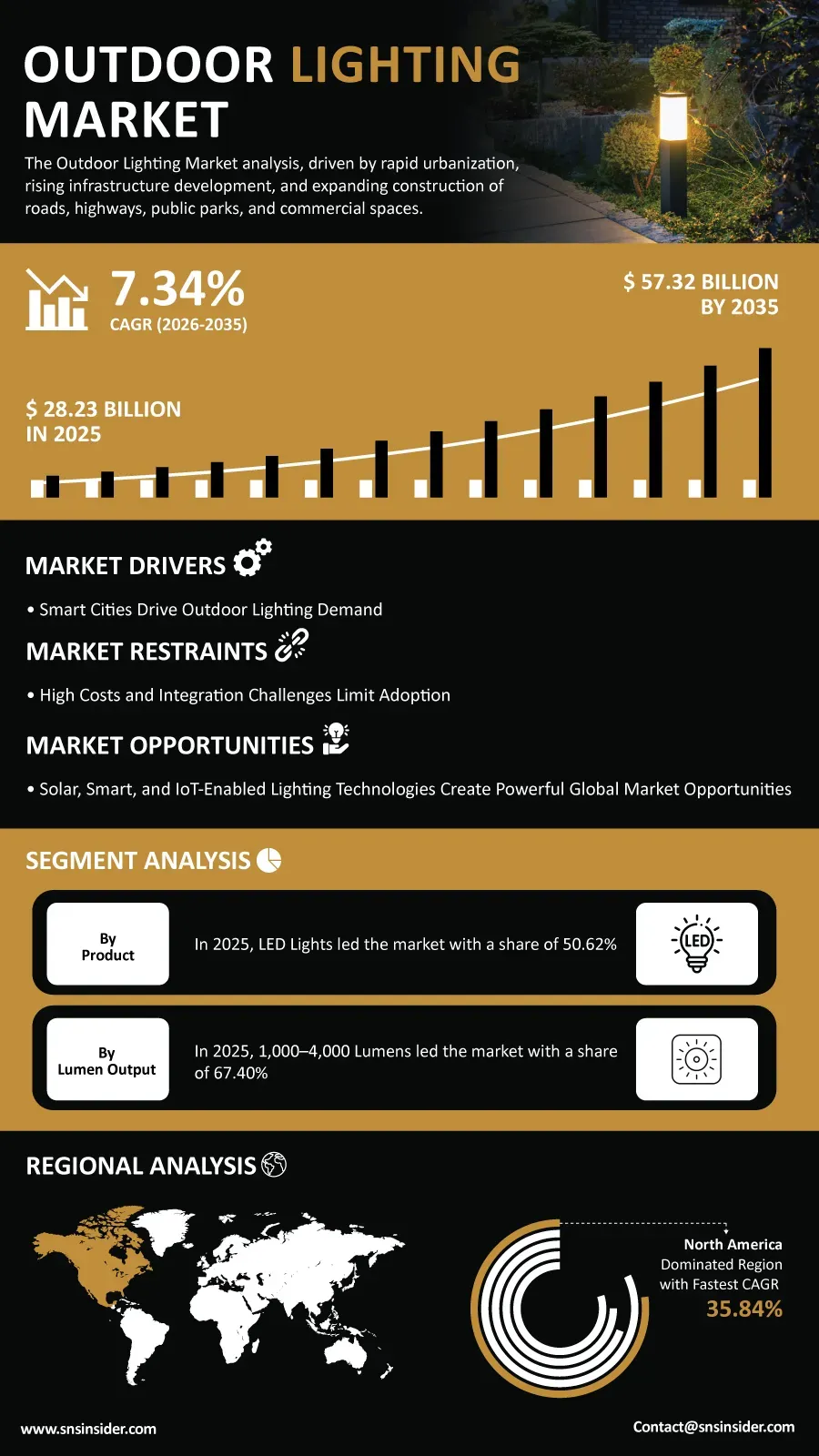
The global Outdoor Lighting Market is expected to witness steady expansion over the coming decade as governments, municipalities, and commercial developers prioritize energy-efficient infrastructure and smart urban development. According to a recent study by SNS Insider, the global Outdoor Lighting Market size valued at USD 28.23 billion in 2025, is anticipated to grow to USD 57.32 billion by 2035, registering a CAGR of 7.34% over the 2026–2035 forecast period.
Rapid urbanization along with the growing investment in transportation, commercial establishments, and recreational areas is driving the need for technologically advanced lighting systems. Local governments have been upgrading their traditional lighting network by incorporating energy-efficient systems in an effort to make the area safe for its residents while consuming less energy.
Innovation in technology is continually revolutionizing the lighting market through smart lighting systems, solar lighting systems, and adaptive lighting systems that form a part of smart cities. Companies have been developing lighting solutions that are sustainable and energy efficient.
To Get Detailed Insights on the Outdoor Lighting Market – Request a Sample Report
Smart Infrastructure Investments Continue to Expand Market Opportunities
Increasing importance of the development of smart cities has opened up many prospects for the outdoor lighting manufacturers globally. Through the use of IoT sensors, connected networks and control automation technologies, municipalities are now able to increase their efficiency in the utilization of energy and improve visibility at night in the roadways, parks, campuses, and public buildings.
In addition, the efforts towards sustainability have furthered the process of shifting to LED and solar lighting technology outdoors. The government's efforts to reduce consumption of energy and increase utilization of renewable energy are resulting in the replacement of old lighting technologies with smart lighting solutions that do not need any maintenance.
Furthermore, fast commercial growth and increased investments in the landscaping and architectural lighting, along with infrastructural development have also contributed towards the steady growth of the market.
Key Market Insights Highlight Shifting Demand Patterns
By product, LED lights held a share of 50.62% of global market revenue in 2025 owing to their superior energy efficiency, long operating life, and lower maintenance requirements. Plasma lamps are projected to register the fastest growth through 2035 at a CAGR of 10.40%, supported by increasing adoption in high-intensity industrial and large-scale outdoor applications.
By lumen output, the 1,000–4,000 lumens category was holding 67.40% of market revenue in 2025 as it remains suitable for residential areas, parking facilities, pathways, and commercial environments. The above 4,000 lumens segment is anticipated to experience the fastest expansion, growing at a CAGR of 9.50% as demand rises for highways, stadiums, logistics hubs, and industrial installations.
By application, the commercial segment accounted for 66.10% of market revenue in 2025, driven by continued investments in municipal infrastructure, retail developments, hospitality facilities, and public spaces. Residential applications are projected to record the highest growth rate with a CAGR of 8.90%, fueled by increasing consumer spending on home security, landscape lighting, and smart outdoor environments.
Based on distribution channel, offline sales segment led with 65.40% market share in 2025 due to strong demand for installation support and project-based procurement. Online distribution is projected to grow at the fastest pace with a CAGR of 11.20% as digital purchasing platforms continue expanding their reach among residential and commercial buyers.
Energy Efficiency and Connected Lighting Drive Industry Transformation
Outdoor lighting is increasingly developing from merely providing light to being an intelligent infrastructure which can provide operational data and better services to people. Predictive maintenance feature of smart lighting infrastructure helps cities detect problems sooner and save on maintenance costs.
There is also growing adoption of solar lighting systems in rural areas, highways, industrial zones, and other places where connection to a power grid is either not possible or too expensive. Such technology helps achieve sustainability goals while reducing the overall cost of operation of such outdoor lights.
Manufacturers keep on innovating by creating better optics, more durable materials, better wireless communications, and cloud-based management systems to improve the efficiency of lighting and its lifespan.
Regional Markets Demonstrate Strong Growth Potential
North America is forecasted to command 35.84% share of total market revenues in 2025, driven by the presence of robust infrastructure, LED replacement programs, and advanced technology such as smart cities. Investments being made in connected street lights and intelligent lighting systems have bolstered North America’s position as a dominant market player.
Asia Pacific is anticipated to be the most promising region with a CAGR of 8.44% from 2020 to 2035. This rapid development in the region is due to urbanization, developments in transport network, smart city projects initiated by the government, and increased use of solar lights.
As countries continue modernizing urban infrastructure while pursuing energy-efficiency targets, demand for advanced outdoor lighting systems is expected to remain strong throughout the forecast period.
Industry Participants Focus on Innovation and Smart Lighting Solutions
The competitive landscape continues to evolve as manufacturers invest in intelligent lighting platforms, IoT-enabled controls, and sustainable product development. Companies are introducing solutions that combine high-performance illumination, remote monitoring capabilities, predictive maintenance, and energy optimization to address the changing needs of municipalities, commercial developers, and industrial customers.
Key companies operating in the global Outdoor Lighting Market include Philips Lighting, Acuity Brands, Inc., Eaton Corporation, Cree, Inc., General Electric (GE Lighting), Osram Licht AG, Hubbell Incorporated, Zumtobel Group, Thorn Lighting, Panasonic Corporation, Syska LED, Dialight plc, Schréder Group, Havells India Ltd., Hinkley Lighting, LEDVANCE, Lutron Electronics, Legrand S.A., Toshiba Lighting & Technology, and Fagerhult Group.
An SNS Insider analyst Sushant Kadam commented, “The transition toward intelligent urban infrastructure, combined with growing investments in sustainable public lighting, is creating long-term opportunities for the outdoor lighting industry. Manufacturers delivering connected, energy-efficient, and low-maintenance lighting solutions will be well positioned to benefit from the continued expansion of smart cities and modern infrastructure projects worldwide.”
About the Author

Get in touch




