Oxygen Concentrator Market is growing steadily on a global scale due to the gradual transfer of respiratory treatments from hospital care to homecare by healthcare organizations. The growth is being spurred by increased incidences of chronic respiratory diseases, the aging population needing constant oxygen treatment, and developments in medical technology.
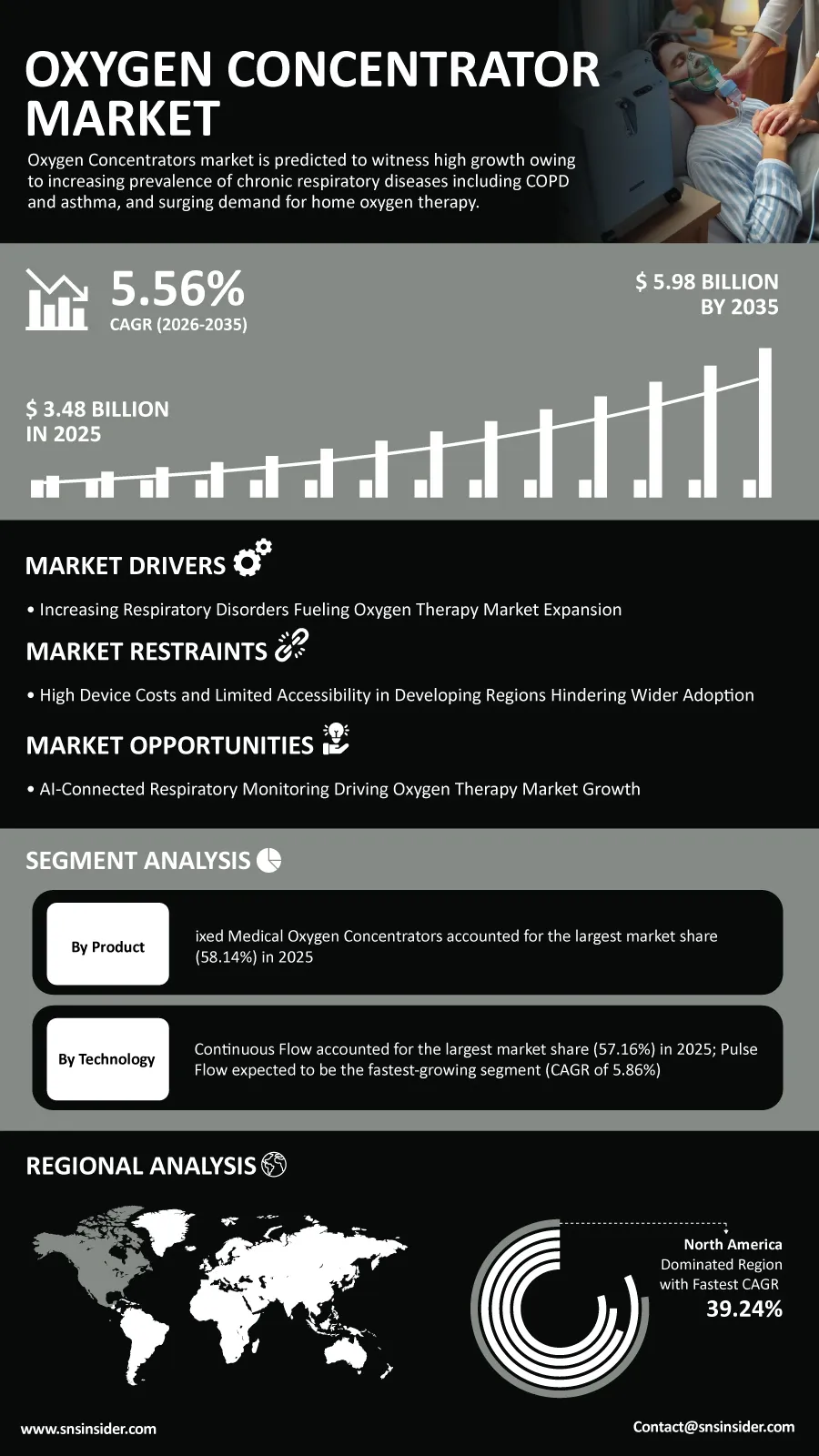
According to a recent study by SNS Insider, the global Oxygen Concentrator Market size valued at USD 3.48 billion in 2025, is anticipated to grow to USD 5.98 billion by 2035, registering a CAGR of 5.56% over the 2026–2035 forecast period. Demand is being reinforced by growing investments in home healthcare infrastructure, broader reimbursement coverage, and next-generation oxygen delivery systems designed to improve mobility, efficiency, and patient comfort.
Manufacturers have been designing light-weighted, noiseless, and digitalized devices that can assist in continuous monitoring of breathing. This technology is aiding patients in better management of their chronic diseases while minimizing reliance on prolonged hospitalization and thereby providing new avenues for medical devices manufacturers globally.
To Get Detailed Insights on the Oxygen Concentrator Market – Request a Sample Report
Home-Based Respiratory Care Reshapes Industry Growth
In various nations, healthcare services have focused on developing outpatient treatment approaches in an effort to reduce costs and enhance quality of life among patients. Oxygen concentrators have emerged as a key element in such a development since they offer effective oxygen supply for patients suffering from conditions, such as COPD, asthma, pulmonary fibrosis, and various other respiratory disorders.
Particularly, portable units have been receiving increased focus because patients require more independence during treatment. Additionally, technological improvements in battery power, intelligent oxygen supply, remote monitoring, and energy-efficient components are helping manufacturers differentiate themselves from one another.
Product Innovation Drives Market Competition
Technology providers in the field of medicine are still developing more advanced portable systems that incorporate the features of digital health care systems. Due to the incorporation of Bluetooth, Wi-Fi connectivity, and AI support, patients can monitor their oxygen treatment without being physically present at hospitals and clinics.
Dual-mode concentrators capable of delivering both continuous-flow and pulse-flow oxygen are also becoming increasingly attractive as healthcare providers seek flexible solutions that accommodate diverse patient needs while optimizing battery performance and operational efficiency.
Market Segments Reflect Changing Patient Preferences
Based on product type, fixed medical oxygen concentrators accounted for the largest market share of 58.14% in 2025, reflecting their widespread use across hospitals, long-term care facilities, and home healthcare environments. Portable medical oxygen concentrators are projected to record the fastest growth through 2035 as demand rises for lightweight, travel-friendly respiratory support systems.
By technology, continuous-flow oxygen concentrators captured 57.16% of market revenue during 2025 due to their suitability for patients requiring uninterrupted oxygen delivery. Pulse-flow technology is expected to register the fastest expansion, growing at a CAGR of 5.86% throughout the forecast period, supported by increasing adoption among active patients seeking improved mobility.
From an end-use perspective, home care remained the dominant segment with a 62.8% market share in 2025 as patients increasingly preferred receiving long-term oxygen therapy outside hospital settings. Meanwhile, non-home care applications are forecast to expand at the fastest pace as demand grows across emergency care, ambulatory centres, and specialised respiratory clinics.
North America Maintains Leadership While Asia Pacific Accelerates
North America still maintained its position with the highest market share in 2025, generating around 39.24% of the world's total revenues due to the existence of advanced health care infrastructure and reimbursement schemes and high adoption of portable oxygen therapy devices.
The U.S. Oxygen Concentrator Market registered USD 1.18 billion revenue in 2025 and is predicted to register USD 1.76 billion in 2035 at a CAGR of 5.16%. Growing innovations in products and favorable regulations that encourage usage of portable oxygen concentrators while traveling by flights will help drive the market demand in future.
Asia Pacific is predicted to be the fastest growing regional market with a CAGR of 6.20% up until 2035 due to rising health care investments, greater awareness about treatment of respiratory diseases, and better access to home oxygen therapy.
Region wise, the U.S. held 39% market share in North America, Germany accounted for 28% market share in Europe, China held 40% market share in Asia Pacific, Saudi Arabia held 32% market share in the Middle East & Africa, and Brazil held 45% market share in Latin America.
Industry Leaders Expand Advanced Oxygen Therapy Portfolios
Competition continues to intensify as manufacturers accelerate product development and strengthen respiratory care offerings. In June 2025, Inogen, Inc. introduced the Voxi 5 Stationary Oxygen Concentrator, designed to deliver quiet, continuous-flow oxygen therapy for long-term patient care. Earlier in January 2025, CAIRE Inc. launched the IntenOxy 5 stationary oxygen concentrator featuring approximately 95.5% oxygen concentration, flow settings ranging from 0.5 to 5 LPM, and lower power consumption. Product innovation also continued during 2024, with Inogen's Rove 4 Portable Oxygen Concentrator and Drive DeVilbiss Healthcare's PulmO2 10 L Oxygen Concentrator expanding options for both developed and emerging healthcare markets.
Major companies operating in the global oxygen concentrator market include Inogen, Inc., Philips Respironics, CAIRE Inc., Invacare Corporation, Drive DeVilbiss Healthcare, Nidek Medical Products, Inc., O2 Concepts, GCE Group, Teijin Limited, Chart Industries, ResMed Inc., React Health, Precision Medical Inc., OMRON Healthcare, Longfian Scitech Co., Ltd., Oxymat A/S, DeVilbiss Healthcare LLC, Medical Depot, Inc., Koninklijke Philips N.V., and Yuwell (Jiangsu Yuyue Medical).
An SNS Insider analyst Parry Kardani commented, "The oxygen concentrator market is entering a new phase of innovation where digital connectivity, portability, and patient-centric design are becoming equally important as clinical performance. Companies investing in intelligent respiratory care technologies and home healthcare solutions are expected to capture significant long-term opportunities as demand for non-invasive oxygen therapy continues to expand worldwide."
About the Author

Get in touch