
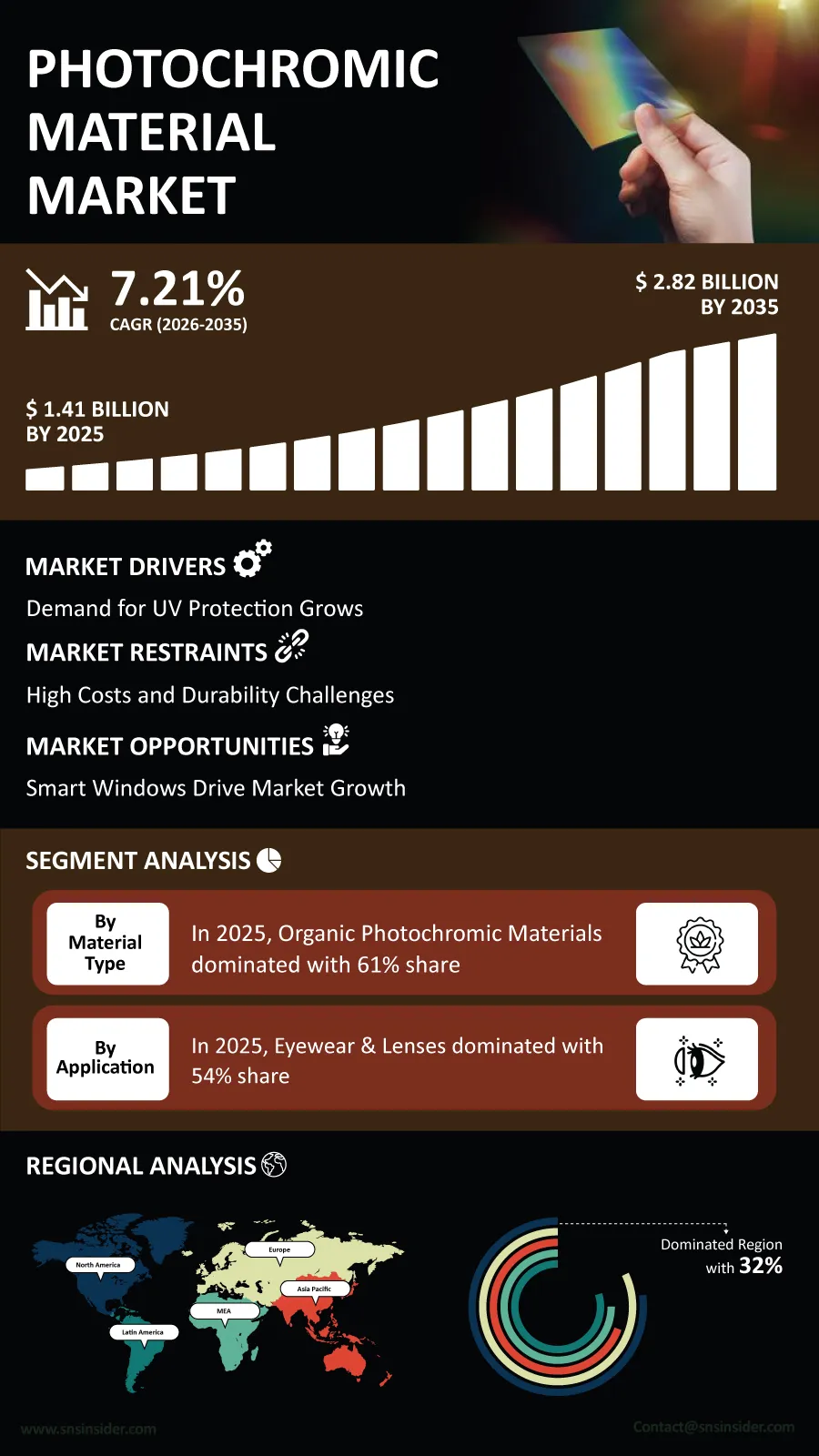
The global Photochromic Material Market is witnessing robust expansion as manufacturers increasingly develop advanced light-responsive materials for eyewear, smart buildings, automotive glazing, and specialty consumer products. “According to a recent study by SNS Insider, the global Photochromic Material Market size valued at USD 1.41 Billion in 2025, is anticipated to grow to USD 2.82 Billion by 2035, registering a CAGR of 7.21% over the 2026–2035 forecast period.”
The increasing concern over UV protection, visual comfort, and energy conservation technology is driving the demand for smart photochromic materials in a range of industries. The reason is that these smart materials vary their optical characteristics in accordance with the prevailing light conditions, thereby providing increased visual comfort and energy efficiency.
In addition to this, the market is also witnessing improvements in specialty chemicals, optical materials, and smart coatings. Companies are conducting research and development in order to come up with photochromic technology that reacts quickly, lasts long, and is color stable.
To Get Detailed Insights on the Photochromic Material Market – Request a Sample Report
Smart Building Adoption and Advanced Optical Applications Create Long-Term Growth Opportunities
Investment in sustainable building and intelligent infrastructure all across the world is providing significant chances for photochromics material producers. Adaptive glass solutions are being used more often by architects and developers in commercial buildings and private construction projects in order to achieve better thermal comfort, light control, and decrease the need for air conditioning.
On the other hand, the vision care segment is still offering substantial growth opportunities for the manufacturers of photochromic materials, since more people are becoming interested in the development of lenses which would be able to adapt to outdoor conditions and protect eyes from harmful UV rays.
Moreover, automotive companies are introducing adaptive solutions in glazing systems, mirrors, and interior parts in order to minimize glare. With the introduction of intelligent mobility solutions and innovative vehicles, the need for intelligent light management materials will become even higher.
Key Market Insights Highlight Shifting Demand Patterns
Based on material type, organic photochromic materials accounted for approximately 61% of global market revenue in 2025 due to their flexibility, lightweight characteristics, and broad application across eyewear and specialty coatings. Inorganic photochromic materials are expected to witness the fastest growth through 2035 as industries increasingly require superior durability and thermal stability for demanding applications.
In terms of application, eyewear and lenses held 54% of the global market in 2025, supported by increasing consumer preference for adaptive vision solutions. Construction and architecture is anticipated to become the fastest-growing application segment as smart windows and adaptive façade technologies gain wider adoption in sustainable building projects.
By activation mechanism, UV-activated photochromic materials represented 57% of market revenue in 2025 owing to their reliable performance in outdoor environments. Dual light-activated materials are projected to expand at the fastest pace as next-generation technologies enable faster response under both ultraviolet and visible light conditions.
Material Innovation Accelerates Industry Transformation
The industry of photochromic materials keeps changing owing to the emergence of new materials which provide fast activation, increased longevity, higher clarity, and improved durability. Hybrid materials which benefit from both inorganic and organic technology have been created, thus increasing their number of applications.
Moreover, companies pay more attention to manufacturing technologies that are more environmentally friendly, including materials which can be recycled. Advances in the field of nanotechnology, polymer chemistry, and coating technologies help create new high-performing products.
Changing consumer demands mean that innovation in smart materials that provide high performance but do not harm the environment will play an important role in competition.
Regional Markets Demonstrate Strong Growth Potential
North America held around 32% of the total market revenue share in 2025 due to the availability of sophisticated specialty chemicals production, demand for high-end opticals, and adoption of smart building systems. High customer awareness about protection for the eyes and continuous innovations in materials are other contributing factors towards the leading position.
Asia Pacific region is anticipated to experience the highest rate of growth till 2035 due to rapid industrialization, increasing constructions activities, rising automotive production, and growing disposable incomes in countries such as China, India, Japan, and South Korea. Excellent manufacturing facilities and government policies favoring green infrastructure make the market environment favorable.
Europe holds an important position in the market with high adoption of energy-efficient buildings, eyewear market presence, and continuous investment in architectural glazing technologies. At the same time, Latin America and Middle East and Africa are growing markets due to urbanization, infrastructural development, and consumer awareness.
Industry Participants Focus on Advanced Material Innovation
The competitive landscape remains highly innovation-driven as manufacturers continue investing in advanced photochromic compounds, specialty coatings, and next-generation optical technologies. Strategic partnerships, product development, manufacturing expansion, and sustainability-focused initiatives remain central to strengthening competitive positioning across global markets.
Key companies operating in the global Photochromic Material Market include Transitions Optical (EssilorLuxottica), Tokuyama Corporation, Mitsui Chemicals, PPG Industries, Milliken Chemical, Yamada Chemical Co. Ltd., LCR Hallcrest LLC, QCR Solutions Corp, Vivimed Labs, Carl Zeiss AG, HOYA Corporation, Rodenstock GmbH, Vision Ease Lens, Signet Armorlite Inc., Optiswiss AG, SEIKO Optical Products Co. Ltd., Nikon Corporation, ChromoGenics AB, Nissan Chemical Corporation, and Color Change Corporation.
An SNS Insider analyst Himanshu Sharma commented, “Growing demand for intelligent materials that combine optical performance, energy efficiency, and sustainability is creating significant opportunities across multiple industries. Companies investing in advanced photochromic technologies, high-performance coatings, and next-generation adaptive materials are expected to remain well positioned as smart infrastructure and premium optical applications continue to expand globally.”
About the Author

Get in touch




