
Longevity Market Report Scope & Overview:
The Longevity market is witnessing continuous growth owing to the increase in the number of cases associated with age-related disorders such as cardiovascular diseases, neurodegeneration and metabolic dysfunction around the globe. Moreover, the growth can be attributed to the rising adoption of preventive healthcare practices coupled with the advancements made in genomics, biomarkers, and AI-driven drug discovery technologies. The longevity solutions are interventions used to promote healthspan and lifespan through nutraceuticals, regenerative medicine and personalized therapies. The solutions obtained are delivered through digital health tools and wellness ecosystems without the use of conventional curative approaches that can hinder prevention.
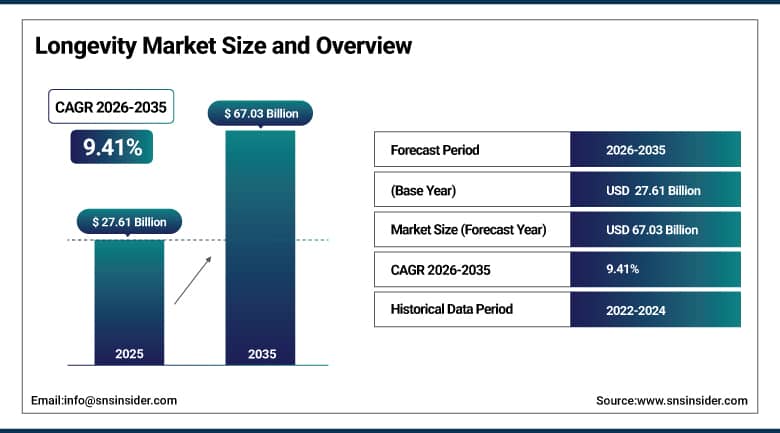
The Longevity Market was valued at USD 27.61 Billion in 2025 and is expected to reach USD 67.03 Billion by 2035, growing at a CAGR of 9.41% from 2026 to 2035.
In 2025, the number of consumers of longevity solutions is expected to reach about 120 million.
To Get More Information On Longevity Market - Request Free Sample Report
Longevity Market Trends:
-
Rising prevalence of age-related diseases and increasing focus on healthspan extension are driving demand for longevity solutions across preventive and therapeutic segments.
-
Growing adoption of nutraceuticals, anti-aging pharmaceuticals, and regenerative medicine is boosting the expansion of the longevity market.
-
Advancements in genomics, biomarkers, AI-driven drug discovery, and aging clock technologies are improving early detection and personalized longevity interventions.
-
Increasing integration of digital health tools, wearables, and real-time health monitoring is enabling continuous tracking of biological age and treatment outcomes.
-
Expanding consumer awareness and shift toward preventive healthcare and personalized medicine are accelerating adoption of longevity products and services.
-
Rising investments, partnerships, and collaborations between biotech firms, pharmaceutical companies, and research institutions are accelerating innovation and commercialization in the longevity ecosystem.
Key Market Highlights
|
Market Parameter |
Market Highlight / Data |
Key Growth Driver |
|---|---|---|
|
Largest Technology Type |
Genomics & Epigenetics – 24.25% share in 2025 |
Key significance in knowing genetic predisposition to aging and enabling personalized interventions. |
|
Fastest-Growing Technology Type |
Biomarker / Aging Clock Technologies – 12.49% CAGR |
Increased need for biological age determination through precision medicine. |
|
Largest Product Type |
Nutraceuticals & Dietary Supplements – 28.05% share in 2025 |
Consumer inclination toward preventative healthcare, availability, and usage within wellness centers. |
|
Fastest-Growing Product Type |
Senolytics & Senotherapeutics – 14.24% CAGR |
Breakthroughs in research involving cellular aging and removal of senescent cells. |
|
Largest Application |
Preventive Healthcare & Wellness – 30.25% share in 2025 |
Growing awareness regarding health optimization and preference for preventive healthcare over curative treatments. |
|
Fastest-Growing Application |
Personalized Medicine – 14.35% CAGR |
Developments in AI-based diagnostics, genetics, and personalized medicine approaches. |
|
Largest End User |
Individuals / Consumers – 35.12% share in 2025 |
Growing use of personal longevity strategies such as nutraceuticals, wellness solutions, and wearables. |
|
Fastest-Growing End User |
Pharmaceutical & Biotechnology Companies – 10.26% CAGR |
Growing research on longevity drugs and therapies. |
|
Largest Distribution Channel |
Direct-to-Consumer (DTC) – 32.23% share in 2025 |
Consumer preference to purchase longevity products directly from brands through subscriptions. |
|
Fastest-Growing Distribution Channel |
Online / E-commerce Platforms – 12.25% CAGR |
High adoption of digital technologies, ease of access, and wide-ranging products. |
|
Largest Region |
North America – 39.84% share in 2025 |
Increased consumer awareness related to prevention care and strong presence of biotechnology firms. |
|
Fastest-Growing Region |
Asia Pacific – 11.25% CAGR |
Rapidly aging population, increasing healthcare awareness, and rising disposable incomes. |
U.S. Longevity Market Insights:
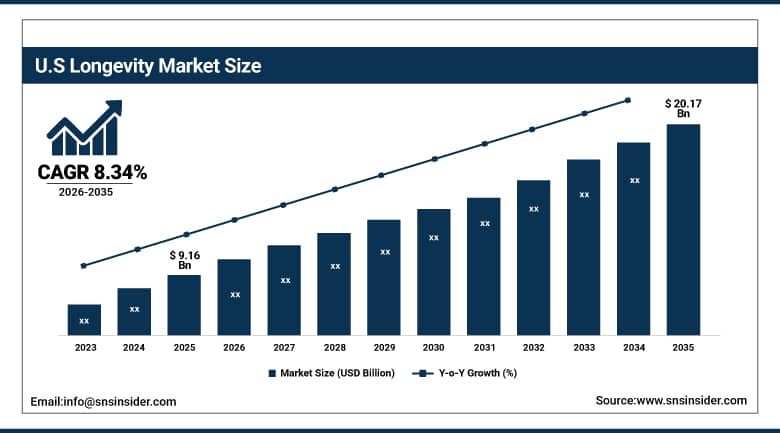
The U.S. Longevity Market is expected to reach USD 20.17 Billion in 2035 from USD 9.16 Billion in 2025, exhibiting a CAGR of 8.34%. The growth can be attributed to the growing interest of consumers in preventive healthcare and increasing the life span, growing instances of age-associated ailments, high penetration of nutraceuticals, anti-aging medications, and regenerative medicines, in addition to fast developments in AI-based health analysis and biomarkers.
Longevity Market Growth Drivers:
-
Rising focus on preventive healthcare, healthspan extension, and increasing prevalence of age-related diseases driving demand for longevity solutions.
The heightened awareness of health risks related to aging along with the increasing incidence of chronic and age-related diseases has become some of the major factors propelling the market growth for Longevity. The use of nutraceuticals, anti-aging drugs, regenerative and personalized medicine solutions by individuals and wellness centers and healthcare providers to increase lifespan and healthspan is also gaining momentum due to technological breakthroughs in genomics, biomarker analysis, health analytics driven by AI, and health monitoring through digital devices.
More than 45% of consumers and healthcare providers have implemented one or more longevity solutions in 2025 such as supplements, preventive medications, or health monitoring solutions aimed at increasing healthspan.
Longevity Market Restraints:
-
High costs of advanced longevity solutions and limited standardization of clinical validation are restraining widespread adoption of longevity therapies.
Expensive investment in innovative anti-aging treatments, such as those based on regenerative medicine, genetic and cellular therapies, and customized AI-powered treatment programs, continues to present a major hindrance to the industry’s growth. The low level of insurance coverage and reimbursement rates for elective and preventive care for longevity-related procedures poses another challenge for accessing advanced healthcare. Moreover, the absence of established standards and regulations for most anti-aging solutions, together with their long-term effectiveness, raises concerns among patients and practitioners about their use.
Longevity Market Opportunities:
-
Expanding integration of AI-driven longevity platforms, precision diagnostics, and preventive wellness ecosystems presents significant growth opportunities for the Longevity Market.
The growing adoption of AI-based health analysis, AI-powered diagnostic technology, and personalized longevity services is generating substantial business opportunities for organizations operating in the value chain. Businesses that integrate their solutions in the form of genomics, biomarker analysis, wearable health tracking devices, and analysis tools are seeing increased consumer uptake, along with the wellness centers and healthcare providers. The growing investment in the development of prevention-focused healthcare services, combined with the demand for personalized health solutions and wellness programs, has led to innovations in the domain of longevity solutions.
Over 50% of consumers and wellness centers were seen to be adopting or interested in AI-powered health monitoring tools and personalized longevity solutions in 2025.
Longevity Market Segmentation Analysis:
-
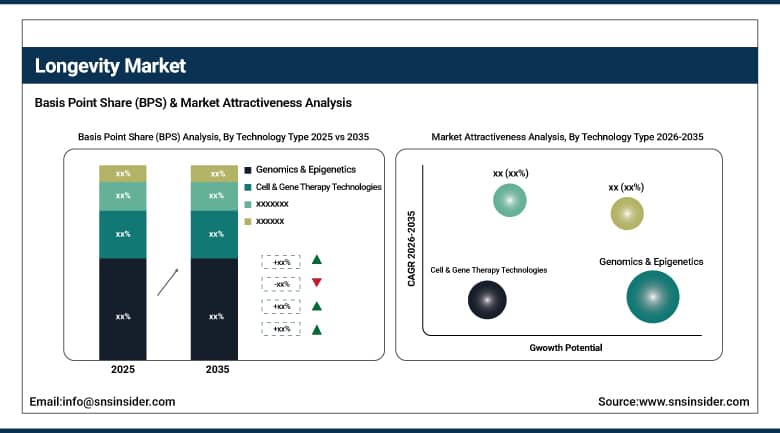
By Technology Type, Genomics & Epigenetics dominated with a 24.25% market share in 2025, whereas Biomarker / Aging Clock Technologies are projected to record the fastest CAGR of 12.49% through 2026–2035.
-
By Product Type, Nutraceuticals & Dietary Supplements held the largest market share of 28.05% in 2025, while Senolytics & Senotherapeutics are expected to grow at the fastest CAGR of 14.24% during 2026–2035.
-
By Application, Preventive Healthcare & Wellness held the largest share of 30.25% in 2025, while Personalized Medicine is anticipated to expand at a strong CAGR of 14.35% during the forecast period.
-
By End User, Individuals / Consumers accounted for the highest market share of 35.12% in 2025, while Pharmaceutical & Biotechnology Companies are expected to grow at the fastest CAGR of 10.26% during 2026–2035.
-
By Distribution Channel, Direct-to-Consumer (DTC) channels held the largest share of 32.23% in 2025, while Online / E-commerce Platforms are expected to grow at the fastest CAGR of 12.25% during the forecast period.
By Technology Type, Genomics & Epigenetics Dominate While Biomarker / Aging Clock Technologies Grow Rapidly:
Genomics & Epigenetics segment dominated the market due to its key significance in knowing genetic predisposition to aging and facilitating personalized interventions for longevity. In 2025, more than 650 million tests were performed on account of high integration in preventive health care techniques using genetic analysis techniques.
Biomarker / Aging Clock Technologies are the fastest-growing segment most promising one as far as growth rates are concerned, with increased need for biological age determination through precision medicine. The total number of tests performed reached above 220 million in 2025 mainly in digital health services and longevity centers.
By Product Type, Nutraceuticals & Dietary Supplements Dominate While Senolytics & Senotherapeutics Grow Rapidly:
The Nutraceuticals & Dietary Supplements segment dominated the market owing to consumer inclination toward preventative health care, availability, and usage within various wellness centers. In 2025, consumption exceeded 900 million units, as there was heavy demand for vitamins, antioxidants, and longevity-related supplements used by people to increase their health span.
Senolytics & Senotherapeutics are the fastest-growing segment owing to breakthroughs in research involving cellular aging and removal of senescent cells. Consumption exceeded 140 million units in 2025 and was popular at various longevity centers offering therapy.
By Application, Preventive Healthcare & Wellness Dominate While Personalized Medicine Grow Rapidly:
Preventive Healthcare & Wellness segment dominated the market owing to growing awareness regarding health optimization and an increased preference for preventive healthcare compared to curative treatments. The number of engagements reached above 1.1 billion in 2025 within supplements, wellness programs, and lifestyle optimization categories, representing the widespread use by consumers and wellness organizations.
Personalized Medicine is the fastest-growing segment, driven by developments in AI-based diagnostics, genetics, and personalized medicine approaches. More than 300 million personalized cases were witnessed in 2025, especially in longevity clinics and specialized healthcare centers.
By End User, Individuals / Consumers Dominate While Pharmaceutical & Biotechnology Companies Grow Rapidly:
The Individuals/Consumer’s segment was the most dominant segment owing to the growing use of personal longevity strategies such as nutraceuticals, wellness solutions, wearables, and preventive health care. The number of engagements made by consumers in 2025 exceeded 1.2 billion across supplements, digital healthcare, and lifestyle optimization products.
The Pharmaceutical & Biotechnology Companies segment is expected to grow the fastest due to the growing research on longevity drugs and therapies. The number of research and development activities conducted by companies in 2025 exceeded 280 million.
By Distribution Channel, Direct-to-Consumer (DTC) Dominates While Online / E-commerce Platforms Grow Rapidly:
Direct-to-Consumer (DTC) segment dominated the market share due to consumers were increasingly preferring to purchase longevity products directly from brands such as supplements, wellness products, and prevention-based health programs available through subscriptions. For instance, in 2025, over 950 million transactions were made in the DTC segment due to brand-owned channels and personalization features.
Online / E-commerce Platforms are the fastest-growing segment, fueled by high adoption of digital technologies, ease of access, and wide-ranging products available on the platform. Over 600 million sales orders were made using online platforms in 2025, representing the momentum being witnessed in the digital health ecosystem.
Regional Insights:
North America Longevity Market Insights:
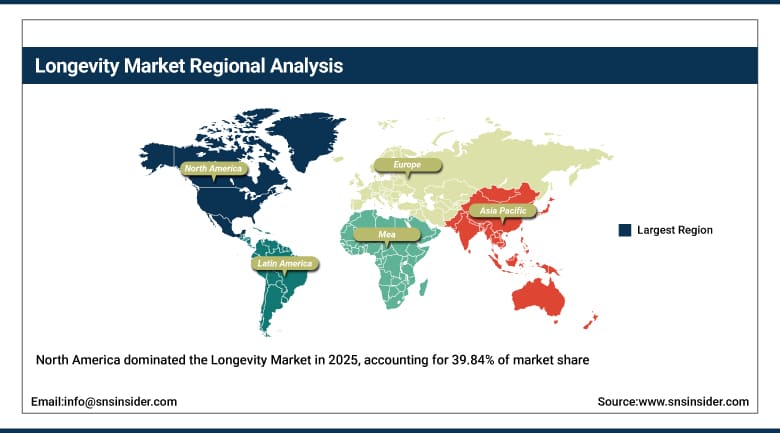
North America holds the largest market share at 39.84% in 2025 due to increased consumer awareness related to prevention care, strong presence of biotechnology and digital health firms, and a well-established healthcare system in the United States and Canada. The use of nutraceuticals, anti-aging drugs, regenerative medicines, and artificial intelligence-based applications in wellness centers and specialty clinics contributes to the growth of the longevity market in North America. In addition to that, there are several factors such as increasing research investments into the field, favorable regulations regarding wellness innovation, and demand for health optimization that positively impact the development of the industry.
Get Customized Report as Per Your Business Requirement - Enquiry Now
U.S. Market Insigths:
Consumer spending on preventive care, rapid adoption of digital health solutions, and an emerging ecosystem of innovative biotech startups working on longevity-related topics characterize the U.S. Longevity Market. The expanding application of genomics, biomarkers testing, artificial intelligence tools, and personalized approaches in longevity centers drive market growth.
Asia-Pacific Longevity Market Insights:
The Asia-Pacific Longevity Market is the fastest-growing region, projected to expand at a CAGR of 11.25% during 2026–2035, supported by a rapidly aging population, increasing healthcare awareness, and rising disposable incomes across countries such as China, India, Japan, and South Korea. Expanding adoption of nutraceuticals, traditional medicine integration, wearable health technologies, and preventive wellness services is accelerating market penetration. Growing investments in digital health platforms, longevity clinics, and research initiatives, along with improving access to healthcare infrastructure, are driving strong demand for personalized and preventive longevity solutions across the region.
China Market Insights:
The China Longevity Market is fueled by a fast-growing aging population, an increase in preventive healthcare, and government encouragement to develop innovations in the healthcare sector and advance biotechnologies. Growing usage of nutraceuticals, inclusion of traditional medicine, regenerative medical approaches, and advancements in digital health platforms are driving the growth of the market. Growing investments in AI-powered diagnostics, genomics research, and longevity-oriented startups coupled with awareness among consumers about healthspan enhancement are fueling widespread adoption through wellness centers and longevity clinics.
Europe Longevity Market Insights:
The Europe Longevity Market is fueled by the presence of a robust healthcare system, increasing number of aging populations, and growing preference for preventive and personalized healthcare in countries such as Germany, France, and the UK. Adoption of biomarkers technology, AI-based health tracking systems, nutraceuticals, and regenerative medicine is boosting the growth of the market. Favorable regulatory policies, increased investments in longevity, and collaborations between biotechnology companies and research organizations are driving the innovations. Increased consumer awareness about health optimization and aging is also helping in driving regional market growth.
Germany Market Insights:
Germany is one of the major markets in the European longevity sector due to its well-developed healthcare system, effective research and development operations, and increased adoption of preventive healthcare solutions. The industry growth is expected through the use of genomics, diagnostics based on biomarkers, AI health systems, and personalized wellness programs in longevity clinics and healthcare facilities. The government backing along with the presence of numerous research institutes and biotech companies helps develop and sell more products and services focused on longevity.
Latin America Longevity Market Insights:
The Latin America Longevity Market is expanding owing to growing preventive healthcare awareness, increase in age-related diseases, and improving access to healthcare services in countries such as Brazil, Mexico, and Argentina. The use of nutraceuticals, wellness programs, and digital health solutions drives the market growth. Private healthcare facilities investment, an increasing number of middle-class individuals, and increasing interest in improving lifestyles and preventing chronic diseases are factors stimulating product and service demand in urban areas.
Middle East and Africa Longevity Market Insights:
The Middle East & Africa Longevity Market owing to improved healthcare infrastructure, increased healthcare expenditure, and increased consciousness about preventive and wellness-based healthcare. Nutraceuticals, digital health applications, and other forms of personalized healthcare have gained popularity among several countries in the region such as Saudi Arabia, the UAE, and South Africa. In addition to government efforts aimed at improving healthcare infrastructure and increased investments in biotechnology, there is slow but steady progress toward the development of the market.
Competitive Landscape:
Altos Labs, a leading biotechnology firm, concentrates on cellular rejuvenation programming and longevity science, with the objective of counteracting age-related cellular deterioration via sophisticated reprogramming technologies. The company is significantly allocating resources to early-stage research that integrates stem cell biology, epigenetics, and regenerative medicine, all with the goal of prolonging healthspan. Its methodology prioritizes the fundamental biological processes of aging, as opposed to merely addressing symptoms, thereby establishing its position as a high-impact innovator within the longevity sector. Furthermore, strategic partnerships with prominent academic institutions and the recruitment of leading scientific experts bolster its research capabilities and its long-term innovation trajectory.
-
In September 2025, Altos Labs moved its cellular reprogramming initiatives closer to preclinical trials. The company concentrated on epigenetic reset mechanisms, aiming to rejuvenate cellular function and facilitate regenerative therapies for age-related ailments.
Calico Life Sciences, a biotech firm fueled by research, is dedicated to unraveling the biology of aging. Its goal? To create ways to live longer, healthier lives. Supported by Alphabet, Calico employs computational biology, genomics, and sophisticated data analysis to pinpoint the molecular pathways linked to aging and age-related illnesses. The company prioritizes long-term research initiatives and collaborations with top research institutions, aiming to transform basic aging research into viable treatments. With a robust computational infrastructure and a collaborative, cross-disciplinary approach, Calico digs deep into the mechanisms of longevity and the identification of biomarkers.
-
In July 2025, Calico Life Sciences broadened its partnerships in aging biology. The company was pushing forward with multi-omics and AI-powered research, aiming to discover new targets linked to longevity and the modulation of age-related diseases.
Insilico Medicine, a prominent player in the biotech field, is at the forefront of drug discovery, aging research, and therapies aimed at extending life. The company employs artificial intelligence, deep learning, and generative models to speed up the process of finding new drug candidates. These candidates are designed to address age-related diseases and the biological mechanisms of aging. Insilico's platform integrates genomics, proteomics, and clinical data, allowing for the efficient design and validation of molecules. This approach helps to cut down on both the time and expense of development. With its emphasis on AI-driven precision medicine and aging biomarkers, Insilico is a significant innovator at the intersection of technology and longevity science.
-
In May 2025, Insilico Medicine moved several AI-generated drug candidates into clinical trials. These initiatives encompassed programs targeting fibrosis and conditions associated with aging, demonstrating the adaptability of its extensive AI drug discovery platform in the field of therapeutics designed to extend lifespan.
Longevity Market Key Players:
-
Altos Labs
-
Calico Life Sciences
-
Insilico Medicine
-
Unity Biotechnology
-
BioAge Labs
-
Juvenescence
-
Retro Biosciences
-
Life Biosciences
-
Rubedo Life Sciences
-
LyGenesis
-
Elevian
-
Oisin Biotechnologies
-
Human Longevity Inc.
-
Clock.bio
-
Genflow Biosciences
-
AgeX Therapeutics
-
Halia Therapeutics
-
BioSplice Therapeutics
-
Oura
-
Elysium Health
Longetivity Market Report Scope:
| Report Attributes | Details |
|---|---|
| Market Size in 2025 | USD 27.61 Billion |
| Market Size by 2035 | USD 67.03 Billion |
| CAGR | CAGR of 9.41% From 2026 to 2035 |
| Base Year | 2025 |
| Forecast Period | 2026-2035 |
| Historical Data | 2022-2024 |
| Report Scope & Coverage | Market Size, Segments Analysis, Competitive Landscape, Regional Analysis, DROC & SWOT Analysis, Forecast Outlook |
| Key Segments | • By Product Type (Nutraceuticals & Dietary Supplements, Anti-Aging Pharmaceuticals, Regenerative Medicine, Senolytics & Senotherapeutics, Hormone Replacement Therapy (HRT), Others) • By Technology Type (Genomics & Epigenetics, Biomarker / Aging Clock Technologies, Artificial Intelligence & Machine Learning, Wearable Health Monitoring Technologies, Cell & Gene Therapy Technologies, Others) • By Application (Preventive Healthcare & Wellness, Age-Related Disease Treatment, Personalized Medicine, Chronic Disease Management, Fitness & Lifestyle Optimization, Others) • By End User (Individuals / Consumers, Hospitals & Clinics, Pharmaceutical & Biotechnology Companies, Research Institutes, Longevity & Wellness Centers, Others) • By Distribution Channel (Direct-to-Consumer (DTC), Online / E-commerce Platforms, Pharmacies & Retail Drug Stores, Specialty Clinics, Institutional Sales, Others) |
| Regional Analysis/Coverage | North America (US, Canada, Mexico), Europe (Eastern Europe [Poland, Romania, Hungary, Turkey, Rest of Eastern Europe] Western Europe] Germany, France, UK, Italy, Spain, Netherlands, Switzerland, Austria, Rest of Western Europe]), Asia Pacific (China, India, Japan, South Korea, Vietnam, Singapore, Australia, Rest of Asia Pacific), Middle East & Africa (Middle East [UAE, Egypt, Saudi Arabia, Qatar, Rest of Middle East], Africa [Nigeria, South Africa, Rest of Africa], Latin America (Brazil, Argentina, Colombia, Rest of Latin America) |
| Company Profiles | Altos Labs, Calico Life Sciences, Insilico Medicine, Unity Biotechnology, BioAge Labs, Juvenescence, Retro Biosciences, Life Biosciences, Rubedo Life Sciences, LyGenesis, Elevian, Oisin Biotechnologies, Human Longevity Inc., Clock.bio, Genflow Biosciences, AgeX Therapeutics, Halia Therapeutics, BioSplice Therapeutics, Oura, Elysium Health |
Frequently Asked Questions
North America dominated with a 39.84% share in 2025, while Asia-Pacific is the fastest-growing region, expected to expand at a CAGR of 11.25% during 2026–2035.
Nutraceuticals & Dietary Supplements dominated with a 28.05% share in 2025, while Senolytics & Senotherapeutics are projected to grow at the fastest CAGR of 14.24% during 2026–2035.
Growth is driven by rising prevalence of age-related diseases, increasing focus on preventive healthcare, adoption of nutraceuticals and regenerative therapies, and advancements in AI-driven diagnostics and personalized medicine.
The market is valued at USD 27.61 Billion in 2025 and is projected to reach USD 67.03 Billion by 2035.
The Longevity Market is projected to grow at a CAGR of 9.41% during 2026–2035.
