
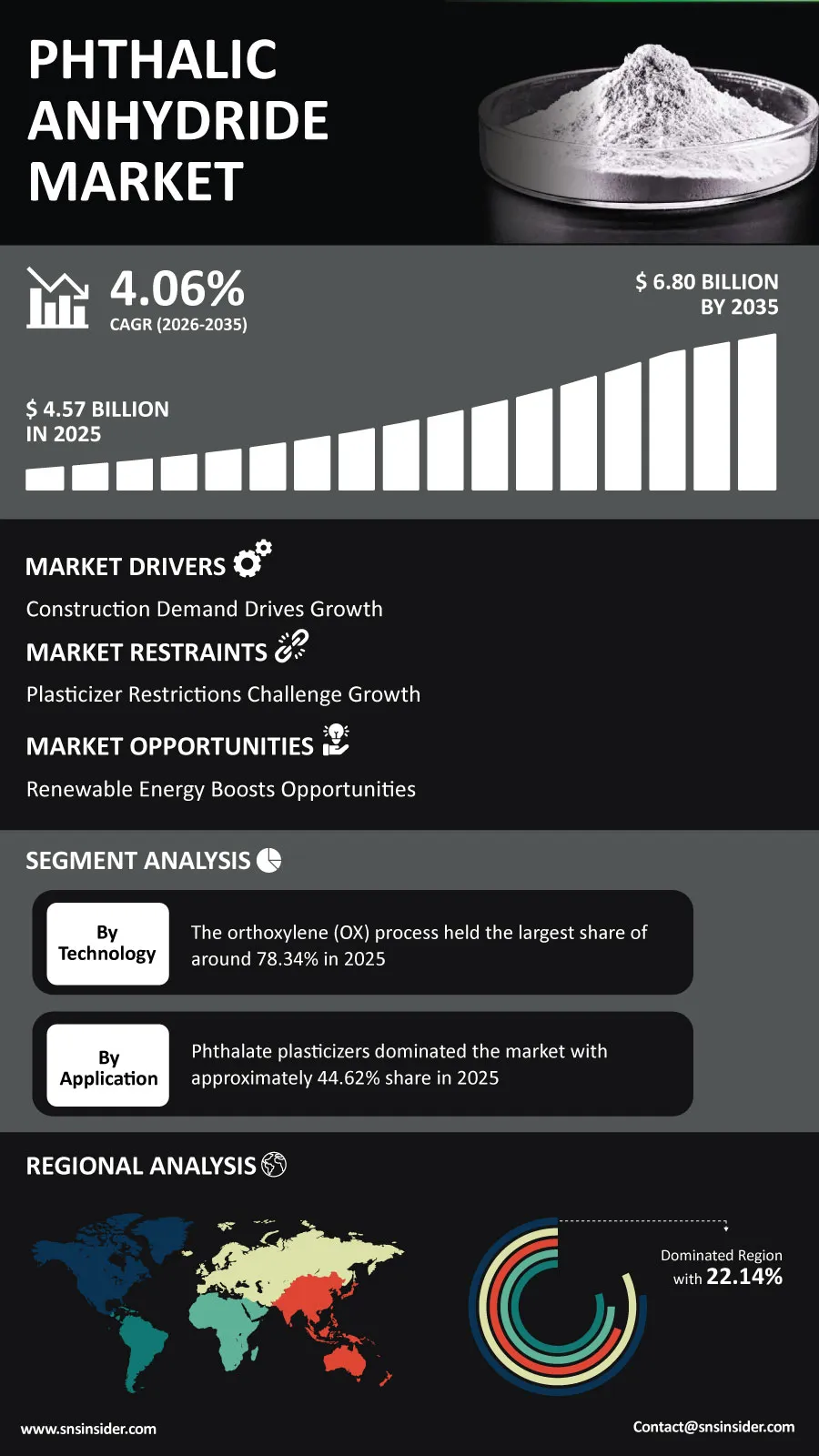
The Phthalic Anhydride market will see constant growth in the global market due to rising downstream demand for plasticizers, coatings, and composite materials. “According to a recent study by SNS Insider, the global Phthalic Anhydride Market size valued at USD 4.57 Billion in 2025, is anticipated to grow to USD 6.80 Billion by 2035, registering a CAGR of 4.06% over the 2026–2035 forecast period.”
Phthalic anhydride will continue to be an essential intermediate for the production of phthalate plasticizers, unsaturated polyester resin (UPR), and alkyd resins for construction material, automobile, marine, and architecture applications. Urbanization and infrastructure developments in the Asia Pacific and other emerging markets are boosting the demand growth in the industry.
The industry is also benefiting from new capacity additions and optimization efforts by large Asian manufacturers. The orthoxylene-based manufacturing route is currently dominating investment in the industry owing to feedstock advantages and low-cost operations, whereas the existing naphthalene-based plants are key in selected regional markets.
To Get Detailed Insights on the Phthalic Anhydride Market – Request a Sample Report
Infrastructure and Coatings Demand Create Long-Term Growth Opportunities
The increase in investments in housing construction, transport sector, and industrial constructions is helping to create a good environment for the use of phthalic anhydride. The use of alkyd resin is growing in line with the increased need for paints and coatings application. The consumption of UPR is also rising in construction composite products, marine products, and renewable energy applications.
The construction of wind energy infrastructure is becoming a major source of opportunity for manufacturers of phthalic anhydride used in the production of UPR. The blades of wind turbines, reinforced fiberglass pipes, and other big composites need high quantities of polyester resin intermediates.
Key Market Insights Highlight Shifting Demand Patterns
Based on technology, Orthoxylene (OX) was the largest contributor with a 78.34% share of revenues globally in 2025 because of greater conversion efficiency, abundant availability of raw materials, and good synergy with the petrochemical refining industry. The Naphthalene process would record the highest CAGR till 2035 because of the continuing operation of existing assets using the traditional coal-tar route in Eastern Europe and certain Asian countries.
Based on form, the share of Molten phthalic anhydride in revenues of 2025 was 61.47%, with growing preference for pipeline delivery of liquid material in integrated downstream companies for continuous processing activities. The Flake form segment is forecast to grow steadily, especially in export sales and in batch manufacturers needing easy handling and stability for storage.
With respect to application, Phthalate plasticizers had a 44.62% share in market demand in 2025 because of the consumption of flexible PVC in insulation of wire and cable, flooring, roofing membrane, and interior automotive parts. Unsaturated Polyester Resins were the fastest growing application category because of increasing demand in construction, marine, and wind energy composites applications.
Regulatory Shifts Encourage Process Innovation
The industry is faced with a constantly evolving regulatory environment as there are increasing restrictions being imposed on ortho-phthalate plasticizers in North America and Europe. The trend is prompting downstream manufacturers to turn towards phthalate-free solutions, leading to a rather uncertain demand environment for incumbents.
Efforts at improving efficiency and competitiveness through investment in clean technologies, energy savings and better catalysts have been underway. The digital monitoring of processes and integration of refineries have also helped in improving orthoxylene conversion efficiency.
Asia Pacific Emerges as Fastest-Growing Phthalic Anhydride Market at 4.84% CAGR; North America Secured 22.14% Share in 2025
Asia Pacific region will account for the highest CAGR of 4.84% through 2035. Urbanization trends, growing consumption of PVC, and development in the automotive industry and construction industry in regions like China, India, and Southeast Asia are contributing towards growth in the demand of the APAC region. Expansion of capacity in Chinese and Indian producers leads towards increased supply and rising international trade in the global market.
North America represented the largest share of 22.14% in the revenue share of the global market in 2025 due to developed infrastructure of chemical manufacturing plants, stable supply of orthoxylene raw material, and steady demand from the paints and coatings industry. The North American market will rise from USD 0.68 billion in 2025 to USD 0.97 billion by 2035.
Industry Participants Focus on Efficiency and Capacity Expansion
The competitive environment is still lively with producers working towards integration of feedstock, optimization, and capacity expansion in the region. Some of the major companies are consolidating their standing through development of orthoxylene-based manufacturing, improvements in process reliability, and better logistics for plasticizer and resin customers.
Key companies operating in the global Phthalic Anhydride Market include BASF SE, Aekyung Petrochemical Co., Ltd., Koppers Holdings Inc., Perstorp Holding AB, UPC Technology Corporation, Polynt S.p.A., Nan Ya Plastics Corporation, Thirumalai Chemicals Ltd., IG Petrochemicals Ltd., Stepan Company, Lanxess AG, ExxonMobil Chemical Company, Nippon Steel Chemical & Material Co., Ltd., Panjan Petrochemical Co., Tronox Holdings PLC, Mitsubishi Chemical Corporation, Wanhua Chemical Group Co., Ltd., Henan Qingcheng Chemical Co., Ltd., TPC Consolidated Corporation, and Hanwha Solutions Corporation.
An SNS Insider analyst Himanshu Sharma commented, “Steady growth in PVC plasticizers, coatings, and composite materials is sustaining long-term demand for phthalic anhydride. Producers that enhance feedstock integration, improve energy efficiency, and expand their presence in high-growth Asian markets will be better positioned to capitalize on evolving downstream demand patterns and infrastructure-led consumption growth.”
About the Author

Get in touch




