
The global progressive web apps industry is undergoing a phase of rapid commercial growth. “Businesses want the app-like customer experience without the expense of building and maintaining separate native apps for each platform. Customers want fast loading, offline access and smooth checkout on any device. This has created a clear cost and reach advantage for digital businesses of a single web-based app that works everywhere.
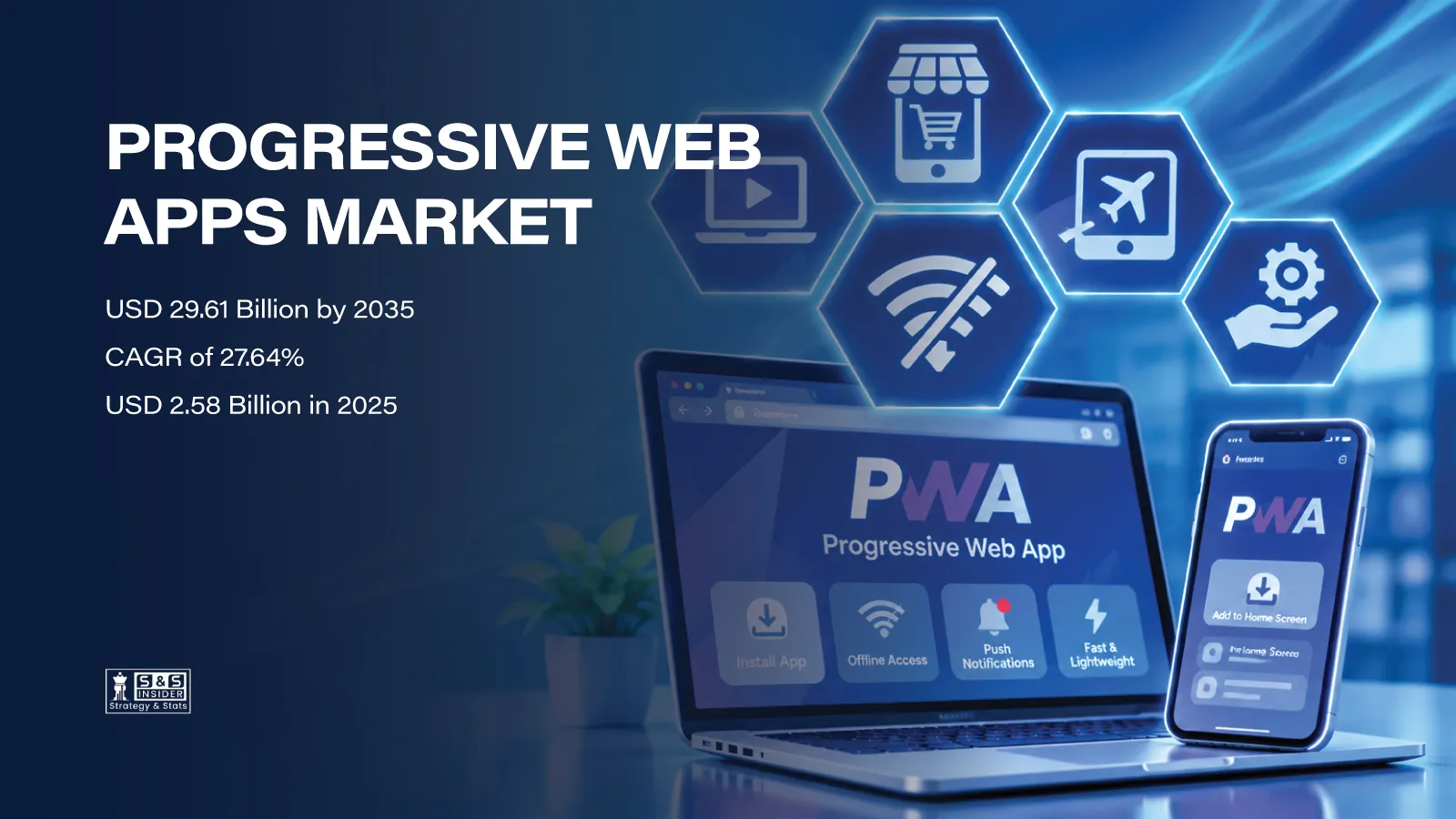
According to a recent study by SNS Insider, the global Progressive Web Apps Market size was valued at USD 2.58 Billion in 2025 and is anticipated to reach USD 29.61 Billion by 2035, registering a CAGR of 27.64% over the forecast period 2026–2035. The market is estimated at USD 3.29 Billion in 2026.
Development Cost Pressure Is Reshaping Digital Channel Budgets
Developing separate apps for iOS, Android and web means multiple code bases, multiple teams and higher maintenance costs. Each update has to be duplicated and tested on each platform, slowing releases and adding to costs.
Progressive web apps allow companies to deliver to all devices from a single code base. This reduces development and maintenance costs and helps teams push updates faster.
With digital budgets under tighter scrutiny, finance and technology leaders are measuring app investments by total cost of ownership. This makes for a strong case for PWA vendors to sell their solutions as tools for budget control as well as user experience.
To Get Detailed Insights on the Progressive Web Apps Market – Request a Sample Report
Direct Customer Access Opens Revenue Opportunities Beyond App Stores
Native apps depend on app store approval, listing rules, and fee structures. Progressive web apps reach users through a browser link, a search result, or a shared message, with no store in between.
This puts businesses in a better position to control pricing, promotions and the customer relationship. First-party engagement data can also be collected by companies themselves, creating better personalisation and marketing decisions.
Vendors can capitalise on this change by offering analytics, push notification services, payment integration and performance monitoring as paid add-ons. These services generate recurring revenues, and deepen long-term relationships with clients.
Progressive Web Apps Market Segmentation Highlights
By Component
In 2025, the platform had the largest market share of 56.20% as businesses first invest in the core frameworks required to build and run PWAs. The services segment is projected to witness the highest CAGR of 30.12% which will fuel opportunities in design, migration, optimisation and ongoing support work.
By Organization Size
Large enterprises dominated the market with 64.90% share in 2025 as they have the scale and budgets to replace or supplement native apps. The highest CAGR of 30.46% is expected to be witnessed in small and medium enterprises. This gives vendors an opportunity for low-cost, template and subscription price solutions.
By Application
EThe largest market share of 29.40% was held by e-commerce and retail in 2025. The healthcare market is expected to grow at a CAGR of 29.86% driven by opportunities in patient portals, appointment booking and remote care access.
North America Leads with 35.20% Market Share as Asia Pacific Advances at 30.50% CAGR
North America held the largest revenue share of 35.20% in the Progressive Web Apps Market in 2025. The U.S. market was valued at USD 744.69 Million in 2025, and it is expected to reach a CAGR of 27.10%. The region presents strong opportunities for vendors serving online retailers, media companies and financial services providers. Here, for buyers, page speed, security and measurable conversion wins drive their buying decisions.
Asia Pacific’s revenue was 28.90% in 2025 and is expected to record the fastest CAGR of 30.50% in 2026-2035. The rapid growth of mobile user populations and price-sensitive consumers are creating a demand for lightweight apps that can perform well on low-cost devices and slower networks.
Europe held a share of 24.60% of the global market in 2025. The Middle East & Africa accounted for 5.90% and Latin America accounted for 5.40%. Opportunities in these regions will depend on the adoption of digital commerce, the quality of the network and local business investment in online channels.
PWA-as-a-Service Could Widen the Customer Base
Many small businesses lack in-house developers and cannot fund a custom app build. Low-code builders, managed PWA platforms, and monthly subscription plans give these firms a practical route to an app-like presence.
Vendors can reach this group through partnerships with e-commerce platforms, web agencies, and hosting providers. These channels expand market reach without large direct sales costs.
Such models also support recurring income through hosting, maintenance plans, feature upgrades, and analytics subscriptions.
Competitive Outlook: Speed to Launch to Become a Key Differentiator
Future competition in the progressive web apps industry is likely to center on more than core framework features. Customers want tools that shorten build time, simplify integration with existing systems, and show clear gains in user engagement.
Vendors that combine reliable platforms with ready-made templates, strong developer support, and flexible pricing may hold a stronger market position. Partnerships with commerce platforms, cloud providers, and digital agencies can also help expand commercial reach.
Progressive Web Apps Market Outlook Through 2035
Over the next decade, progressive web apps are set to play a larger role in digital channel planning, customer engagement, and online sales strategy. Vendors that can show clear savings in development cost and clear gains in conversion and retention will be best placed to capture new demand across retail, healthcare, media, and financial services.
About the Author

Get in touch




