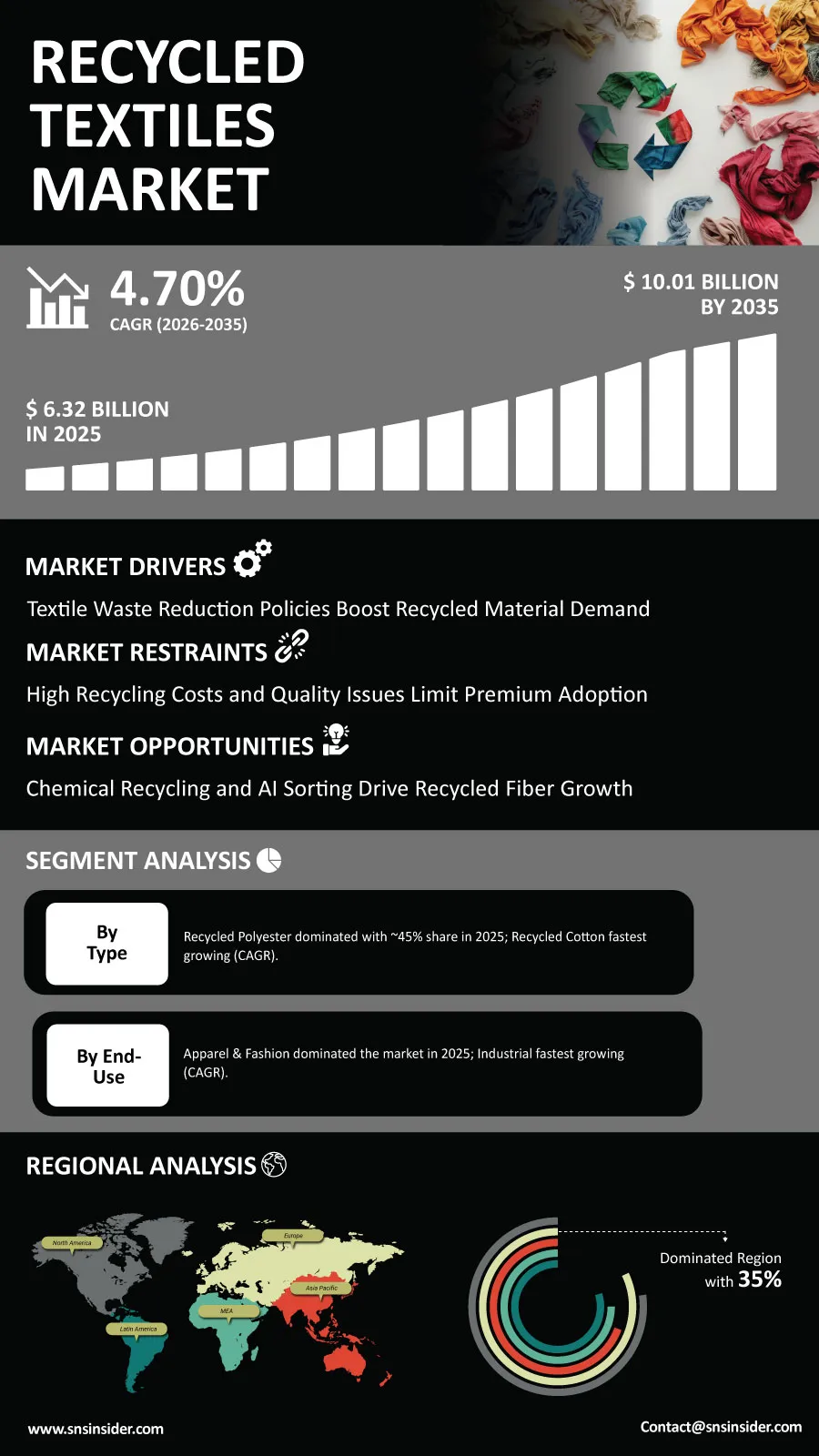
The global Recycled Textiles Market is seeing growth due to government-led initiatives to reduce wastage of textiles and switch to a circular production model. “According to a recent study by SNS Insider, the global Recycled Textiles Market size valued at USD 6.32 Billion in 2025, is anticipated to grow to USD 10.01 Billion by 2035, registering a CAGR of 4.70% over the 2026–2035 forecast period.”
As a result of heightened environmental consciousness, strict regulations on waste management in textiles, and the rising focus of businesses on ESG goals, the textile value chain is changing. Fashion brands, home furniture makers, and industries are increasingly using recycled fibers in their product lines to reduce carbon emissions and meet consumer demands for eco-friendly products. Improvements in technology for fiber recycling, sorting, and recycling continue to increase product quality and applicability.
To Get Detailed Insights on the Recycled Textiles Market – Request a Sample Report
Circular Economy Policies Create Long-Term Growth Opportunities
Governments in leading economies are adopting regulations that drive recycling, reuse, and sustainable production in the textile industry. The establishment of recycled-content standards, extended producer responsibility schemes, and segregated textile recycling systems has driven an increase in the feedstock available for recycling, as well as the adoption of innovative recycling technologies.
Moreover, fashion companies are partnering with recycling technology firms to ensure the acquisition of sustainable raw material for future collections. The application of fiber-to-fiber recycling, along with AI-powered textile sorting technology and chemical recycling, will lead to greater efficiencies in recycling, a reduction in landfill usage, and will be pivotal in creating a circular economy within the textile industry in the next ten years.
Key Market Insights Highlight Evolving Material Demand
In terms of textile waste source, the Post-consumer segment captured around 65% global market revenue in 2025 due to rise in recovered discarded apparel and household textiles through organized collection initiatives. The Pre-consumer segment is expected to register highest growth owing to recovery of production waste by manufacturers and adoption of zero-waste manufacturing.
Because of end-use application across apparel, sportswear and home textile applications in 2025 nearly 45% market share was held by Recycled Polyester based on type. With improvements in cotton fiber recovery, Recycled Cotton is expected to see the strongest growth over the next decade through 2035 as preferences shift to biodegradable and natural fibers.
Based on end use, the Apparel and Fashion segment was estimated to hold a major share of over 25%of the global recycled fibers market in 2025 as international clothing brands launch new lineups made from recycled materials and other sustainable commitments. Due to growing use in automotive components, construction textiles, insulation materials, and filtration products Industrial is predicted as the fastest-growing segment over the forecast period. In 2025, the end-user distribution channel contributed nearly 41% to overall revenue in Retail Stores whereas online channels are supposed to gain the highest CAGR due to digital commerce having facilitated access of sustainable textile products.
Advanced Recycling Technologies Accelerate Industry Transformation
Innovation continues to be a hallmark of the recycled textiles sector, with businesses otherwise putting in next-gen recycling suppliers that can provide premium fibers from post-consumer garment discard. AllMarkets Being used for more premium apparel and performance textile applications, manufacturing competitive fibers is enabled with chemical recycling processes that blend virgin chemistry.
Banks are also leading to improve feedstock quality and operational efficiency using artificial intelligence, automated sorting systems and digital material identification technologies. In effect, enabling manufacturers to achieve higher recycling yields, reduced contamination and improved scalability all in support of global sustainability objectives.
Europe Captured 35% of the Recycled Textiles Market in 2025, While Asia Pacific Set to Record the Fastest Growth Through 2035
The Recycled Textiles Market in Europe accounted for roughly 35% of total revenue in 2025 driven by robust sustainability policies, consumer awareness, and development of a circular economy in the region. Nations such as Germany, the Netherlands, Sweden, Denmark, and the United Kingdom have been making significant investments in the collection and recycling of textiles.
Asia-Pacific region is expected to witness the highest growth during the forecast period owing to its vast textile manufacturing capacity, sustainability programs, and investments in recycling technologies in nations such as China, India, Bangladesh, Vietnam, and Indonesia. North America is continuously improving its market standing due to its producer responsibility legislation, whereas developing economies in Latin America and Middle East and Africa are making more investments in sustainable textile manufacturing and recycling.
Industry Participants Focus on Sustainable Innovation and Recycling Capacity
The competition in the international market of Recycled Textiles focuses on improving the recycling capacities and enhancing the quality of the fiber and also developing recycling technology for converting textiles into other textiles. Large corporations have been making huge investments in chemical recycling, artificial intelligence sorting techniques, collaboration, and circular manufacturing.
Key companies operating in the global Recycled Textiles Market include Lenzing AG, Teijin Limited, Toray Industries, Inc., Unifi, Inc. (REPREVE), Aquafil S.p.A. (ECONYL), Patagonia, Inc., Adidas AG, H&M Group, Renewlane A/S, Worn Again Technologies, Ambercycle Inc., Carbios S.A., Evrnu, Inc., Recover Upcycled Textile S.L., Far Eastern New Century Corporation, Birla Cellulose (Aditya Birla Group), Indorama Ventures Public Company Limited, Eastman Chemical Company, RadiciGroup, and Polygenta Technologies Ltd.
An SNS Insider analyst Himanshu Sharma commented, "The transition toward circular textile manufacturing is becoming a strategic priority for governments, global apparel brands, and industrial manufacturers. Organizations investing in advanced recycling technologies, sustainable fiber innovation, and resilient recycling infrastructure are expected to gain significant competitive advantages as regulatory requirements and consumer demand continue reshaping the global textiles industry."
About the Author

Get in touch