
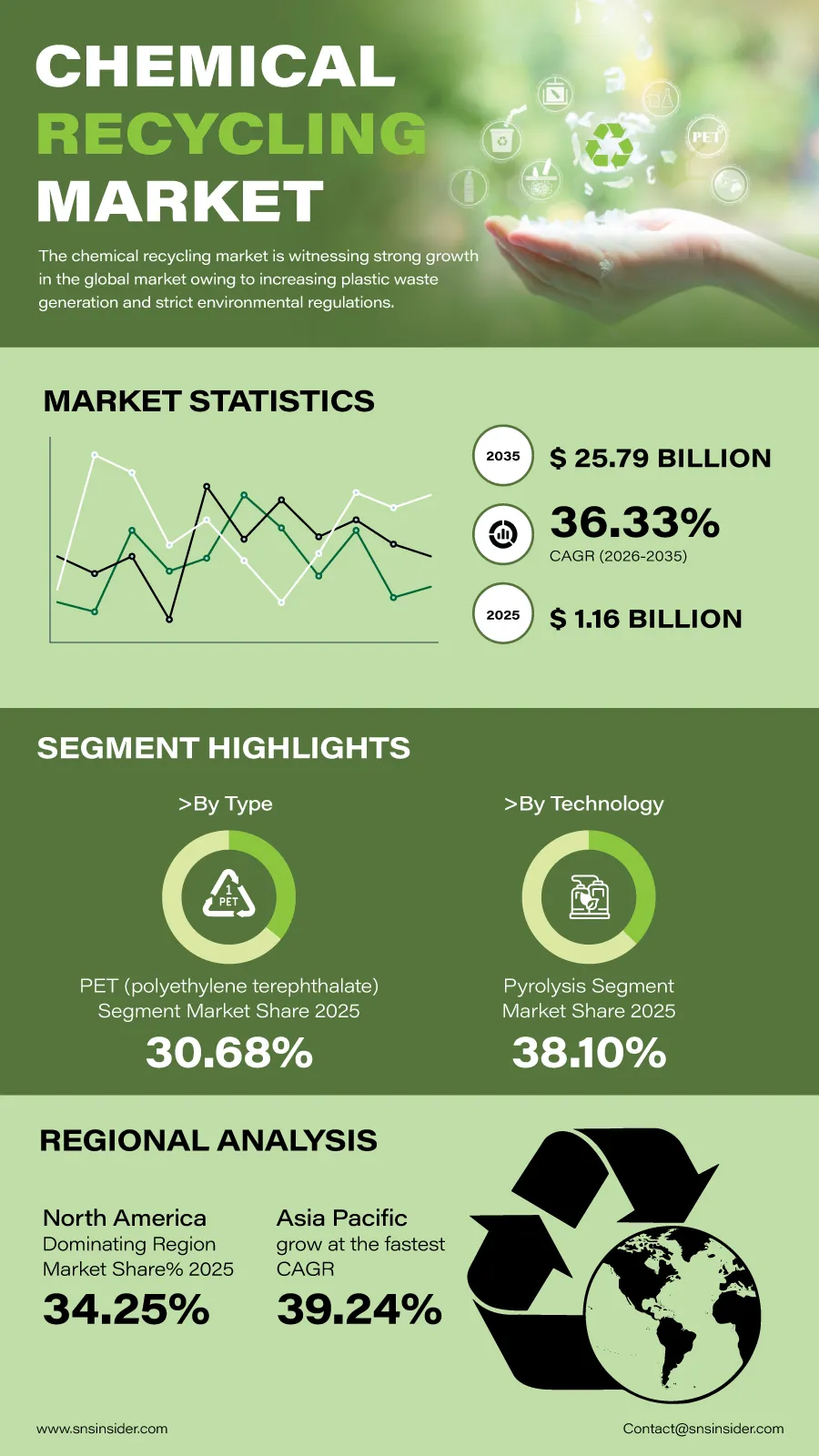
The global Chemical Recycling Market is poised for significant expansion as industries intensify efforts to reduce plastic waste and accelerate the transition toward circular material management. “According to a recent study by SNS Insider, the global Chemical Recycling Market size valued at USD 1.16 billion in 2025, is anticipated to grow to USD 25.79 billion by 2035, registering a CAGR of 36.33% over the 2026–2035 forecast period.”
The increased need to decrease landfilling, improve recycling infrastructure, and move away from using raw material from fossil fuels is changing the direction of investments in the plastics value chain. Companies are showing greater interest in recycling technologies that can reclaim the useful raw material from plastics that are not easy to recycle through traditional means.
To Get Detailed Insights on the Gin Market – Request a Free Sample Report
As the goals for sustainability get more challenging in areas such as packaging, the automotive industry, consumer goods, and industrial production, the role of chemical recycling seems poised to increase in order to enhance material recovery and sustainability. Continued investments in full-scale plants and technological advancement will certainly be seen in the coming decade.
Circular Economy Initiatives Continue to Accelerate Industry Expansion
The shift towards circular systems of production around the world is leading to an environment where the adoption of recycling technology becomes easier. The policies that push for more recycling activities together with the business goals to minimize their carbon footprint encourage companies to install chemical recycling plants.
Firms are now investing in conversion technologies that can convert different types of mixed plastic into high-quality feedstock to be used in making other products. Advances in the efficiency of processes, catalysts, and recovered materials are contributing to the commercialization of next-generation recycling technology.
Collaboration between technology suppliers, petrochemical firms, waste management agencies, and consumer product companies is also contributing to a steady stream of innovations in the sector, offering prospects for future growth.
An Infographic Representation of the Global Chemical Recycling Market
Key Market Insights Highlight Changing Industry Priorities
Among material categories, PET (polyethylene terephthalate) accounted for 31.74% of global market revenue in 2025, supported by strong collection networks and widespread demand across food packaging and beverage applications. Meanwhile, polyurethane waste is projected to register the fastest expansion through 2035, advancing at a 43.80% CAGR as industries seek effective recycling solutions for more complex polymer streams.
From a technology perspective, pyrolysis represented 38.10% of total market revenue in 2025 due to its versatility in processing mixed plastic waste. However, depolymerization is expected to experience the strongest growth, with a projected 44.45% CAGR, reflecting rising demand for high-purity recycled monomers suitable for closed-loop manufacturing.
Across end-use industries, the packaging sector generated 44.68% of market revenue in 2025, driven by increasing recycled content requirements and sustainability initiatives from consumer goods companies. The automotive industry is anticipated to be the fastest-growing application segment, expanding at a 41.64% CAGR as manufacturers pursue lightweight, sustainable material alternatives.
Innovation and Sustainability Shape Future Investment Strategies
Technology development is one of the key attributes in the field of chemical recycling. There have been efforts to develop more effective conversion systems that will enhance the quality of the product without increasing operational expenses and environmental pollution.
There have been advancements in terms of technology where advanced forms of depolymerization process and the enzyme-based recycling process are being developed that will allow more plastic types to be recycled using chemicals.
At the same time, rising investment in integrated recycling facilities and digital process optimization is improving scalability, enabling commercial operators to increase throughput while maintaining operational efficiency and regulatory compliance.
Regional Markets Present Diverse Growth Opportunities
North America held around 34.25% of the share in the global market revenue in 2025 due to its advanced industrial infrastructure, good investments, and increasing development of commercial recycling plants. The continued involvement of petrochemicals and technology providers has been helping the region maintain its dominant position.
The fastest growth in the market is expected to be witnessed by the Asia-Pacific region at a CAGR of 39.24%. The region offers vast potential due to the reasons such as industrialization, increased consumption of plastic, growth in manufacturing capabilities, and supportive policies of governments.
Europe is another significant area for growth in terms of development as a result of strict regulations on the environment, requirement to have recyclable content, and circular economy programs. In addition, there is the expansion of the recycling infrastructure in Latin America and the Middle East & Africa regions.
Industry Participants Focus on Commercial Scale and Technology Leadership
Competition within the global Chemical Recycling Market continues to intensify as companies prioritize technology commercialization, strategic partnerships, and capacity expansion. Manufacturers are investing in larger processing facilities, improving feedstock flexibility, and enhancing operational efficiency to meet growing customer demand.
Key companies operating in the global Chemical Recycling Market include Loop Industries, Agilyx, Plastic Energy, Brightmark, Carbios, PureCycle Technologies, Mura Technology, Licella Holdings, Eastman Chemical Company, BASF SE, Dow Inc., ExxonMobil, Shell plc, TotalEnergies SE, LyondellBasell Industries, Indorama Ventures, Covestro AG, OMV AG, Neste Oyj, and Veolia Environnement.
An SNS Insider analyst Himanshu Sharma commented, "The chemical recycling industry is entering a transformative phase driven by increasing circular economy investments, evolving sustainability regulations, and rapid advances in recycling technologies. Organizations capable of delivering scalable, cost-effective, and high-quality material recovery solutions are expected to strengthen their competitive position as global demand for sustainable plastics continues to accelerate."
About the Author

Get in touch




