
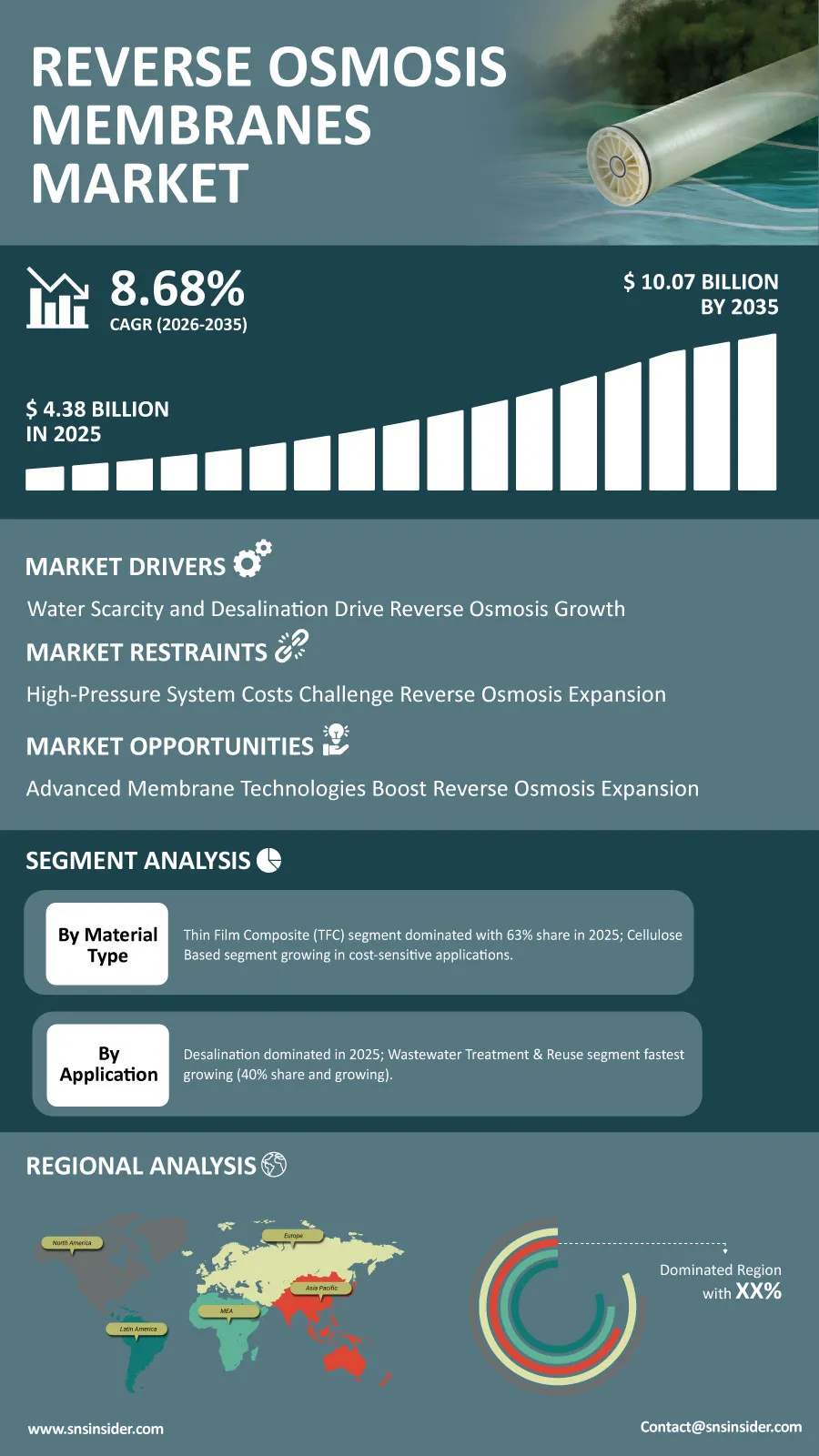
The worldwide market for Reverse Osmosis Membranes is moving into an era of expansion as governments, utilities, and industries favor technologies for advanced water purification owing to increasing freshwater shortages and regulations. “According to a recent study by SNS Insider, the global Reverse Osmosis Membranes Market size valued at USD 4.38 Billion in 2025, is anticipated to grow to USD 10.07 Billion by 2035, registering a CAGR of 8.68% over the 2026–2035 forecast period.”
Demand for high-performance membrane technologies is growing as investments to seawater desalination, wastewater recycling and industrial water treatment are increasing. These issues combined with climate-induced water stress and growth in manufacturing industry are pushing utilities and industrial players to implement reverse osmosis systems that provide reliable, high-purity water to support sustainability goals over a longer time frame.
To Get Detailed Insights on the Reverse Osmosis Membranes Market – Request a Sample Report
Water Security Initiatives Create Significant Long-Term Market Opportunities
Infra spending is being expedited globally, with water availability being one of the key global concerns and critical to accelerated infra spend across developed and emerging economies. Governments are spending big on advanced desalination plants, upgrades to municipal treatments and water reuse projects in an attempt to add to freshwater supplies and withstand extended periods of drought. Such investments results in demand for long lasting advanced reverse osmosis membrane systems along with replacement elements.
High-efficiency water purification technologies are increasingly being adopted by industrial sectors to help reduce the use of fresh water and meet tightening discharge regulations. Semiconductor manufacture, pharmaceuticals, food processing, power generation and chemicals need ultra-pure process water which creates an environment for new membrane materials that provide better contaminant rejection rates, durability and costs through operating efficiency.
Key Market Insights Highlight Expanding Application Areas
Based on the material type, Thin Film Composite (TFC) membranes held nearly 63% global market share for revenue in 2025, attributed to better contaminant rejection, high water permeability and established penetration across municipal & industrial treatment plants. Operators are targeting energy efficiency and fouling resistance so advanced membrane materials employing next-gen nanotechnology are likely to see the fastest growth through 2035.
Spiral Wound systems accounted for a 38% share in market revenue in 2025 as they are extensively used and deployed at desalination plants, and large-scale treatment facilities. During the forecast period, Hollow Fiber modules are expected to experience the highest growth as utilities begin utilizing smaller high-recovery filtration systems for wastewater recycling and potable reuse.
Based on application, Desalination was the highest revenue generating segment in 2025 and is projected to continue investing in water scarce regions. Wastewater Treatment & Reuse is set to Meylor growth, as industries and municipalities expand water recycling initiatives to augment long-term resource security. As for the end use share, Municipal Water Treatment secured the leading position in global demand whereas industrial and pharmaceutical application is projected to see highest CAGR through 2035.
Next-Generation Membrane Technologies Accelerate Industry Innovation
Manufacturers are developing better-performing membrane materials that help to solve process problems and result in lower treatment costs. Recently developed thin-film composite membranes, graphene-enhanced materials, biomimetic membrane technologies and energy-efficient designs allow higher water values, less operating pressure.
These include digital monitoring platforms, predictive maintenance software and intelligent process optimization tools — which maximise the expected performance of membranes through reduced fouling, increased service life and decreased maintenance requirements. This technological advancement above allows water treatment operators to maximize productivity, while meeting sustainability goals both economically and environmentally.
Asia Pacific Dominated the Reverse Osmosis Membranes Market in 2025, Driven by Rapid Water Infrastructure Expansion and Desalination Projects
Based on the area, Middle East and Africa will take up most of global Reverse Osmosis Membranes Market in 2025 attributable to fast advancement of municipal water framework, clear desalination ventures too as quick industrialization compelling resource capital interests in water security in nations like China, India, Japan just as Southeast Asia. Robust governmental-supported actions to improve access to drinking water and wastewater management continue to strengthen leadership in the region.
North America market comes from utilities replacing aged wastewater infrastructure and industries with new advanced systems to meet changing regulation. Europe will continue to be supported by strict environmental regulations and a growing recycling movement, while demand remains solid in the Middle East & Africa region due to further expansion of the significant desalination capacity. Reverse osmosis technologies are also seeing increased adoption across applications in municipal utilities, mining, food processing and industrial water treatment sector in Latin America.
Industry Participants Focus on High-Performance Membrane Innovation
The Global Reverse Osmosis Membranes Market remains competitive with innovations including product advancements and expansion of facilities to set up sophisticated membrane materials for energy-efficient separation and contaminant removal. To bolster their competitive stance and facilitate the ample supply of global clean water solutions, companies sustain investments in research; automation and digital monitoring technologies; and sustainable manufacturing processes.
Key companies operating in the global Reverse Osmosis Membranes Market include DuPont Water Solutions, Toray Industries, Hydranautics (Nitto Group), SUEZ Water Technologies & Solutions, LG Chem Ltd., Koch Separation Solutions, Pentair plc, Toyobo Co., Ltd., Applied Membranes, Inc., Vontron Membrane Technology Co., Ltd., TriSep Corporation, Evoqua Water Technologies LLC, Dow Water & Process Solutions, Synder Filtration, Membranium, Axeon Water Technologies, CSM Membrane, KEENSEN TECH CO., LTD., and Kuraray Co., Ltd.
An SNS Insider analyst Himanshu Sharma commented, "Rising investments in desalination, water reuse, and advanced industrial purification are reshaping the global water treatment landscape. Companies developing energy-efficient membrane technologies, enhanced contaminant removal capabilities, and intelligent monitoring solutions are expected to benefit significantly as governments and industries accelerate investments in long-term water security and sustainable resource management."
About the Author

Get in touch




