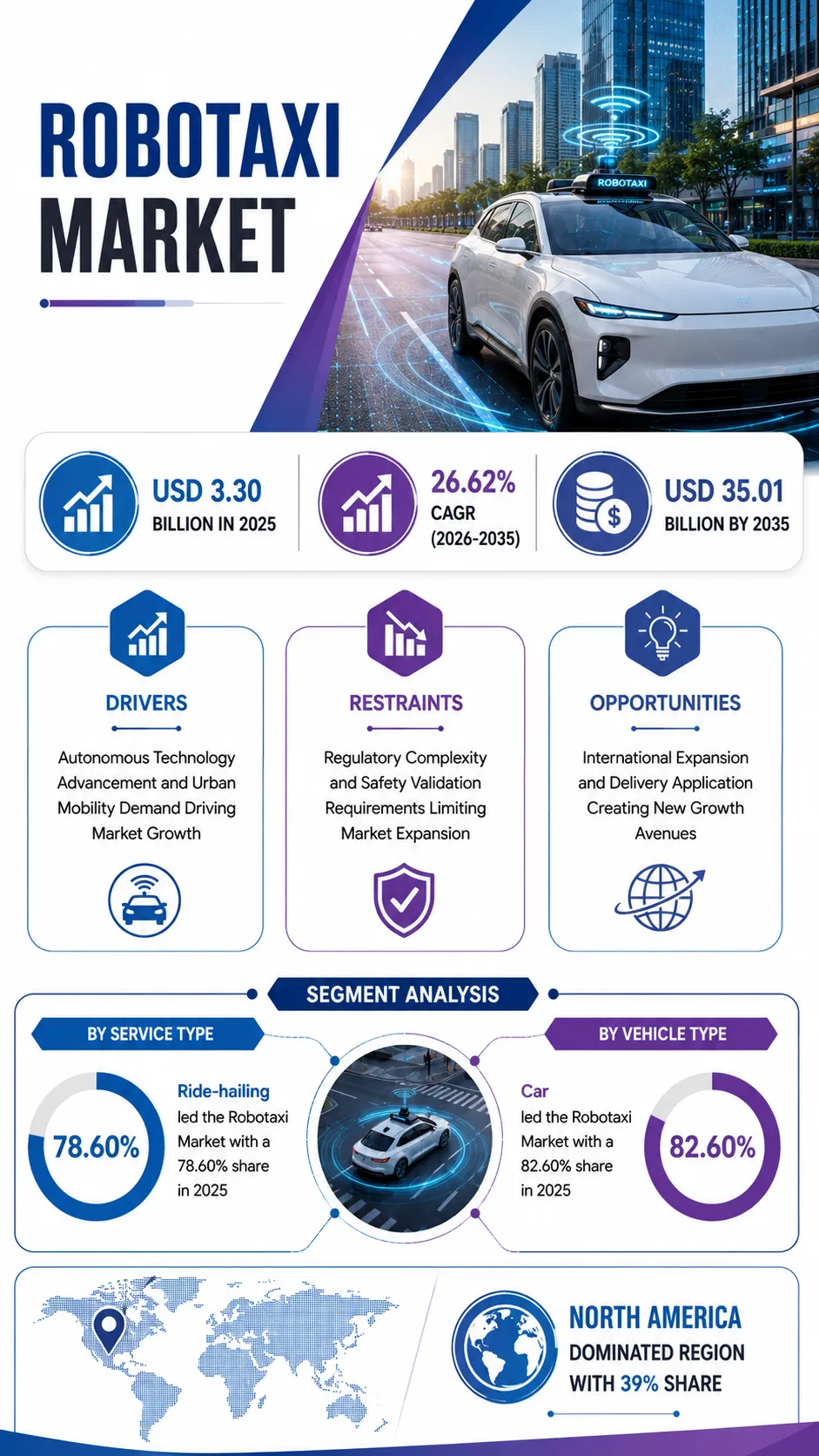
The global Robotaxi Market is set for explosive expansion as leading operators race to scale driverless ride-hailing across major global cities. "According to a recent study by SNS Insider, the global Robotaxi Market size valued at USD 3.30 billion in 2025, is anticipated to grow to USD 35.01 billion by 2035, registering a CAGR of 26.62% over the 2026-2035 forecast period."
There have been tremendous changes within autonomous ride-hailing technology over time due to which many operators who aim at improving urban mobility can take advantage of this trend. This includes the need for more reliable, scalable systems that will provide passengers with the ability to travel safely without a human driver. This applies in situations where robo-taxis are used for urban ride-hailing, airport transfers, and increasingly goods delivery.
Operators are constantly working hard to ensure that their autonomous fleets perform better than before in order to meet various needs of urban commuters and logistics companies.
To Get Detailed Insights on the Robotaxi Market – Request a Sample Report
Driverless Mobility Ecosystems Create New Demand
The Robotaxi Market has evolved from limited supervised testing to more advanced fully driverless commercial use cases. The growing investment in multi-city expansion, sensor technology, and AI-driven decision-making for a variety of urban applications has required the development of more efficient and reliable autonomous fleet systems.
New designs of robo-taxi platforms can increase safety, reduce trip costs, and allow for 24/7 operation without human driver constraints. This gives operators the possibility to be more effective when serving passengers and doing better fleet utilization.
Technology developers, automakers, and ride-hailing platforms are increasingly cooperating thanks to the growing interest in developing future solutions for driverless mobility.
Key Market Findings Highlight High-Growth Segments
The ride-hailing segment dominated all categories in the Robotaxi Market share with a market revenue share of 78.60% in 2025 due to its status as the founding commercial application.
The fastest growing category is expected to be goods delivery which will grow at a CAGR of 32.60% through 2035. This will be possible owing to the increasing need for autonomous last-mile delivery solutions.
By vehicle type, cars held the largest share of total market revenue of 82.60% in 2025 due to their suitability for standard urban trips. The shuttle/van segment will see the fastest growth in revenue generation at a CAGR of 28.40%.
Based on propulsion, electric vehicles generated a share of 74.60% of market revenue in 2025 thanks to their compatibility with autonomous systems. On the other hand, fuel cell propulsion will be the segment recording the fastest revenue growth at a CAGR of 30.20%.
Distributive trends are changing as well. Level 4 automation accounted for a 68.60% revenue share in 2025. But Level 5 automation will turn out to be the fastest-growing category through 2035, on the back of technical advancement, regulatory confidence, and increased demand for unrestricted autonomous operation.
Safety, Scale, and Automation Gain Importance
In this regard, operators have been looking at systems that would make their services safer and require less human intervention and be more scalable.
Innovation in sensor fusion, AI-driven decision-making, and fleet management has been making it possible for companies to come up with services that can operate effectively across demanding urban conditions. In addition to that, increasing emphasis on regulatory approval and public trust is also making it possible for companies to find solutions that optimize robo-taxi performance.
Such trends are likely to become even more prominent in the future.
North America Emerges as the Largest Market Amid Rising Driverless Deployment
The North America region represented the largest regional market in 2025, owing to robust demand for autonomous ride-hailing services and a dense concentration of leading autonomous vehicle technology companies. In addition, Asia Pacific is expected to be the fastest-growing market during the forecast period, propelled by increasing investments in urban mobility solutions and applications across the region's fast-growing autonomous vehicle industries.
On the other hand, Europe represented a meaningful share of global market revenue in 2025, aided by growing urban mobility investment and evolving regulatory frameworks for autonomous vehicle operation.
Leading Companies Drive Innovation and Competition
The environment continues to stay very dynamic since players continue innovating on products and technologies as well as forming partnerships in order to enhance their position in the industry.
Some of the major companies that operate in the global Robotaxi Market are Waymo LLC, Tesla Inc., Baidu Apollo Go, WeRide Inc., Pony.ai Inc., Zoox, Didi Chuxing, Motional, Nuro Inc., and Aurora Innovation Inc.
An SNS Insider Analyst Santosh Bhul commented, "The rapid commercialization of driverless ride-hailing technology is creating unprecedented demand for high-performance autonomous fleet systems. Companies that successfully combine safety validation, scale, regulatory navigation, and advanced engineering capabilities will be best positioned to capitalize on emerging opportunities across passenger transport and delivery applications."
About the Author

Get in touch