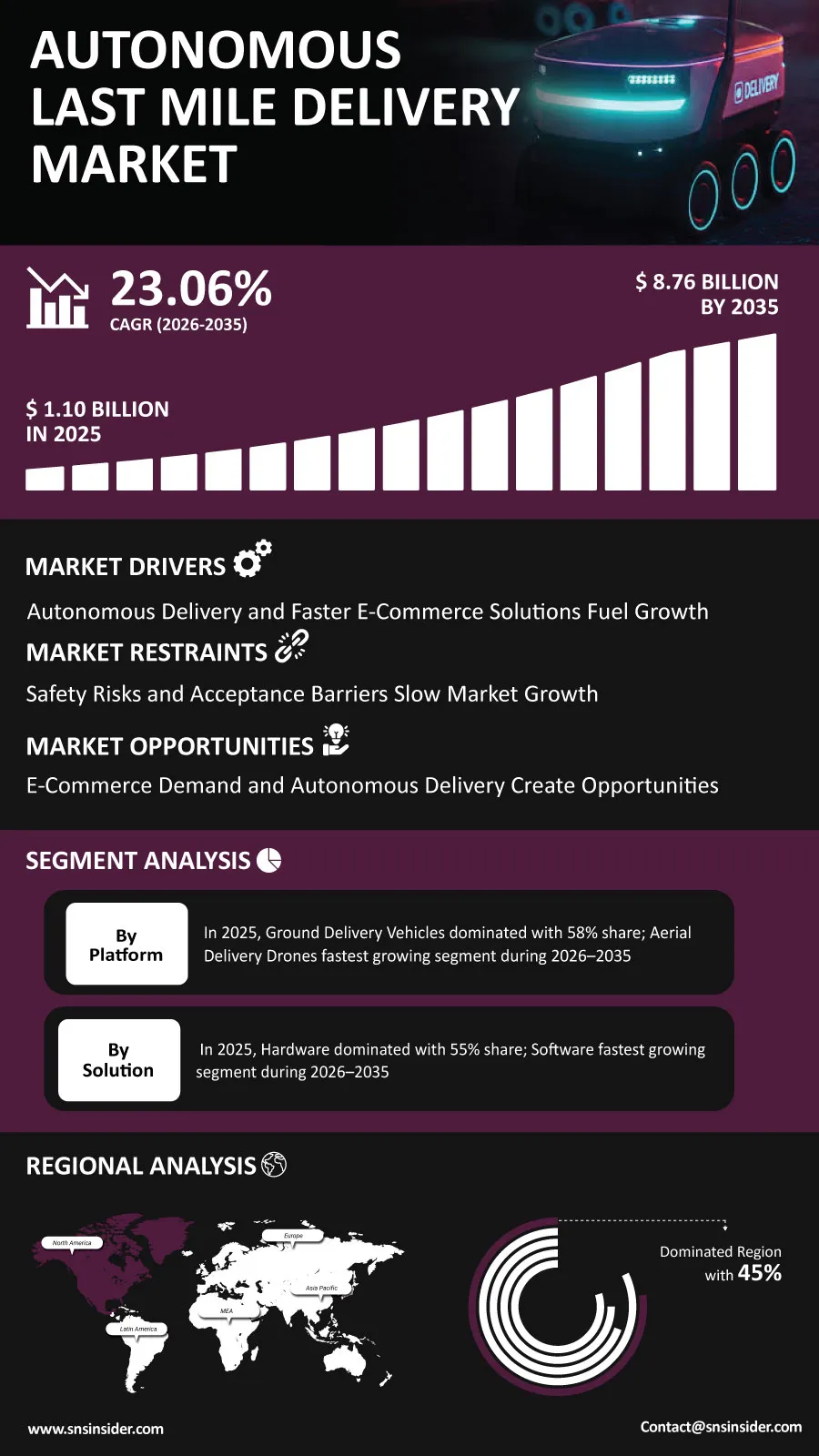
The global Autonomous Last Mile Delivery Market is entering a high-growth phase as retailers, logistics providers, and technology companies accelerate the deployment of automated delivery systems. According to a recent study by SNS Insider, the global Autonomous Last Mile Delivery Market size valued at USD 1.10 billion in 2025, is anticipated to grow to USD 8.76 billion by 2035, registering a CAGR of 23.06% over the 2026–2035 forecast period.
The exponential rise in online sales is placing additional demands on logistics chains for speedier, more versatile, and economical delivery services. Additionally, rising costs associated with labor, traffic congestion in cities, and the need for accurate timing of deliveries is motivating organizations to explore the possibility of unmanned solutions for short-distance deliveries.
Rapid advancements in the fields of artificial intelligence, computer vision, robotics, navigation, and battery technologies are enabling delivery platforms to become increasingly capable of functioning with reduced human involvement. These trends are widening the range of possibilities for deployment in residential areas, commercial zones, medical institutions, and similar delivery settings.
To Get Detailed Insights on the Autonomous Last Mile Delivery Market – Request a Sample Report
E-Commerce Logistics Transformation Creates New Growth Opportunities
The ongoing move to purchase goods and services on the internet is resulting in a huge potential opportunity for autonomous delivery solutions. There is growing pressure on retailers to cut down on their fulfillment times, without increasing their transportation cost, especially in urban areas where traditional delivery methods are hampered by traffic and labor cost increases.
Autonomous land vehicles and drones can facilitate the development of flexible delivery options for companies to be able to handle more orders. Combining with warehouse automation, digital maps, cloud logistics solutions, and smart fleet management makes the business case for autonomous last-mile delivery even stronger.
Also, there are smart cities developing that make the business environment more conducive, through development of advanced transportation systems and automated transportation solutions.
Key Market Insights Highlight Shifting Demand Patterns
By platform, ground delivery vehicles were expected to account for 58% of global market revenue in 2025, supported by their established use in grocery, food, and parcel distribution. Aerial delivery drones are projected to be the fastest-growing platform through 2035 as improvements in navigation, battery performance, and regulatory frameworks enable faster deliveries across congested or difficult-to-access locations.
Based on solution, hardware segment was anticipated to hold 55% of market revenue in 2025 because autonomous delivery requires vehicles, cameras, sensors, LiDAR systems, communications equipment, and other physical infrastructure. Software is expected to record the fastest growth as operators increasingly require sophisticated route planning, fleet coordination, real-time monitoring, and autonomous decision-making capabilities.
In terms of range, short-range solutions segment was forecasted to contribute 62% of market revenue in 2025, reflecting their widespread application in local food, grocery, and parcel delivery. Long-range platforms are expected to expand rapidly as advances in navigation and energy storage improve the feasibility of autonomous deliveries across greater distances and underserved locations.
By end user, retail segment was projected to account for 46% of market revenue in 2025, driven by increasing online order volumes and the need for efficient fulfillment. Healthcare is anticipated to be the fastest-growing end-user segment as autonomous platforms gain traction for transporting medicines, laboratory specimens, and critical medical supplies.
AI and Robotics Reshape Delivery Operations
AI integration is playing a vital role for autonomous delivery systems. The software technology helps in analyzing the traffic situation, optimizing routes, controlling multiple vehicles at once, and taking decisions in the operation process.
On the other hand, advancements in robotics and sensor technologies are helping the delivery platforms move in more complicated scenarios. This becomes especially useful in cities where pedestrians, cyclists, variable road situation, and complicated traffic patterns can pose some difficulties.
At the same time, a combination of autonomous mobility and electric engines is helping with sustainability goals as it helps avoid fuel-powered delivery vehicles.
North America Secures 45% Autonomous Delivery Market Share in 2025 Amid Rising E-Commerce and Automation Demand
North America is forecast to continue as the foremost regional market, capturing nearly 45% of worldwide revenues by 2025. Advanced technological know-how, massive investments in autonomous mobility, a well-developed e-commerce network, and active commercial trials are contributing to regional market leadership.
The Asia Pacific region is anticipated to show the highest growth until 2035, driven by fast urbanization trends, growing digital commerce, smart city initiatives, and adoption of autonomous robots and drones. China, Japan, and other major countries are building large logistics automation ecosystems, thus creating additional business opportunities for autonomous delivery solutions.
With urban population growth and digitalization of logistics systems, autonomous delivery solutions are poised to get wider adoption within regional markets.
Industry Participants Focus on Automation and Commercial Deployment
The competitive environment continues to be fluid with players focusing on building out autonomous cars, drones for deliveries, navigation capabilities, and logistics software. Key themes include greater focus on safety, extended range, increased cargo carrying capability, and integration into existing fulfillment systems.
Key companies operating in the global Autonomous Last Mile Delivery Market include Airbus S.A.S., Matternet, Flirtey, Drone Delivery Canada, Flytrex, Amazon.com, JD.com Inc., Marble Robot, Starship Technologies, Savioke, DHL International GmbH, United Parcel Service of America, Inc., DPD, Nuro, Wing (Alphabet), and FedEx.
An SNS Insider analyst Sushant Kadam commented, “The rapid evolution of e-commerce, combined with advances in autonomous mobility and intelligent logistics software, is creating a strong commercial foundation for automated last-mile delivery. Companies capable of combining safety, operational reliability, and scalable fleet management will be positioned to capture substantial opportunities as autonomous delivery moves from pilot programs toward broader deployment.”
About the Author

Get in touch