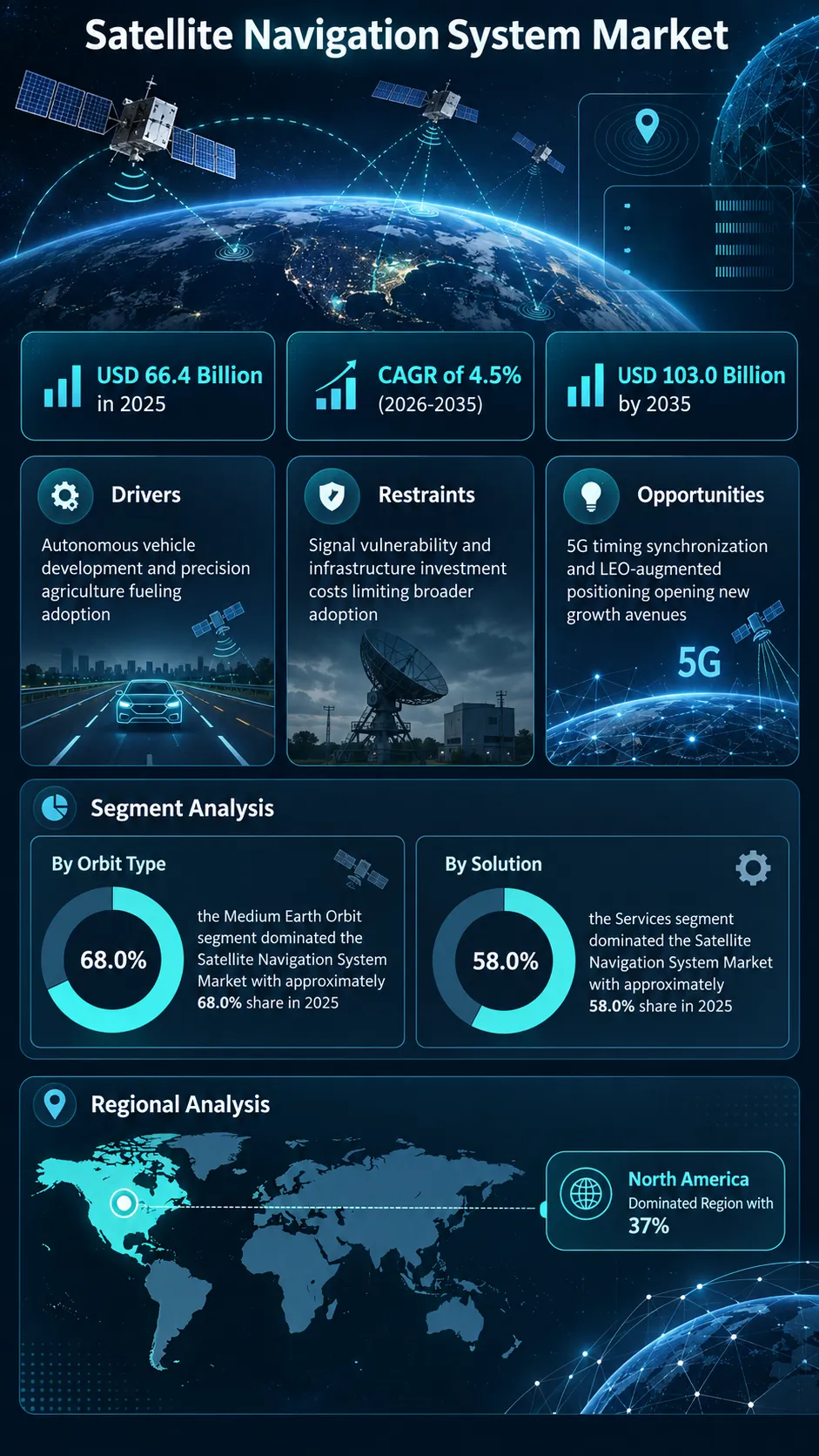
The global Satellite Navigation System Market continues its steady climb as automotive, agriculture, and telecom industries lean further into precise, multi-constellation positioning technology. “According to a recent study by SNS Insider, the global Satellite Navigation System Market size valued at USD 66.4 billion in 2025, is anticipated to grow to USD 103.0 billion by 2035, registering a CAGR of 4.5% over the 2026-2035 forecast period.”
There have been steady changes within receiver and constellation technology over time, due to which many developers aiming at improved accuracy and signal redundancy can take advantage of this trend. This includes the need for more resilient, multi-constellation receiver designs that give buyers confidence in positioning reliability, across a wide range of applications from vehicle navigation to network timing synchronization. This applies in situations where satellite navigation systems are used across automotive, agriculture, surveying, and telecom applications.
Manufacturers are constantly working to improve receiver accuracy and constellation redundancy in order to meet various needs of automotive, agriculture, and industrial buyers worldwide.
To Get Detailed Insights on This Market – Request a Sample Report
Autonomous Vehicle and Precision Agriculture Ecosystems Create New Demand
The satellite navigation system market has evolved from basic single-constellation positioning into a broader mix of multi-constellation, augmented, and LEO-complemented technologies. The growing investment in receiver miniaturization, signal redundancy, and multi-application development has required the development of more efficient and reliable production systems.
New receiver and constellation approaches can improve positioning accuracy, reduce signal vulnerability, and expand the range of applications satellite navigation can serve. This gives manufacturers the possibility to be more effective when reaching automotive, agriculture, and industrial buyers and strengthening claims around reliability and precision.
Constellation operators, receiver manufacturers, and downstream application developers are increasingly cooperating due to the growing interest in developing future solutions for precise, resilient satellite-based positioning.
Key Market Findings Highlight High-Growth Segments
The Medium Earth Orbit segment dominated all categories in the satellite navigation system market share with a market revenue share of approximately 68.0% in 2025 due to its established role as the backbone orbital altitude for nearly every major global constellation.
The fastest growing category is expected to be the Low Earth Orbit & other orbits segment, which will grow at a CAGR of approximately 7.89% through 2035. This will be possible owing to rising interest in LEO-based positioning systems offering stronger ground-level signal strength.
By application, road & automotive held the largest share of total market revenue at approximately 34.0% in 2025 due to the scale of the global vehicle fleet and rising ADAS integration. The timing synchronization segment will see the fastest growth in revenue generation at a CAGR of approximately 7.4%.
Regional trends show North America leading with approximately 37.0% revenue share in 2025, while Asia Pacific is expected to register a fast growth trajectory driven by China's BeiDou constellation and rapidly expanding regional automotive and agriculture applications.
Receiver Accuracy, Signal Redundancy, and Application Diversification Gain Importance
In this regard, manufacturers have been looking at satellite navigation products that would make their receivers more accurate, their signal reception more redundant, and their applications more diverse.
Innovation in multi-constellation receiver design, LEO-augmented positioning, and multi-application development has been making it possible for companies to come up with products that can meet increasingly demanding buyer and regulatory expectations. In addition to that, increasing emphasis on timing synchronization infrastructure is also making it possible for companies to find solutions that support telecom and financial network reliability.
Such trends are likely to become even more prominent in the future.
North America Leads Amid Deep GPS Infrastructure and Innovation Base
North America represented approximately 37.0% share of global market revenue in 2025 and was the largest regional market, owing to the United States' position as home to the GPS constellation and a deep base of leading receiver manufacturers and application developers. In addition, Asia Pacific is expected to register a fast growth trajectory during the forecast period, propelled by China's BeiDou constellation and rapidly expanding automotive, agriculture, and industrial applications across the region.
On the other hand, Europe represented a meaningful share of global market revenue in 2025, aided by the EU's continued Galileo constellation expansion and strong automotive and industrial application development anchored by Germany.
Leading Companies Drive Innovation and Competition
The environment continues to stay very dynamic since players continue innovating on receiver and constellation technology as well as forming partnerships in order to enhance their position in the industry.
Some of the major companies that operate in the global satellite navigation system market are Garmin Ltd., Trimble Inc., Hexagon AB, Qualcomm Technologies, Inc., Broadcom Inc., Thales Group, RTX Corporation, L3Harris Technologies, Inc., Lockheed Martin Corporation, Northrop Grumman Corporation, Honeywell International Inc., Furuno Electric Co., Ltd., Topcon Corporation.
An SNS Insider Analyst Santosh Bhul commented, “The steady progress toward multi-constellation, high-precision positioning technology is creating consistent demand across automotive, agriculture, and telecom applications. Manufacturers that successfully combine receiver accuracy innovation, signal redundancy design, LEO-augmented positioning capability, and reliable constellation partnerships will be best positioned to capitalize on emerging opportunities across road, agriculture, surveying, and timing synchronization applications.”
About the Author

Get in touch