
Savory Ingredients Market Report Scope & Overview:
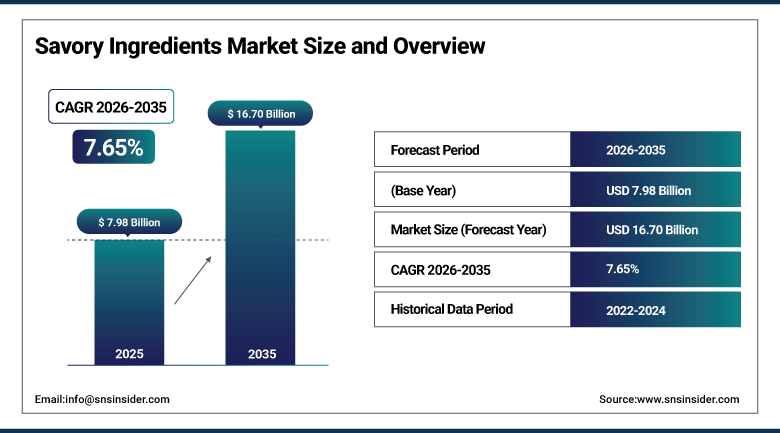
The Savory Ingredients Market was valued at USD 7.98 Billion in 2025 and is expected to reach USD 16.70 Billion by 2035, growing at a CAGR of 7.65% from 2026 to 2035.
Market of savory ingredients is expected to grow at a rapid rate due to the increasing requirement for speedy, flavorful, and processed food items, the swift growth of foodservice sector, and the rising demand for convenience foods. The savory ingredients are flavors which are added in food products while their processing, and help in improving the savory flavor and aroma of food items, also called as umami, including monosodium glutamate, yeast extracts, hydrolyzed vegetable proteins, and nucleotides utilized in snacks, soups, sauces, ready meals, and seasonings. In addition, there are several factors contributing to the growth of the market such as the latest developments in food processing technologies, changing customer preferences for stronger flavors, and growing consumption of global cuisines.
The European Commission's updated specifications for food additives under Regulation (EU) 2024/2597 focus on natural derivation and transparency requirements, creating opportunities for savory ingredient manufacturers to differentiate through clean-label claims as recent regulatory changes across major markets increasingly support natural ingredient positioning over synthetic flavor enhancer alternatives.
To Get more information Savory Ingredients Market - Request Free Sample Report
Savory Ingredients Market Trends
- Rising consumer preference for natural ingredients is driving demand for clean-label seasonings and natural flavor enhancers.
- Growing use in plant-based foods is increasing demand for savory ingredients that deliver meat-like umami profiles.
- Increasing demand for low-sodium and clean-label products is accelerating innovation in yeast extracts and natural flavor enhancers.
- Expanding foodservice activity is sustaining demand for consistent and scalable savory flavor solutions.
- Strategic partnerships are supporting development of natural, application-specific savory ingredient solutions.
The U.S. Savory Ingredients Market Outlook
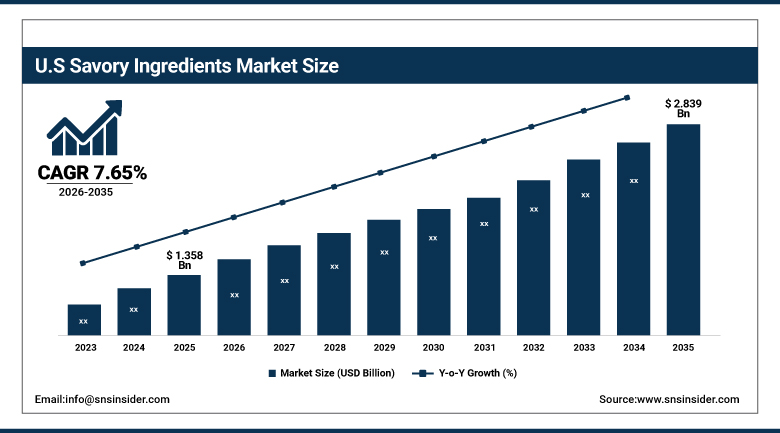
The U.S. savory ingredients market was valued at USD 1.35 Billion in 2025 and is projected to reach USD 2.83 Billion by 2035, growing at a CAGR of 7.65% during 2026–2035.
The top companies in terms of food production and foodservices in the country are also constantly growing their use of savory flavoring products because of an increased demand for low sodium, gluten-free, and plant-based savory ingredients in the country’s food manufacturing industry. The continued consumer preferences towards convenience foods along with the rapid growth of the foodservice industry and the adoption of global cuisines, which require strong and savory tastes, further contribute to the consistent demand for savory products.
The United States is expected to grow at a notable CAGR during the forecast period, due to the rising demand for low-sodium, gluten-free, and plant-based savory components, positioning the region as the fastest-growing market for savory ingredients globally.
Savory Ingredients Market Segment Analysis
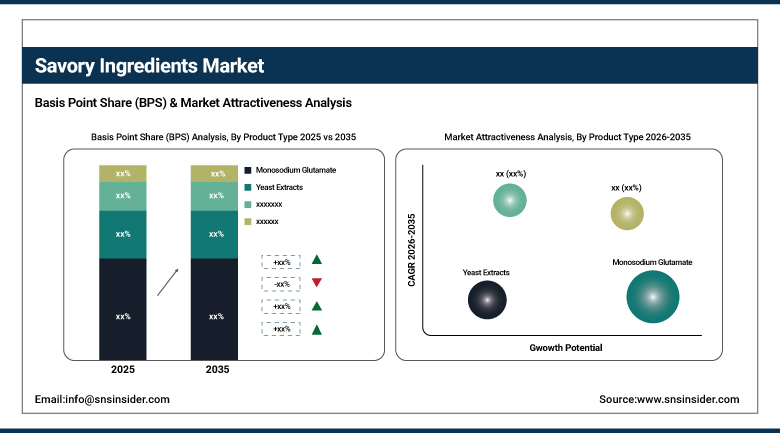
- By Product Type, monosodium glutamate dominated the savory ingredients market with a 32.00% share in 2025, while yeast extracts is the fastest-growing product type segment with a CAGR of 7.60% from 2026–2035.
- By Form, powder dominated the savory ingredients market with a 68.00% share in 2025, while liquid is the fastest-growing form segment with a CAGR of 7.20% from 2026–2035.
- By Application, food processing dominated the savory ingredients market with a 31.20% share in 2025, while ready meals is the fastest-growing application segment with a CAGR of 8.20% from 2026–2035.
- By Origin, synthetic dominated the savory ingredients market with a 62.19% share in 2025, while natural is the fastest-growing origin segment with a CAGR of 7.87% from 2026–2035.
By Product Type, monosodium glutamate dominated the savory ingredients market, while yeast extracts is the fastest-growing segment.
By product type, monosodium glutamate segment held the major market share of 32.00% in 2025. Monosodium glutamate remains the dominant product type category owing to its cost-effective, potent umami flavor enhancement properties, making it the most widely used and commercially established savory ingredient across global processed food, snack, and seasoning manufacturing applications.
The yeast extracts segment is expected to grow at the fastest CAGR of 7.60% during the forecast period 2026-2035, due to demand for clean-label ingredients. Growing consumer preference for natural, minimally processed flavor enhancers is driving strong yeast extract adoption, as manufacturers increasingly reformulate products to replace synthetic monosodium glutamate with naturally derived umami-boosting alternatives.
By Form, powder dominated the savory ingredients market, while liquid is the fastest-growing segment.
According to form, the biggest market share of 68.00% belonged to powder segment in 2025. This preference for powder forms is due to the easy inclusion of these forms in different food products, providing convenience, longer shelf life, and easy usage in food processing, wherein powder ingredients can be easily incorporated into different food products.
The liquid segment is expected to witness the fastest CAGR of 7.20% during the forecast period 2026-2035. Robust growth is externally driven by increasing application in beverage, soups and sauces, and prepared meals segments, where factors like rapid solubility, enhanced flavor dispersion, and superior mouthfeel are paramount for manufacturers seeking optimal flavor delivery.
By Application, food processing dominated the savory ingredients market, while ready meals is the fastest-growing segment.
By application, food end use is estimated to dominate with 31.20% share in 2026. Food processing applications have continued to dominate as the primary application due to the significance of savory ingredients in the production of snacks, soups, sauces, seasonings, and other packaged foods, accounting for the biggest use case that is influencing global demand for savory ingredients.
Ready meals application is projected to post the highest CAGR of 8.20% throughout the forecast period from 2026 to 2035. Rising popularity of ready-to-eat meals among consumers is fueling the growth of this application as consumers are looking for prepared meals that offer restaurant-quality umami flavors.
Regional Insights
|
Region |
Major Country |
Share within Region, 2025 (%) |
|---|---|---|
|
North America |
United States |
85.00% |
|
Europe |
Germany |
27.60% |
|
Asia Pacific |
Japan |
38.90% |
|
Middle East & Africa |
UAE |
25.60% |
|
Latin America |
Brazil |
37.70% |
North America Savory Ingredients Market Insights
North America is expected to grow at a notable CAGR from 2026 to 2035, due to the rising demand for low-sodium, gluten-free, and plant-based savory components across the region's health-conscious consumer base and expanding foodservice industry.
The US was the leading country within the North America savory ingredients market in 2025, driven by growing consumer preference for convenience food and rapid foodservice industry expansion. Canada is contributing to regional growth through its own expanding food processing sector and growing consumer interest in clean-label savory ingredients.
Europe Savory Ingredients Market Insights
The Europe savory ingredients market was a major contributor in 2025. This is attributed to strong regulatory support for clean-label, natural ingredient positioning under updated European Commission food additive specifications, alongside sodium reduction initiatives driving innovation across seasoning blend formulation.
In Germany, the market size of savory ingredients is likely to witness expansion at 5.3% CAGR owing to the EU policies encouraging clean label and natural ingredients as well as reduced sodium content and the influence of clean label trend on product development. France will also be contributing to the growth of the region, which is likely to grow at 5% CAGR owing to richness of its traditional cuisine.
Asia Pacific Savory Ingredients Market Insights
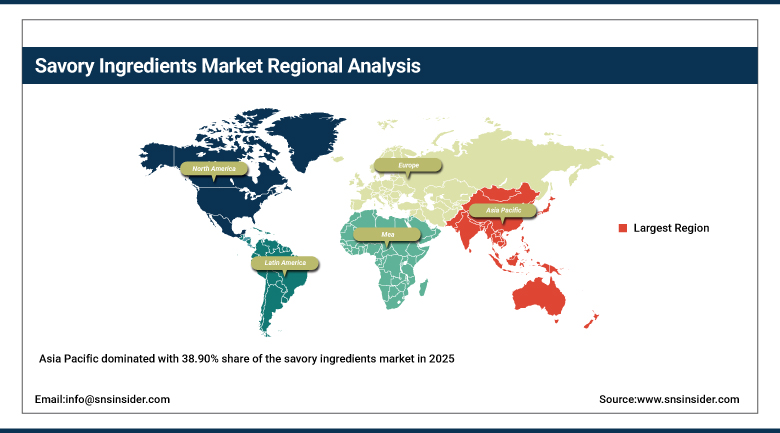
Asia Pacific dominated with 38.90% share of the savory ingredients market in 2025, driven by deeply ingrained culinary traditions emphasizing umami and savory flavors, rapid urbanization, large populations, and expanding packaged food industries across the region.
Japan savory ingredients revenue is growing at a CAGR of 6.3% from 2026 to 2035, driven by high consumption of umami-rich seasonings in instant noodles, ramen, sauces, and packaged meals, alongside high demand for umami flavorings and traditional seasonings and a focus on clean-label and premium seasoning innovations. China and India are also contributing to regional growth through expanding packaged food industries and rapid urbanization.
Get Customized Report as per Your Business Requirement - Enquiry Now
Middle East & Africa and Latin America Savory Ingredients Market Insights
Middle East & Africa and Latin American regions are gradually expanding savory ingredient adoption as foodservice and packaged food manufacturing investment grows across both regions, supported by increasing regional consumer demand for convenient, flavorful food products.
Brazil is set to be a prominent Latin American market fueled by growing packaged food manufacturing capacity and rising consumer demand for convenience food. The Middle East & Africa region has UAE and Saudi Arabia investing in modern food processing infrastructure that is gradually increasing demand for savory ingredients across their expanding foodservice and packaged food sectors.
Growth Drivers: Rising convenience food demand and foodservice expansion driving market growth
The demand for savory ingredients is being spurred by the increasing desire on the part of the consumers for fast and delicious meals coupled with the expansion of the foodservice industry, changing consumer demands, new food processing techniques, and increased demand for convenience foods. There is also an increased demand for flavorsome tastes which has led to increased utilization of savory ingredients in snack foods, ready meals, and plant-based foods.
Growing consumer demand for flavorful, convenient food options and the increasing adoption of global cuisines continue to drive market expansion, with savory ingredients holding an estimated 100% share of the flavor enhancer market. Rising urbanization, the increasing appetite for flavorful food, and the surge in processed and convenience food, combined with recent regulatory changes across major markets supporting natural ingredient positioning, are further supporting demand across the forecast period.
Restraints: Sodium reduction regulations and synthetic ingredient scrutiny limiting market expansion
One of the main barriers to market growth is growing regulatory pressure around sodium content and synthetic flavor enhancer scrutiny, particularly across European and North American markets, which requires manufacturers to reformulate products and can constrain the use of traditional, cost-effective savory ingredients such as monosodium glutamate.
Moreover, the increased cost of production with regard to the natural alternative ingredients used to enhance savory flavors such as yeast extract and fermentation umami, among others, is still putting pressure on the pricing front against traditional synthetic enhancers. There is consumer misinformation and health worries concerning monosodium glutamate, which despite scientific evidence of its safety, is creating further marketing challenges for food producers using this ingredient type.
Opportunities: Expansion of clean-label reformulation and plant-based applications creating new growth avenues
Recent regulatory changes across major markets support natural ingredient positioning, creating substantial opportunities for savory ingredient manufacturers to differentiate through clean-label claims, as food companies increasingly reformulate products away from synthetic flavor enhancers toward naturally derived umami-boosting alternatives.
There is a considerable growth opportunity in the continued development of savory ingredients tailored to plant-based meat and dairy alternative applications requiring authentic umami flavor replication. The expansion of foodservice industry growth and packaged food manufacturing capacity in emerging markets across Asia Pacific and Latin America is likely to unlock substantial new demand throughout the forecast period.
Recent Developments
- 2025: Ajinomoto Co. expanded its monosodium glutamate and umami seasoning production capacity, strengthening its ability to supply growing global demand for cost-effective flavor enhancement solutions.
- 2025: Kerry Group launched an updated natural savory flavor system designed for clean-label reformulation, offering food manufacturers a solution for replacing synthetic flavor enhancers with naturally derived alternatives.
- 2026: dsm-firmenich launched a new yeast extract product line specifically formulated for plant-based food applications, targeting manufacturers seeking authentic umami flavor replication in alternative protein products.
- 2026: Ohly, part of ABF Ingredients, expanded its yeast extract production capacity, strengthening its ability to supply growing demand for clean-label savory ingredients across food and beverage manufacturing.
Savory Ingredients Companies are:
- Ajinomoto Co., Inc.
- Kerry Group plc
- dsm-firmenich
- Givaudan SA
- Archer Daniels Midland Company
- Sensient Technologies Corporation
- IFF (International Flavors & Fragrances Inc.)
- Tate & Lyle plc
- Symrise AG
- Ohly (ABF Ingredients)
- Angel Yeast Co., Ltd.
- Lesaffre
- Associated British Foods plc
- Cargill, Incorporated
- Kikkoman Corporation
- Fufeng Group Limited
- Meihua Holdings Group Co., Ltd.
- Prinova Group LLC
- Vitux Group AS
- Biospringer (Lesaffre)
Savory Ingredients Market Report Scope :
| Report Attributes | Details |
|---|---|
| Market Size in 2025 | USD 7.98 Billion |
| Market Size by 2035 | USD 16.70 Billion |
| CAGR | CAGR of 7.65% From 2026 to 2035 |
| Base Year | 2025 |
| Forecast Period | 2026-2035 |
| Historical Data | 2022-2024 |
| Report Scope & Coverage | Market Size, Segments Analysis, Competitive Landscape, Regional Analysis, DROC & SWOT Analysis, Forecast Outlook |
| Key Segments | • By Product Type (Monosodium Glutamate, Yeast Extracts, Hydrolyzed Vegetable Proteins, Nucleotides, Hydrolyzed Animal Proteins, Others) • By Form (Powder, Liquid) • By Application (Food Processing, Soups/Sauces/Dressings, Ready Meals, Snacks) • By Origin (Natural, Synthetic) |
| Regional Analysis/Coverage | North America (US, Canada), Europe (Germany, UK, France, Italy, Spain, Russia, Poland, Rest of Europe), Asia Pacific (China, India, Japan, South Korea, Australia, ASEAN Countries, Rest of Asia Pacific), Middle East & Africa (UAE, Saudi Arabia, Qatar, South Africa, Rest of Middle East & Africa), Latin America (Brazil, Argentina, Mexico, Colombia, Rest of Latin America). |
| Company Profiles | Ajinomoto Co., Inc., Kerry Group plc, dsm-firmenich, Givaudan SA, Archer Daniels Midland Company, Sensient Technologies Corporation, IFF (International Flavors & Fragrances Inc.), Tate & Lyle plc, Symrise AG, Ohly (ABF Ingredients), Angel Yeast Co., Ltd., Lesaffre, Associated British Foods plc, Cargill, Incorporated, Kikkoman Corporation, Fufeng Group Limited, Meihua Holdings Group Co., Ltd., Prinova Group LLC, Vitux Group AS, Biospringer (Lesaffre). |

Frequently Asked Questions
The Savory Ingredients Market is expected to grow at a CAGR of 7.65% from 2026 to 2035.
The Savory Ingredients Market was valued at USD 7.988 Billion in 2025.
The market is driven by consumers' growing need for quick, tasty, and prepared meals, the rapid expansion of the foodservice industry, and rising demand for convenience food.
The Monosodium Glutamate segment dominated the Savory Ingredients Market in 2025, accounting for approximately 32.00% market share.
The Asia Pacific region dominated the Savory Ingredients Market in 2025, driven by deeply ingrained culinary traditions emphasizing umami and savory flavors.
