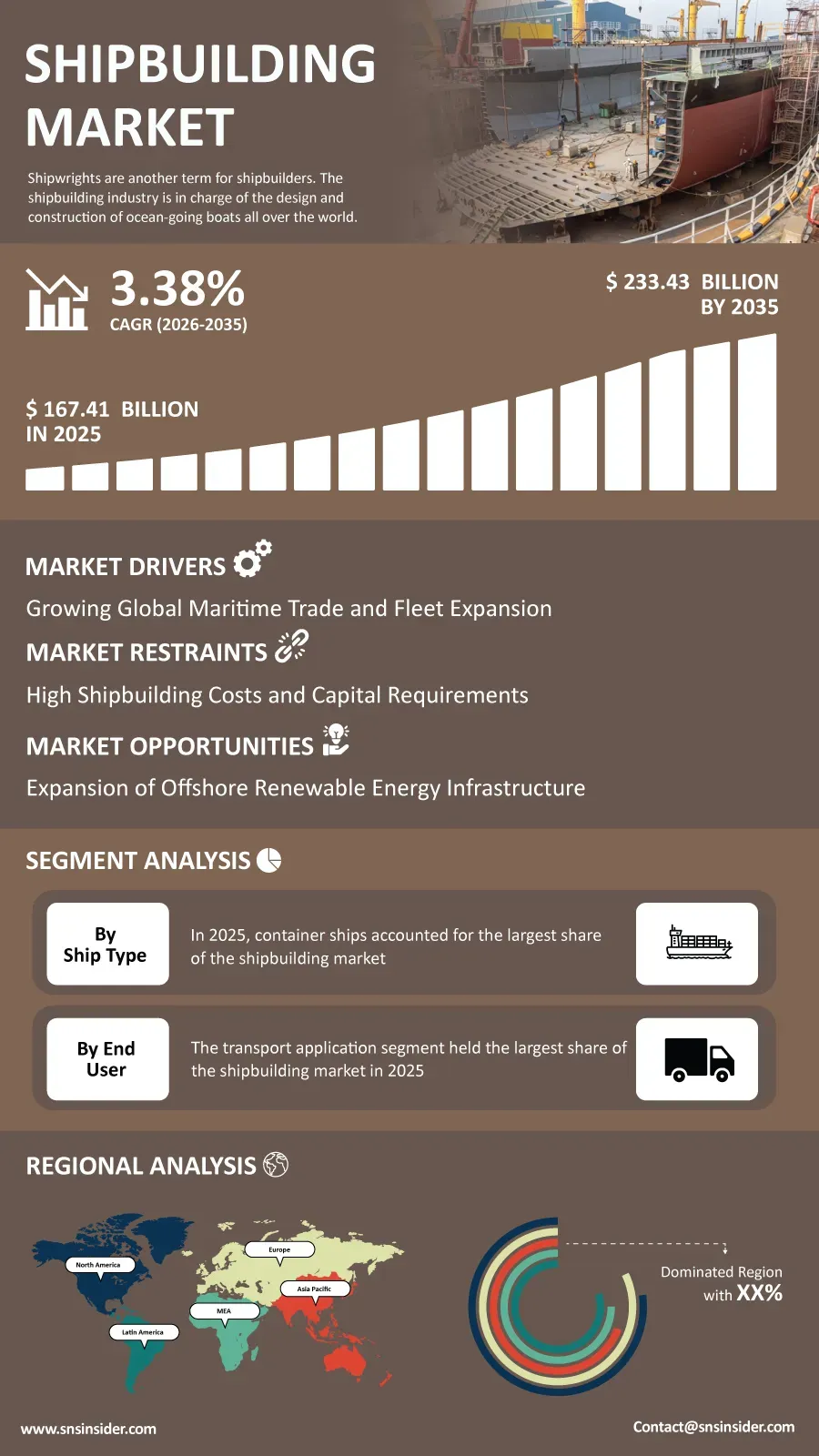
The global Shipbuilding Market is expected to do steady business in the coming decade as international trade volumes continue to rise and governments channel extensive funds into maritime infrastructure, naval modernization, and sustainable vessel technologies. “According to a recent study by SNS Insider, the global Shipbuilding Market size valued at USD 167.41 billion in 2025, is anticipated to grow to USD 233.43 billion by 2035, registering a CAGR of 3.38% over the 2026–2035 forecast period.”
The ongoing reliance on maritime transportation for international trade, in addition to increasing investor interest in energy-efficient vessels, is reshaping investments in commercial and defense shipbuilding. With the installation of more advanced technologies and compliance with new environmental regulations, shipping firms are modernizing aging fleets with state-of-the-art vessels that make operations more efficient.
Strengthening international logistics networks, higher offshore energy activities and growing demand for specialized vessels useful in various commercial, industrial and military applications are also bolstering the industrys long-term outlook.
To Get Detailed Insights on the Shipbuilding Market – Request a Sample Report
Maritime Fleet Modernization Creates New Growth Opportunities
Fleet renewal strategies aimed at increasing fuel efficiency and cutting emissions have been prioritized by both governments and private shipping operators to improve the competitive position of their maritime sectors. Orders for orders won by more advanced shipbuilding technologies and can meet requirements with the next-generation ship solutions in terms of cargo capacity, operational performance, and safety.
Digital transformation is now a vital part of modern shipbuilding. Production timeliness is supported by smart manufacturing, advanced design software, automation and digital engineering that improves vessel quality and lifecycle management.
On the other hand, international environmental regulations are getting stricter, which keep promoting greener propulsion technologies, lightweight construction materials and energy-efficient ship designs that positively impact long-term sustainability goals of the whole maritime sector.
Key Market Insights Highlight Evolving Industry Demand
By ship type, container ships dominated the global revenue market share with more than 40% in 2025 due to the growth of international trade and e-commerce logistics, coupled with demand from long-haul users for major sea transportation routes.
Based on type, the passenger ship segment is expected to lead the market with rapid growth throughout the forecast time frame (2023–2035) as worldwide tourism has resumed coupled with cruise operators are investing in large and better equipped vessels that enhance passenger experience and environmental performance.
From the perspective of end-user, in 2025, transportation sector held the highest market revenue owing to ongoing demand for commercial cargo carriers for international imports and exports.
We predict that military segment will grow at highest rate in the coming years as governments seek to strengthen their navies by investing more on naval defence, expanding fleet capability, and enhancing maritime security capabilities through spending on advanced warships, patrol vessels, submarines among others.
Sustainability and Smart Ship Technologies Drive Industry Transformation
The shipbuilding process- manufacturers are experiencing a large technological change as there is more and more pressure for greener maritime operations. Shipbuilders are designing advanced propulsion systems, digital monitoring platforms, automated navigation technologies and intelligent vessel management solutions both for improved fuel consumption as well as lower operating costs.
Automation is revolutionizing production facilities thanks to robotics, precision manufacturing, and digital quality assurance systems that improve productivity and reduce construction times.
Similarly, an increase in investment innovation is happening with autonomous shipping technologies, predictive maintenance platforms and connected vessel ecosystems for commercial and defense applications.
As shipping companies strive for higher levels of operational resilience, the demand is also growing for ships that are able to deliver long-term sustainability, safety and digital connectivity.
Asia Pacific Accounted for the Leading Market Share in 2025; North America Forecast to Expand at a Steady CAGR by 2035
The Asia Pacific continues to hold the dominant regional market, closely allied with its wide-ranging shipbuilding infrastructure, cost competitive manufacturing capacity, state supported industrial policies and presence of global giants in shipbuilding. China, South Korea and Japan continue to lead the world in commercial and naval vessel production.
As a result of ongoing defense modernization programs, increasing offshore energy development activities, and further investments in commercial shipping infrastructure support new vessel construction, North America is expected to expand steadily. A slew of technological innovation and regulatory compliance initiatives tightening regional competitiveness further.
Europe additionally retains its place as a serious hub for the classy vessel building, bolstered by level of experience within the areas of cruise ships, fat boats and environmentally-friendly shipbuilding technology.
Economic development in Latin America and the Middle East & Africa continue to create new opportunities from growing port infrastructure, offshore resource development and investment in maritime transportation networks supporting regional economic development.
Leading Shipbuilders Strengthen Global Competitive Position
Competitive LandscapeShift Towards Sustainable Shipbuilding Manufacturers are also expanding their production capabilities through investment in digital engineering strategies, alternative propulsion technologies, and novel vessel designs. The competitive landscape of commercial shipbuilding and defense shipbuilding continues to evolve through partnerships, government contracts, and research and development investments.
Key companies operating in the global Shipbuilding Market include Korea Shipbuilding & Offshore Engineering Co. Ltd., Mitsubishi Heavy Industries Ltd., Oshima Shipbuilding Co. Ltd., Sumitomo Heavy Industries Ltd., Damen Shipyards Group, Fincantieri Group, BAE Systems Plc, General Dynamics Corporation, Huntington Ingalls Industries Inc., Samsung Heavy Industries Co. Ltd., Hyundai Heavy Industries Co. Ltd., Daewoo Shipbuilding & Marine Engineering Co. Ltd., China State Shipbuilding Corporation (CSSC), Japan Marine United Corporation, Imabari Shipbuilding Co. Ltd., STX Offshore & Shipbuilding Co. Ltd., Mazagon Dock Shipbuilders Limited, Cochin Shipyard Limited, Austal Limited, and Navantia S.A.
An SNS Insider analyst Santosh Bhul commented, "The future of global shipbuilding will be shaped by sustainable vessel technologies, digital manufacturing capabilities, and continued investments in maritime infrastructure. Companies that successfully combine engineering innovation with environmental compliance and operational efficiency will be best positioned to capitalize on evolving global shipping requirements."
About the Author

Get in touch